Work started at sunset
Fully equipped with rubber boots, arm sleeves, and gloves
though heavily armored at the start
Fully equipped with rubber boots, arm sleeves, and gloves
though heavily armored at the start
by Lim Chunhan
by Choi Yujeong
Published 31 Jul.2025 14:53(KST)
Updated 31 Jul.2025 15:49(KST)
"If you work during the day, you’ll be foaming at the mouth. It feels like you can’t breathe."
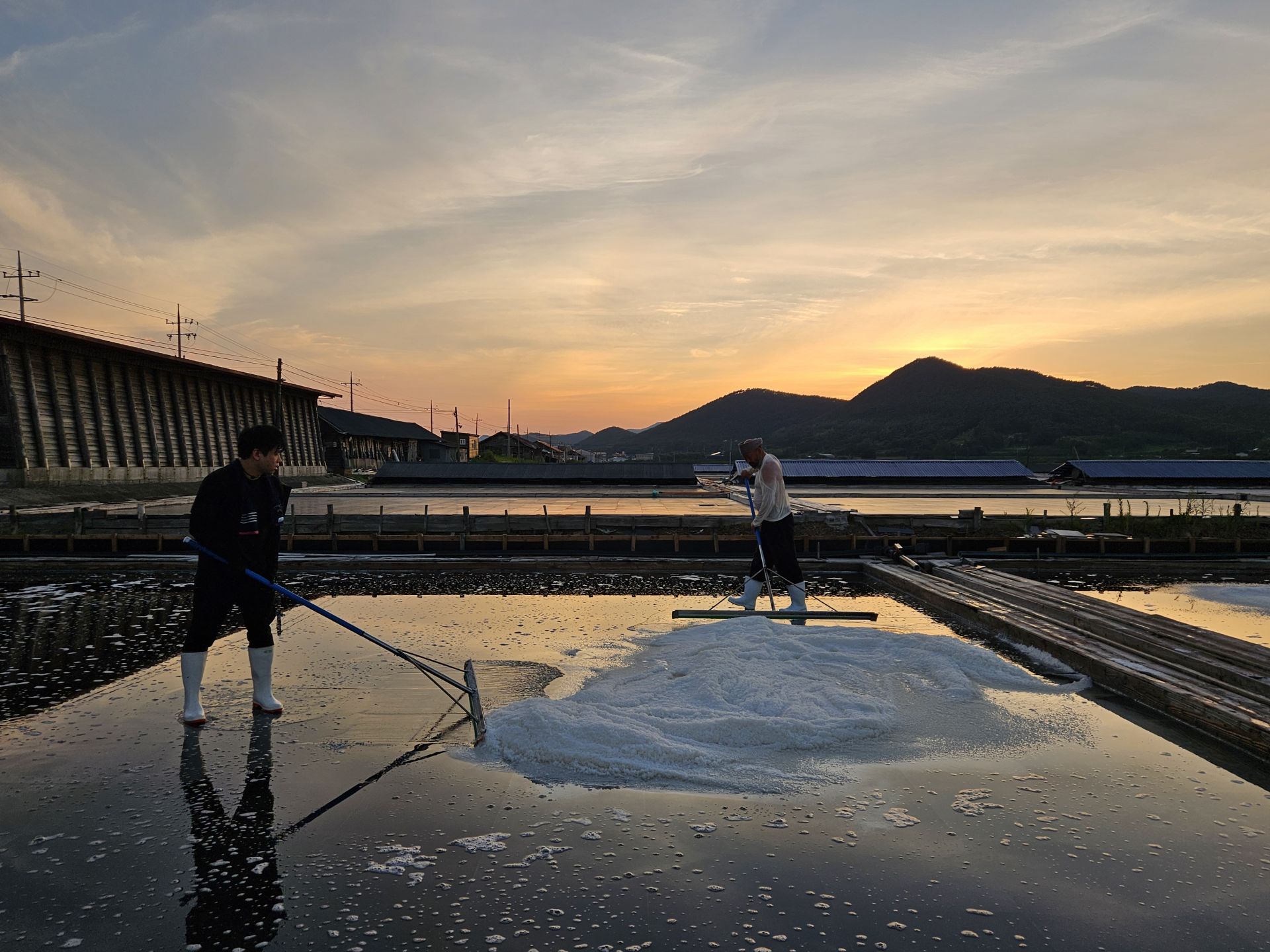
At 6:30 p.m. on July 29, at the Gomsosalt Farm in Buan-gun, North Jeolla Province. The daytime high reached 35 degrees Celsius, and even in the evening, the temperature did not drop below 30 degrees. The sun was setting, but the salt farm was still filled with intense heat. This was because the salt had absorbed sunlight throughout the day. Work began with everyone fully equipped: rubber boots, arm sleeves, gloves, and sunshades. Every part of the body was thoroughly covered and ready for the task.
The working hours at the salt farm are in the evening or early morning. This is because working during the day could lead to heatstroke. Choi, who has worked here for 15 years, said, "It's really tough in this heat. But when else will you get to harvest salt? If it gets too hard, take a break?don't overdo it." This salt farm covers 15,000 pyeong (about 49,586 square meters) and produces about 5 tons of sea salt per day. Although it looked peaceful on the surface, the moment you stepped in, the hot steam and heat rising from the ground made it hard to breathe. The surface temperature of the salt farm was actually 35 degrees Celsius. Walking on it felt like walking on fire.
At 7:00 p.m., the main salt-harvesting work began. The sun had not yet set. The red glow of the sunset stretched across the salt farm, and a golden sheen glimmered on the salt. The heat showed no sign of fading. The tools used to scrape the salt stuck to the floor were a 180cm-wide "daepa" and a 50cm-wide "sopa." Choi explained, "This is the daepa, and that is the sopa," as he took out the tools. In the Jeolla dialect, "pada" means "to scrape." The reporter ambitiously grabbed the daepa and began scraping the salt farm floor.
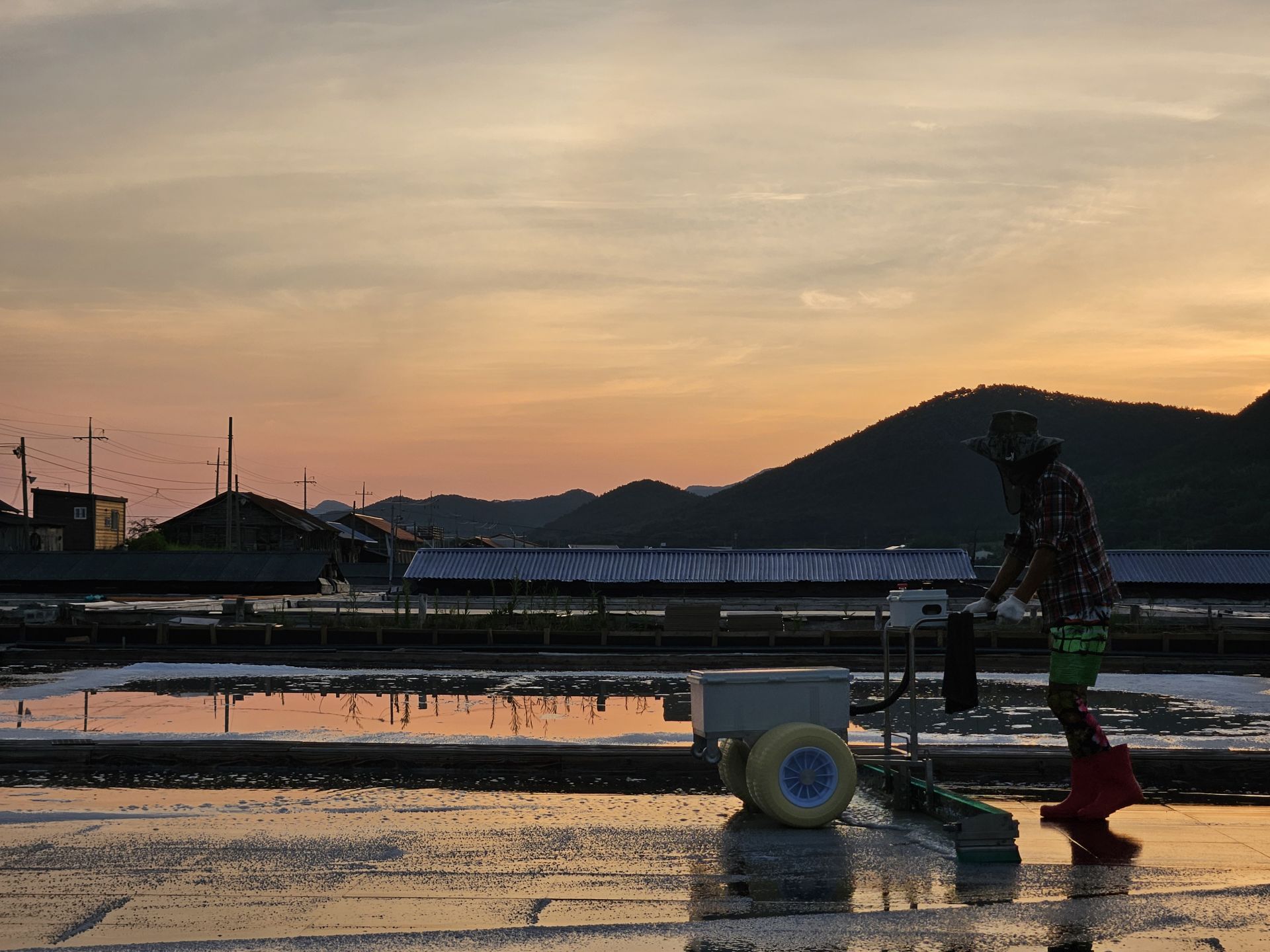
Photo by Park Seungwook
As soon as I pushed the salty water, the weight pressed down on my shoulders and my arms tingled. Salt soaked with bittern felt two to three times heavier than its actual weight. The salt pushed out from the end of the daepa spilled out to both sides, leaving wide marks on the floor like the parting of the Red Sea. But this salt had to be gathered again. The workers said, "You have to push so the salt doesn't scatter too much," and "It's not just about brute force."
After about 20 minutes of work, my body temperature rose even more. Sweat poured down like rain, and I could no longer wear the sunshade. The sunlight reflected off the salt was still hot, even in the evening. With the sun above and radiant heat coming from all sides below, my mind became hazy. Unable to bear the heat, I threw off my hat and gloves. However, my hands kept slipping on the daepa, so I had no choice but to put the gloves back on.
Even as the sky darkened, the air remained hot. The sun was setting, but the salt farm showed no signs of cooling down. The white crystals underfoot, still holding the heat, shone like their own little suns. After 40 minutes of work, my legs trembled, and after about an hour, even my hands wouldn’t obey. When I checked my stinging hands, I found blisters. The amount of salt I gathered from two pans was about 1.2 tons.
At 8:30 p.m., the work of transporting the gathered salt with carts continued. Four people together pushed the salt from seven pans into the salt collection machine. The workers explained, "Now we have automated machines, but in the past, we did it all with shovels." Ten carts, holding about 5 tons of salt, were collected. The carts loaded with salt then had to be moved along the rails.
We started pushing the carts. My legs lost strength, and sweat ran down my back. It took my whole body just to move the cart a hand’s width. After a few pushes, my boots were soaked with brine. Every time I lost my balance, my feet sank into the water, and back pain surged through me.

A reporter from this publication is holding salt collected on the 29th at Gomsal Salt Farm in Buan County, Jeonbuk. Photo by Seungwook Park
원본보기 아이콘At 9:30 p.m., after moving the carts, I turned around to see the night sky stretching beyond the salt farm. As the day at the salt farm was coming to an end, I grabbed the daepa again. My body was exhausted, but there was still work to be done. To produce high-quality salt the next day, it was necessary to thoroughly clean the salt pans. Only after pushing out the remaining brine did the day at the salt farm finally end.
On the way back to the lodging, my sweat-soaked clothes were already mixed with hardened salt. The salty smell and stickiness clinging to my body did not come off easily. It was the lingering trace of the intense heat, the heavy carts, and the relentless labor without a break.
The moment water splashed from the shower, my whole body stung. My skin, battered by sunlight, salt, and sweat all day, told the story of the day’s hardship. Only then could I truly feel the deep meaning of the saying, "Harvesting salt is like life. Nothing in this world is easy."
Labor at the salt farm was more than just producing salt. It was a constant struggle against the powerful forces of nature. Amid the fierce balance between the sun, heat, wind, and salt, the workers silently endured each day. Although the night work was scheduled to avoid the sun, the nights here were never cool. It was a time when the weight of labor pressed down on the entire body.
Choi said, "To make high-quality salt, you need the right wind and sunlight," and "Each grain of salt we make contains our life and sweat." As he said, the salt here was not just a simple seasoning. It was a crystallization of the workers’ sweat, patience, and relentless struggle with nature.
It was only after 10:00 p.m. that the lights of the salt farm gradually went out and darkness filled the space. Yet even in this darkness, tomorrow’s labor was already waiting to begin. The sun of today had set, but the shadow of labor still lingered heavily.
![Summer in Rural Areas Is a Disaster... Heatstroke Risk Up to 35 Times Higher [Workers in Crisis] ⑧](https://cwcontent.asiae.co.kr/asiaresize/251/2025070908130838408_1752016388.jpg)
![Under the Blazing Sun in the "Boiling Furrows": Between Livelihood and Survival [Workers in Crisis] ⑦](https://cwcontent.asiae.co.kr/asiaresize/251/2025072915145763812_1753769698.jpg)
![A Battle With Sewage: "The Heat Was Worse Than the Stench" [Workers in Crisis] ⑥](https://cwcontent.asiae.co.kr/asiaresize/251/2025072908243662777_1753745077.png)
![Out of Breath Amid Piles of Parcels... The Hidden Cost of Fast Delivery [Workers in Crisis] ⑤](https://cwcontent.asiae.co.kr/asiaresize/251/2025071611181847853_1752632298.jpg)
![Work Suspension During Heatwaves Is Standard... Other Countries Enact Laws First [Workers in Crisis] ④](https://cwcontent.asiae.co.kr/asiaresize/251/2025071508591645624_1752537556.jpg)
![Weather Hot Enough to Melt Butter... Benches and Bus Stops Are the Only Rest for Delivery Workers [Workers in Crisis] ③](https://cwcontent.asiae.co.kr/asiaresize/251/2025071511265146207_1752546411.jpg)
![Sixfold Increase in Heat-Related Illnesses Since May [Workers in Crisis] ②](https://cwcontent.asiae.co.kr/asiaresize/251/2025071410522544407_1752457945.jpg)
![Sweat Pours Like Rain in 39-Degree Extreme Heat: "Even Machines Would Break Down" [Workers in Crisis] ①](https://cwcontent.asiae.co.kr/asiaresize/251/2025071409314344091_1752453103.jpg)

Lim Chunhan choon@asiae.co.kr
Choi Yujeong yjchoi@asiae.co.kr
© The Asia Business Daily(www.asiae.co.kr). All rights reserved.