

Experts point out that urgent improvements are needed in the unfair subcontracting system.
<3-2> Wage Arrears at Construction Companies
Controversy Over Illegal Re-Subcontracting by Subcontractors
Unless the Underdeveloped Subcontracting Structure Is Improved,
Wage Arrears Will Inevitably Continue
Effective Institutional Reform Needed
Unless the Underdeveloped Subcontracting Structure Is Improved,
Wage Arrears Will Inevitably Continue
Effective Institutional Reform Needed
The crisis in the construction industry does not simply end with the transfer of responsibility to subcontractors. Ultimately, it falls on the shoulders of on-site workers who sweat and toil at the construction sites. This is the result of the structural problems in the industry, where subcontracting leads to re-subcontracting. Construction payments flow from the client to the main contractor, then to the subcontractor, but are often held up at the re-subcontractor level. When this happens, responsibility becomes unclear and only the workers are left as victims.
Under current law, re-subcontracting is prohibited. However, industry insiders commonly explain that the ecosystem of re-subcontracting remains intact through various means such as the use of 'executive directors.' The more layers of subcontracting there are, the more companies there are taking intermediary margins, and the daily wages of construction workers at the lowest level of the chain disappear. There are calls that rooting out re-subcontracting, which is deeply entrenched in the construction industry, is essential for protecting workers’ livelihoods even amid crisis.
Worked Hard at Construction Sites... but Wages Unpaid for Months
At a data center construction site in Geumcheon-gu, Seoul, where DL E&C, ranked fifth in construction capability evaluation, is the main contractor, there are about 30 daily workers who have not received their wages for May 2025. The wages for April were paid belatedly on July 10, after Asia Economy began its investigation.
A DL E&C representative stated on June 30, "We paid G Company the entire contract amount as per the initial agreement," and added, "Additional construction costs incurred afterward were under internal review and are scheduled to be paid in July." The representative continued, "We made an advance payment of part of the additional construction costs to G Company, but it appears that this money was not used for workers' wages. We became aware of the unpaid wages about a week ago and are requesting G Company to pay the wages as soon as possible." However, even after a month, the wages for May remain unpaid.
G Company is delaying payment. It also told workers, "The payment of additional construction costs is a matter to be coordinated with the site manager." Workers pointed out that the company is shifting its responsibility onto its own staff and called this a typical case of illegal re-subcontracting. According to the workers, the site manager, known as the 'executive director,' is a person who signed a labor contract with G Company and is considered part of G Company's staff.
30 Workers Unpaid at DL E&C's Construction Site, Ranked Fifth in the Industry
Wages Unpaid for Several Months at Taeyoung Construction Site, Ranked 24th
In a normal contractual relationship, when additional construction costs arise, G Company, as the subcontractor, should pay the workers' wages. In reality, workers were contracted under G Company's name and dispatched to the site. Additional settlements with the main contractor are a separate matter for G Company to negotiate, and delaying wage payments for this reason is not justified, according to industry sources. One worker lamented, "We contracted with G Company, so how can they tell us to demand our wages from an individual called the executive director?"
At a youth housing construction site in Jungnang-gu, Seoul, where Taeyoung Construction, ranked 24th and currently undergoing workout (corporate restructuring), is the main contractor, wage arrears have also occurred. About 30 plasterers and bricklayers have not received approximately 200 million won in wages for March and April. On July 1, seven tile workers even staged a sit-in protest at the site office.
Subcontractor A Company of Taeyoung Construction has repeatedly stated, "Settlement with the client has not been completed." In contrast, developer IRDB and main contractor Taeyoung Construction drew a clear line, saying, "We have paid all amounts due and have no legal responsibility."
As the dispute over responsibility drags on, wages have not been paid for several months. At this site, there are also objections regarding the lack of transparency in fund management.
Wage Arrears Erupt as 'Borrowing from Peter to Pay Paul' Fails Amid Construction Slump

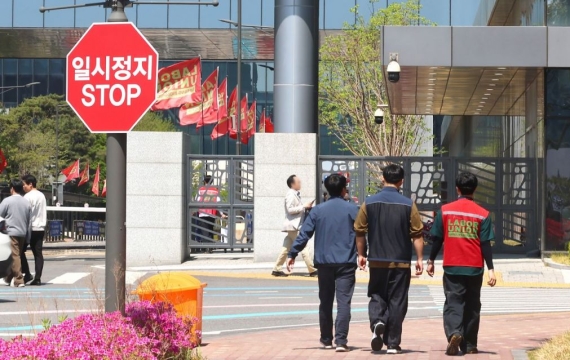
Workers are walking near an apartment construction site in Namgu, Daegu. Photo by Kang Jinhyung
원본보기 아이콘The Framework Act on the Construction Industry fundamentally prohibits re-subcontracting. However, in practice, the deep-rooted custom of re-subcontracting persists by evading the law. The main contractor assigns work to the first-tier subcontractor, which then passes it on to second- and third-tier subcontractors. On paper, all relevant documents such as labor contracts and wage payment statements are in order, making it difficult to determine from documents alone whether re-subcontracting has actually occurred.
Re-subcontracting is not always illegal. If the client gives written consent, it is exceptionally permitted. However, if approval is granted, the client or main contractor must also bear responsibility if problems occur later in the project. For this reason, formally approved re-subcontracting rarely takes place.
Re-subcontracting is a means to collect profit without actually performing the work. For example, if a specialized construction company wins a 1 billion won project from a construction company and then passes it on to another company for 800 million won, it can pocket 200 million won without doing any work. As these intermediary margins are siphoned off through re-subcontracting, funds available for labor and materials decrease. This leads to wage arrears and shoddy construction.
Kim Taejun, head of the New Growth Strategy Research Division at the Construction Policy Research Institute, said, "In the past, site managers could cover losses at one site with money from another, but now that's no longer possible," and added, "With fewer projects, there are no sites from which to transfer funds." He continued, "As this situation persists, wage arrears are erupting everywhere, and productivity continues to decline."
197 Cases of Illegal Subcontracting in the First Half... Experts Say 'Institutional Reform Is Urgent'

Shin Youngcheol, President of the Korea Institute of Construction Technology, said, "In fact, from the moment subcontracting takes place, on-site workers are directly exposed to the risk of wage arrears," adding, "If this backward subcontracting structure is not reformed, wage arrears are bound to recur."
Park Seungkuk, senior research fellow at the Construction Policy Research Institute, also said, "Most domestic construction projects are completed through subcontracting, and subcontracting transactions are so fundamental to the construction production system that their impact on the industry is enormous. However, unfair trade practices that exploit the superior position of contractors still remain, and in reality, subcontracting payments are not made on time." He added, "Rational and effective institutional improvements are needed."
According to the Ministry of Land, Infrastructure and Transport, in the first half of this year, illegal activities were uncovered at 520 cases in 167 out of 1,607 construction sites nationwide, with illegal subcontracting accounting for 197 cases (37.9%), the highest proportion.
Order of Articles in the 'Construction Crisis Report' Series
<1-1> Construction Sites at a Standstill, Daily Workers' Lives Collapsing
<1-2> "Three to Four More Bankruptcies Expected"... Mid-sized Builders on the Chopping Block
<2-1> Project Financing: From 'Lifeline' to 'Trap'
<2-2> Easing Multi-Home Ownership Regulations, the Key to Reviving Local Real Estate
<3-1> "Every Day Is Stressful" Subcontractors and Downstream Industries Shaken
<3-2> Even Major Companies Cannot Avoid Wage Arrears
<3-3> Wage Arrears at Public Enterprises and Local Governments
<3-4> Even the President Has Stepped In... Urgent Need for Vertical Structure Reform
<3-5> The Company That Survived Without Illegal Re-Subcontracting
<3-6> Joined Hands at a Collapsed Site
<4-1> Foreign Construction Workers Encroaching on Domestic Jobs
<4-2> 'Protecting Domestic Workers' Rather Than 'Regulating Foreigners'
<4-3> The Root Cause of Profitability Deterioration: Frequent Rework
<1-2> "Three to Four More Bankruptcies Expected"... Mid-sized Builders on the Chopping Block
<2-1> Project Financing: From 'Lifeline' to 'Trap'
<2-2> Easing Multi-Home Ownership Regulations, the Key to Reviving Local Real Estate
<3-1> "Every Day Is Stressful" Subcontractors and Downstream Industries Shaken
<3-2> Even Major Companies Cannot Avoid Wage Arrears
<3-3> Wage Arrears at Public Enterprises and Local Governments
<3-4> Even the President Has Stepped In... Urgent Need for Vertical Structure Reform
<3-5> The Company That Survived Without Illegal Re-Subcontracting
<3-6> Joined Hands at a Collapsed Site
<4-1> Foreign Construction Workers Encroaching on Domestic Jobs
<4-2> 'Protecting Domestic Workers' Rather Than 'Regulating Foreigners'
<4-3> The Root Cause of Profitability Deterioration: Frequent Rework
IndexConstruction Risk Report
- I Trusted a Major Construction Firm... Where Can I Get My Wages?