"Tonight, I really need to go to bed early."
We make this promise to ourselves every day, but the time we actually get into bed is always late at night.
But now, someone tells us this:
"It is best for you to go to bed around 11:10 p.m."
That "someone," it turns out, is a world-renowned mathematician.
The Sleep Expert in Galaxy Watch Is Actually a 'Numbers Expert'

The Galaxy Watch8 is equipped with a feature that analyzes your sleep rhythm
and recommends optimal bedtimes and wake-up times.
This feature is based on technology developed by
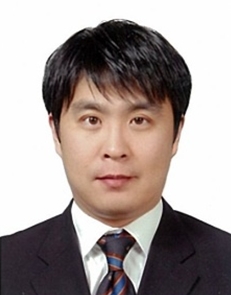
Professor Jae Kyung Kim from the Department of Mathematical Sciences at KAIST.
In a phone interview with Asia Economy,
Professor Kim said, "Samsung Electronics contacted me because they wanted to secure AI sleep measurement technology,
and I transferred the technology after receiving appropriate compensation."
Sleep Time Tailored to My Biological Clock

A person is holding a Galaxy Watch Ultra at an event held in New York, USA. Photo by Reuters Yonhap News
원본보기 아이콘While traditional sleep apps have focused on 'how much you sleep,'
this new feature focuses on 'when you go to sleep and wake up.'
The algorithm developed by Professor Kim's team
analyzes your individual sleep patterns
based on your sleep data,
and then suggests the optimal time for your brain and body to recover
in the form of a 'window of time.'

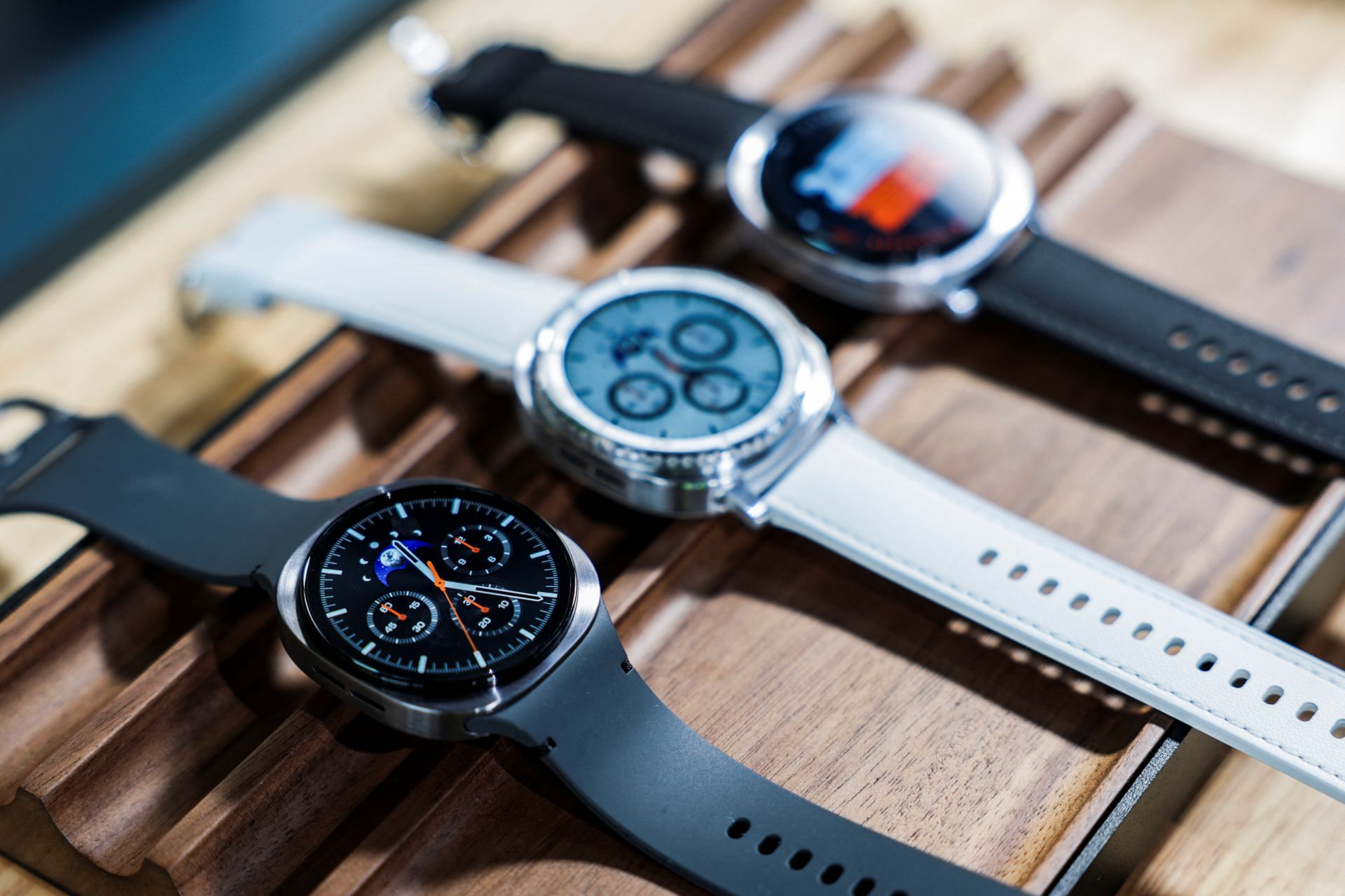
Galaxy Watch 8 and Watch 8 Classic are on display at an event held in New York, USA. Photo by Reuters Yonhap News
원본보기 아이콘For example,
"It is ideal to go to bed between 11:10 p.m. and 11:40 p.m."
providing specific and actionable guidance.
Finding the Optimal Timing in a Complex Rhythm

Professor Kim has studied the human 24-hour biological rhythm
using mathematical models such as differential equations.
Through this research,
he explains that the regularity and timing of sleep
have an even greater impact on sleep quality.
"Not only is 'how much you sleep' important, but 'when' you sleep is just as important, if not more," Professor Kim explains.
He also recommends seven hours of sleep,
stating that both sleeping too much and too little are not good.
Formulas Brought Out of the Lab

Professor Kim has long researched biological rhythm analysis,
and based on this research, he has also developed predictive models for sleep disorders.
Moreover, he has published a book titled "If Mathematics Is the Language of Life,"
sharing his expertise with a broader audience.
Beyond Numbers and Formulas, Toward Better Sleep

Visitors are experiencing the new products at the Galaxy Unpacked 2025 event held at Duggal Greenhouse in Brooklyn, New York, USA. Provided by Samsung Electronics.
원본보기 아이콘The research of this mathematician, who has decoded our body's rhythms into numbers and algorithms,
has now moved beyond the laboratory
and reached our wrists as a feature in smartwatches.
Every night, this technology quietly tells us when it is best to go to bed,
prompting us to reconsider the quality of sleep that we had simply taken for granted as a routine.
-
Reporter Paek Jongmin cinqange@asiae.co.kr
-
Edit Hur Eunmi eungmimon@asiae.co.kr
© The Asia Business Daily(www.asiae.co.kr). All rights reserved.