What is this? The early morning commuter bus is going to be canceled? Why? No, please ㅠㅠㅠ... Why on earth?
Editor's Note[The Future of Transportation - New Transportation Refugee Report] Seoul ranks 16th in the world for transportation accessibility, but the city also exhibits significant disparities in access to transportation convenience. The rapid expansion of the transportation network has aimed for regional balance, but this has resulted in overcrowding in some areas and blind spots in others. Over 75 years of public transportation history, we have now entered an era where artificial intelligence (AI) transportation systems are being established, yet the transportation poor have not disappeared. Transportation inequality leads to imbalances in quality of life. Asia Economy has examined the reality of this issue and sought solutions.
4 a.m., The Commuter Bus I Took Every Day Has Disappeared
At 3:50 a.m. on the 26th in Ganeungdong, Uijeongbu City. On a quiet street with no stores open, a bus appeared. People hurriedly gathered at the bus stop. Those boarding the '106-1' bus were cleaning and security workers commuting to Seoul. This bus is an alternative route for the 106 bus, which was discontinued in August last year. The 106 bus, which had run between Ganeungdong in Uijeongbu and Jongno 5-ga for over 50 years, was discontinued to establish a new route to meet new transportation demand near Gangdong-gu in Seoul. Unlike the 106 bus, which went to the heart of Seoul at Jongno 5-ga, the 106-1 only runs to Dobongsan Station. As a result, passengers from areas previously served by the 106 now have to transfer to another bus at Dobongsan Station.
Mr. Lee (58), who has commuted near Changgyeonggung and used the 106 bus for over 10 years, said, "When time is tight, I often feel burdened by having to transfer." He explained that he always has to rush when transferring to a bus heading toward Jongno from Dobongsan, and he becomes anxious about possibly being late. Mr. Lee also has to cross a road between the 106-1 bus drop-off point and the bus stop for Seoul-bound buses.
They say they are changing the bus routes again because of new apartments in Seoul, hmm...
No, what about our commute...
We earn just enough to get by, are they telling us to take a taxi... If we transfer, we have to stand the whole time ㅠㅠ
We have to protest against it, we can't just watch, let's go tomorrow right away
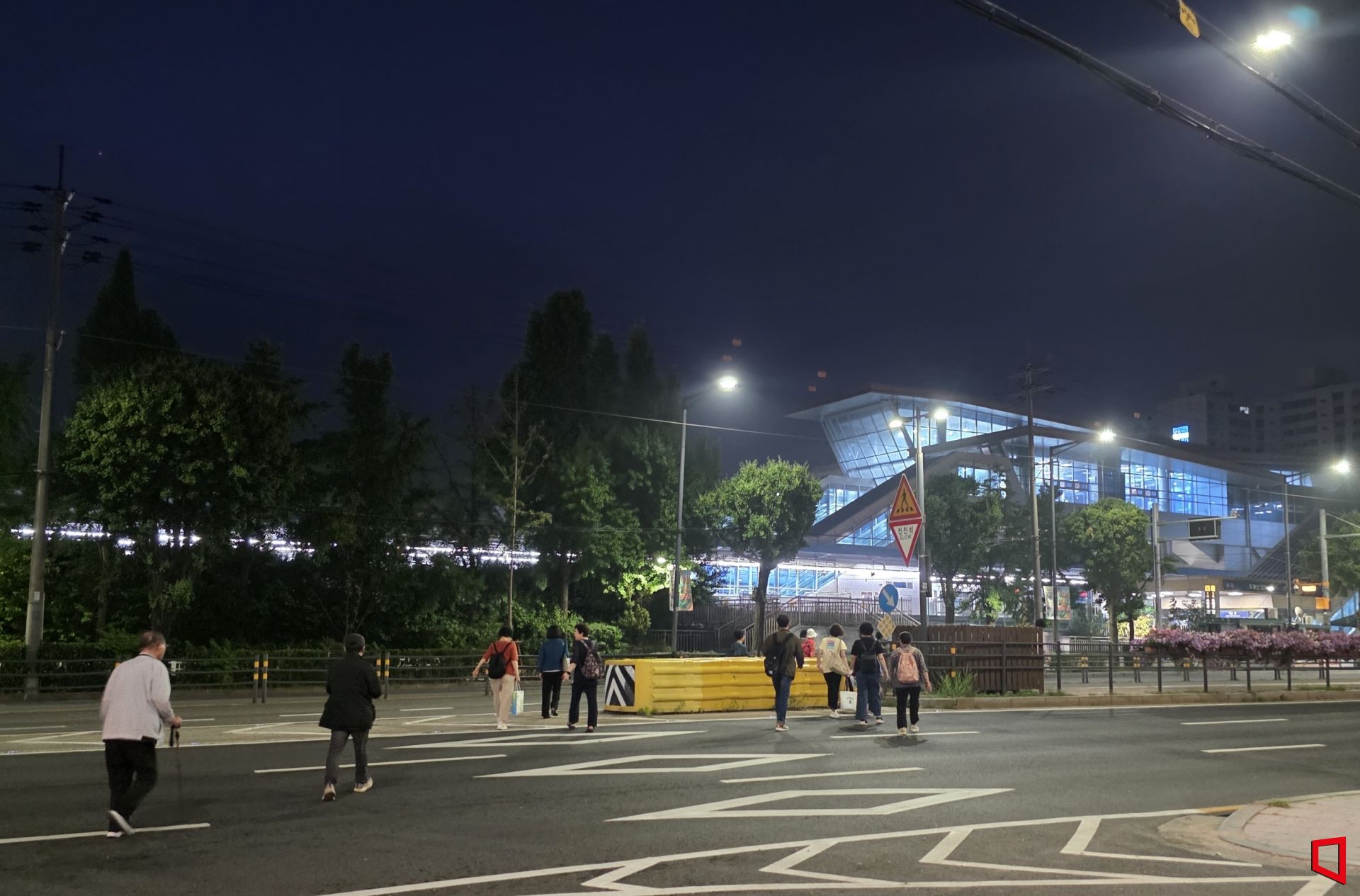
At 4:28 a.m., the 106-1 bus arrived at the 'Dobongsan Station Metropolitan Transfer Center.' As Mr. Lee described, passengers all began running across the road at once. The reporter, caught off guard, ran as well. We had to transfer to a city bus at the 'Dobongsan Station' stop on the other side. There is a crosswalk about 100 meters away, but the 'psychological distance' felt longer than the physical distance due to the rush. As soon as the reporter and others who ran arrived at the stop, the city bus pulled in. What if we hadn't run? Catching his breath, Mr. Lee said to the reporter, "I don't understand why they drop us off on the far side of the road. Everyone is jaywalking and running to transfer, and I'm afraid there might be an accident."
The Shadow of the 'Public Transportation Mecca' Used by 9.4 Million Daily
With subways, buses, and light rail, Seoul is a megapolis boasting public transportation used by 9.4 million people daily. But does Seoul's public transportation network truly connect all parts of the city?
The answer is 'no.' Bus routes that crossed the Seoul boundary into Gyeonggi Province have been successively cut. Last year alone, routes such as the 106 (Uijeongbu~Jongno 5-ga), 704 (Jangheung, Yangju~Seoul Station), 542 (Gunpo~Seoul Sinsa), and 9714 (Gyoha, Paju~Namdaemun) were shortened or discontinued. Even this year, routes like the 1155 (Cheonghak-ri, Namyangju~Seokgye) and 774 (Eunpyeong~Paju) have been shortened.
An analysis of Seoul's bus route adjustment orders over the past year since June last year shows that within Seoul, increased demand led to more stops and buses, but in Gyeonggi, the focus was on reducing buses and discontinuing routes. Of the 19 routes adjusted, all 7 that were discontinued or shortened included Gyeonggi sections. The buses from these shortened or discontinued routes were all used to improve convenience within Seoul or to establish or increase routes to meet new apartment demand. As long-standing routes were discontinued one after another, passengers commuting between Gyeonggi and Seoul voiced opposition. In particular, the 106-1 bus, the alternative for the 106 that the reporter took, was packed with people waiting at every stop even at 4 a.m., and at times there were so many people that some had to stand. Due to the concentration of complaints, a protest against the discontinuation of the 106 bus was even held, attended by the mayor of Uijeongbu.

Universities and Subway Stations: The Gap Between the Haves and Have-Nots
The problem of poor public transportation access also occurs within Seoul. According to 2024 Seoul City data from the Seoul Open Data Plaza, the average commute and school travel times reveal disparities in public transportation accessibility by region. By area, the southwest region of Seoul had the longest average commute and school travel time at 35.16 minutes. By district, Geumcheon-gu had the longest at 41.77 minutes, followed by Yeongdeungpo-gu at 40.91 minutes and Nowon-gu at 40.27 minutes. The shortest was Seodaemun-gu at 27.85 minutes, a difference of up to 13 minutes.
The distribution of subway stations also showed a gap between the haves and have-nots. On lines managed by Korail and Seoul Metro, Songpa-gu had as many as 28 subway stations, Jung-gu had 23, and Gangnam-gu had 21. In contrast, Gangbuk-gu had only 3, Gwanak-gu 4, and Geumcheon-gu 4. As a result of this imbalance, some universities in Seoul have no subway station within easy reach. Kookmin University, located in Seongbuk-gu, is a 25-30 minute walk from the nearest subway station, Bukhansan Bogungmun Station on the Ui-Sinseol Line. Most students get off at Line 4's Gireum Station and transfer to a bus to reach the school. However, the area near Gireum Station is notorious for traffic congestion.
Heo, a student at Kookmin University, said, "Even when I take the bus from Gireum Station, if it's raining or during rush hour, a 15-minute trip has sometimes taken an hour and a half, and there were times when the traffic was so bad that I got off the bus and walked for an hour. This has happened more than once or twice." Yoon Doyoung (23), a third-year student at the same university, said, "When I take the bus from Mia Sageori during school commuting hours, it's so crowded that I sometimes have to let a bus go by. Especially, the bus from the school to Gireum Station is even more packed because it passes by Sangmyung University first."
For this reason, Kookmin University and five other universities in Seongbuk-gu have called for the construction of the 'Gangbuk Transversal Line' light rail. The Gangbuk Transversal Line would connect Cheongnyangni Station, Jeongneung and Gireum in Seongbuk-gu, Hongje in Seodaemun-gu, Digital Media City (DMC) in Mapo-gu, and Mokdong Station in Yangcheon-gu. Yoon said, "Most schools in Seoul have subway stations right in front of them, which makes me envious. Although it's unlikely to be completed before I graduate, as a current student, having the Gangbuk Transversal Line would make things much more convenient."

Economic Efficiency vs. Consideration for the Transportation Disadvantaged
The discontinuation of Gyeonggi bus routes and the existence of transportation blind spots within Seoul are linked to economic logic. The Gangbuk Transversal Line, demanded by universities in Seongbuk-gu, failed the preliminary feasibility study by the Ministry of Economy and Finance in June last year due to insufficient economic viability. Profitability was prioritized over improving citizen accessibility.
The bus quota system, introduced alongside the quasi-public bus system in 2004, is also inseparable from financial issues. According to the quota system, to allocate buses to a new route, existing routes must be discontinued so that the vehicles can be used. This makes it difficult to establish new routes, and even if new routes are created, it results in the loss of routes used by citizens in other areas. The discontinuation of Gyeonggi routes and the establishment of new routes in Gangdong and Jangwi in Seoul follow this trend. Seoul City claims the quota system is implemented to reduce traffic congestion and pollution, but under the quasi-public system, which covers bus company deficits with subsidies, there is also a tendency to limit the increase in buses to prevent excessive financial outlay. Kim Hoonbae, policy committee member of the Public Transportation Network, said, "Increasing the number of vehicles requires more budget, which is why the quota system is in place. If the city had a fully public operation system, it would have been possible to respond to demand even in underserved areas."
Regarding the discontinuation of Gyeonggi routes, Seoul City says it is based on transportation flow. A Seoul City official said, "People want direct buses from all over Gyeonggi and Incheon to the center of Seoul, but this puts a strain on the system. For the overall transportation situation in Seoul, it is appropriate to terminate routes at outer hubs such as Gupabal and Dobongsan." He also said, "There are about 7,000 Seoul city buses, and more than 6,000 Gyeonggi buses enter Seoul, so the supply of Gyeonggi buses is not low compared to the road network."
However, experts say that public transportation should strive for equal opportunity of access as much as possible. Kang Kyungwoo, professor of Transportation and Logistics Engineering at Hanyang University, said, "Under the bus quota system, routes with low demand and difficult operation are the first to be discontinued. If we only pursue efficiency, more areas will be left behind. To maintain Seoul's world-class public transportation service, equity that considers the disadvantaged and underserved areas must also be upheld."
IndexNew Traffic-Vulnerable Population Report
- Run! ... People Risking Their Lives Jaywalking Every Dawn
-

Reporter Kim Youngwon forever@asiae.co.kr
-
Edit Yang Hyejin adoretj@asiae.co.kr
© The Asia Business Daily(www.asiae.co.kr). All rights reserved.