Driven by Foreign Buying and Policy Expectations
Samsung Electronics Rises for 7 Consecutive Sessions
Surpasses 60,000 Won Intraday for the First Time in Over 2 Months
SK Hynix Also Climbs Above 230,000 Won Intraday
Thanks to the strong performance of leading semiconductor stocks, the KOSPI recovered the 2860 level intraday for the first time in about 10 months. Samsung Electronics continued its upward trend for the seventh consecutive session, regaining the '60,000-won level' during trading hours.
As of 9:11 a.m. on the 9th at the Korea Exchange, Samsung Electronics was trading at 60,100 won, up 1,000 won (1.69%) from the previous session. This is the first time since March 28 that Samsung Electronics has recovered the 60,000-won level during trading hours. Samsung Electronics has risen 5.16% so far this month.
SK Hynix also continued its strong rally for the fourth consecutive session, recovering the 230,000-won level intraday. This is the first time SK Hynix's stock price has surpassed 230,000 won since July last year. SK Hynix is also showing a gain of more than 3% today. So far this month, it has risen 9.78%.

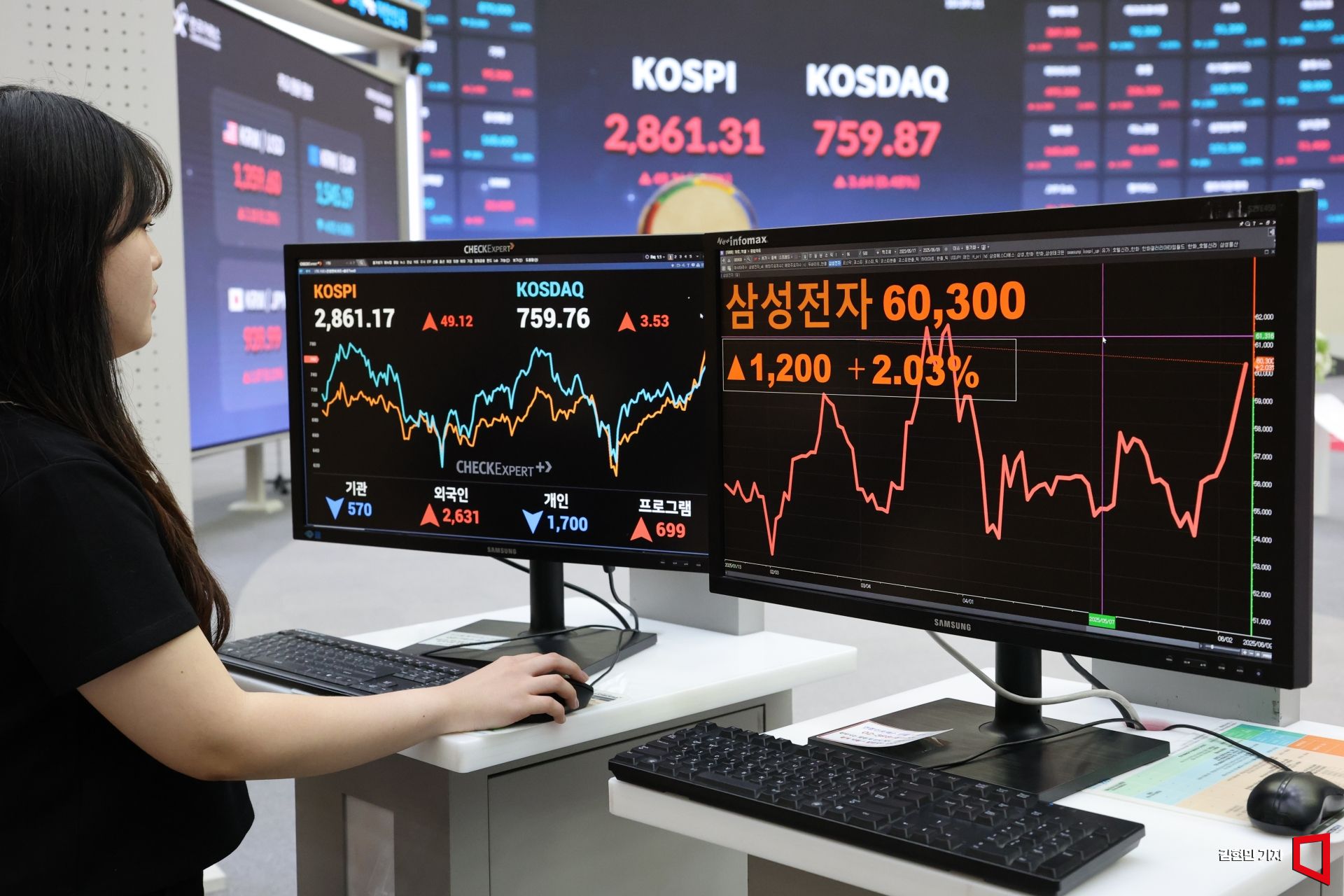
The KOSPI surpassed the 2860 mark during trading, supported by net purchases from foreigners. On the 9th, the KOSPI started higher and broke through the 2860 level during trading. As of 9:41 a.m., it was at 2842.87, up 30.82 points (1.10%) from the previous trading day. At the same time, the KOSDAQ was also up 4.06 points (0.54%) at 760.29. On this day, stock prices and exchange rates were displayed on the status board in the dealing room of Hana Bank in Jung-gu, Seoul. Photo by Jo Yongjun
원본보기 아이콘Foreign buying has driven the strength of semiconductor stocks. So far this month, foreigners have been net buyers of SK Hynix for 691.8 billion won, making it their largest purchase. This was followed by net purchases of Samsung Electronics for 453.1 billion won. Foreign investors had sold large amounts of Samsung Electronics in previous months?1.2778 trillion won in May and 2.7762 trillion won in April?but this month, their behavior has changed.
Expectations for new government policies are also being reflected. President Lee Jaemyung previously announced a plan to support the semiconductor industry as his first policy pledge after being nominated as the Democratic Party's presidential candidate on April 28. At that time, President Lee stated, "We will make Korea the world's leading semiconductor nation," and pledged to quickly enact a special semiconductor law that includes subsidies and tax support for semiconductor companies.

There are also opinions that attention should be paid to Samsung Electronics' recovery of technological competitiveness. Park Yuak, a researcher at Kiwoom Securities, said, "Samsung Electronics has begun to improve the yield of its 1cnm DRAM, which had previously faced difficulties, and mass production testing of HBM3e 12hi products for Nvidia and AMD is proceeding without major issues so far. While it is still too early to be certain, the company is clearly showing a different picture compared to previous disappointing results." He also added, "Although the semiconductor industry is expected to face challenges in the second half of the year due to inventory adjustments, slowing consumer demand, and adjustments in artificial intelligence (AI) capital expenditures (CAPEX), Samsung Electronics is likely to see its stock price differentiate itself thanks to the recovery of its technological competitiveness."
The slowdown in the DRAM market in the second half of the year is expected to be short-lived. Seo Seungyeon, a researcher at DB Financial Investment, stated, "Recently, DRAM prices have rebounded due to preemptive inventory buildup in response to tariff concerns, early purchases resulting from reduced DDR4 production, and increased demand for HBM. The upward trend in DRAM prices is expected to continue through the third quarter due to concerns over tariffs and DDR4 supply shortages. However, from the fourth quarter to the first quarter of next year, high base effects from inventory buildup and seasonal off-peak periods are likely to lead to a short-term slowdown and price decline in the memory semiconductor market. Nevertheless, with the resumption of the peak season in the second quarter of next year, the market downturn is expected to be short-lived."
There are also forecasts that the rebound in NAND prices will continue. Kim Dongwon, a researcher at KB Securities, said, "In the second quarter, NAND prices rebounded due to a combination of preemptive purchasing in response to U.S. tariffs, Chinese government subsidies, and production cuts by manufacturers. In the third quarter, the full-scale launch of Nvidia's Blackwell products and expanded investment in artificial intelligence (AI) servers are expected to drive demand for enterprise solid-state drives (eSSD), leading to an additional 5-10% increase in SSD prices." He added, "In the second half of the year, the effects of reduced supply due to production cuts and process transitions by suppliers, along with continued growth in AI demand, are expected to lead to a rebound in eSSD prices, which should have a positive impact on the earnings of Samsung Electronics and SK Hynix. Currently, the 12-month forward price-to-book ratios (PBR) for Samsung Electronics and SK Hynix are 0.9x and 1.32x, respectively, indicating that the downside for their stock prices is limited. Therefore, it will be important to focus on stocks with upward potential in the second half of the year."
On this day, the KOSPI closed at 2,855.77, up 1.55%, while the KOSDAQ ended at 764.21, up 1.06%.