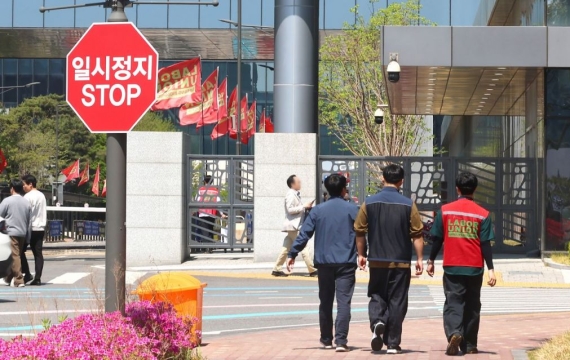

On the 23rd, children who finished English kindergarten are leaving school in the academy district of Mokdong, Yangcheon-gu, Seoul. Photo by Kang Jinhyung
원본보기 아이콘The "age 7 exam" trend is spreading everywhere. In Incheon, which the reporter visited, private education for young children is thriving, especially in new towns such as Songdo and Lu1 City, and is even drawing in children from older districts like Bupyeong and Gyeyang. The reporter met with four kindergarten teachers currently working in Incheon: Lee Sujin (28 years of experience, Lu1 City), Kim Sunhee (25 years, Songdo), Lee Hyejeong (6 years, Gyeyang-gu), and Park Eunjeong (25 years, Bupyeong-gu) to hear about the situation on the ground.
Parents First Check for English Programs at Kindergartens
Lee Sujin, who teaches five-year-old children in Lu1 City, said, "The first thing children who previously attended English kindergartens ask when they come to public kindergarten is, 'Can I really play?'" She added, "There are countless times when I feel sorry because it seems like the children have forgotten how to play due to being overwhelmed with studying." Lee explained, "Kindergarten ends at 4 p.m., but almost no children go straight home. A three-year-old boy starts Taekwondo, at four he starts English, and at five, workbooks are added."
Lee Hyejeong, a teacher in Gyeyang-gu, Incheon, said, "Parents who attend kindergarten information sessions first check whether there is an English program." She added, "Although private kindergartens are not English kindergartens, some offer English classes in the morning." According to the 2022 national curriculum guidelines, English is included as a regular subject starting in third grade of elementary school. While kindergartens can offer English programs as special afternoon activities, they are not allowed to conduct English classes during regular morning hours.
Because "English kindergartens" do not follow these guidelines, they are classified as "academies" rather than kindergartens. Nevertheless, some private kindergartens are violating government guidelines by scheduling English classes in the morning. This is reportedly because parents demand it. If there is no English class, parents do not send their children to those kindergartens. Private kindergartens that offer morning English classes also provide special afternoon programs in subjects such as science, Chinese characters, coding, and even horseback riding.
"Afraid of Making Mistakes..." Even Afraid to Hold Colored Pencils

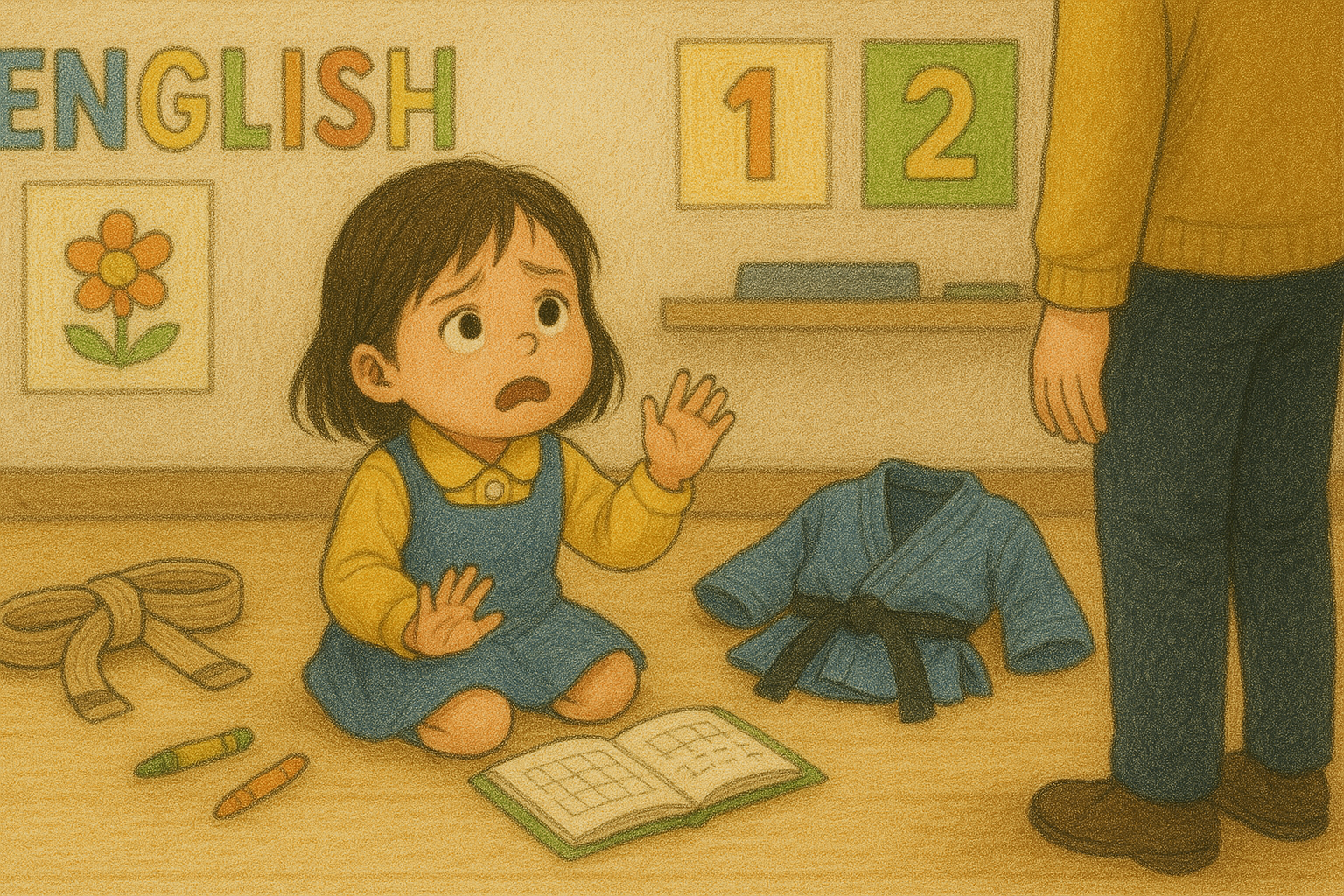
Some children who come from English kindergartens are even afraid to hold colored pencils. When asked why, the child said, "Because I'm afraid of making mistakes." Photo by Getty Images Bank
원본보기 아이콘Public kindergartens that follow government curriculum guidelines are being neglected amid the competition between English kindergartens and private kindergartens. Lee Hyejeong noted, "None of the approximately 20 classes at public kindergartens in Gyeyang-gu are filled to capacity." She pointed out that public education is collapsing, starting from the kindergarten level. Kim Sunhee, a teacher at a kindergarten in Songdo, said, "Every year, I see at least one case of a child returning from an English kindergarten to a public kindergarten," adding, "There is no smile on the children's faces." She explained that a significant number of children suffer from "social maladjustment" and pain as early as kindergarten.
Every Monday, Kim Sunhee gives her students time to talk or draw about what they did over the weekend. She observed a peculiar phenomenon among some children who had attended English kindergartens: they were even afraid to hold colored pencils. When she asked why, the child replied, "Because I'm afraid of making mistakes." Kim Sunhee said, "These children are so accustomed to being 'evaluated' on everything, including drawing, that they seem to perceive everything as a competition." She later learned that the child had been separated for individual study at the English kindergarten because of slow academic progress. Park Eunjeong, a teacher in Bupyeong, had a similar experience. She noticed a child using words that suggested having experienced corporal punishment. Park Eunjeong said, "I didn't press the child to find out if it really happened, but at first, the child couldn't adapt to playing freely and autonomously."
Scenes of kindergarteners shuttling between academies and only heading home at 7 or 9 p.m. are not uncommon in Incheon. Lee Sujin said, "The children I worry about most as a teacher are those who silently endure everything their mothers tell them to do and never show signs of struggle." She added, "Even if they pass the age 5 and age 7 exams and go to a good university, the deficiencies from childhood will show up in some way." Lee Sujin also said, "Even now, some children who attend many academies show signs of attention deficit hyperactivity disorder (ADHD), but it is not easy to talk to parents about it." Park Eunjeong added, "Children who attend five or six academies often do not respond when called and are frequently irritable."
Increasing Number of Children with Depression and Anxiety Disorders

On the 23rd, a banner recruiting kindergarten and elementary students is hung on the exterior wall of an English academy located in the academy district of Mokdong, Yangcheon-gu, Seoul. Photo by Kang Jinhyung
원본보기 아이콘According to data from the Health Insurance Review and Assessment Service obtained by Jin Sunmi, a member of the Democratic Party of Korea, the number of health insurance claims for depression and anxiety disorders among children under the age of nine living in the three districts of Gangnam, Seoul, increased from 1,037 cases in 2020 to 3,309 cases in 2024. This is not just a problem in the three Gangnam districts, where "English kindergartens" are concentrated; nationwide, the number doubled from 15,407 cases in 2020 to 32,601 cases in 2024.
The suffering experienced in kindergarten continues into adolescence. In a survey conducted last year by the Ministry of Gender Equality and Family, 15.0% of teenagers who had thought about or attempted suicide cited academic problems as the reason. This is more than three times higher than the 4.7% recorded in the first survey in 2021.
Park Eunjeong said, "At an age when children should be learning to put on their shoes by themselves and go to the bathroom alone, they are attending five or six academies a day, so they don't even know how to play." Kim Sunhee said, "Kindergarten children must be guaranteed at least two hours of free play time each day." What our children need most right now is not advanced learning, but play.
-
Reporter Oh Jooyean moon170@asiae.co.kr
-
Edit Kim Boram kbram6457@asiae.co.kr
© The Asia Business Daily(www.asiae.co.kr). All rights reserved.