On May 15, village head Yoon Younggi (age 63), whom we met in the rural village of Baegui 2-ri, Yeoncheon-gun, Gyeonggi Province, sighed deeply. Baegui-ri, where Mr. Yoon was born and raised, is a border area closer to Kaesong City in North Korea than to Jongno-gu in central Seoul. Currently, there are 13 vacant homes here. Considering that the village population, excluding residents of the military apartment complex, is just over 300, this is a significant number. Yeoncheon County has designated this area as a vacant home concentration zone.
Commercial district shrank after the military left... Even the remaining residents have passed away due to old age

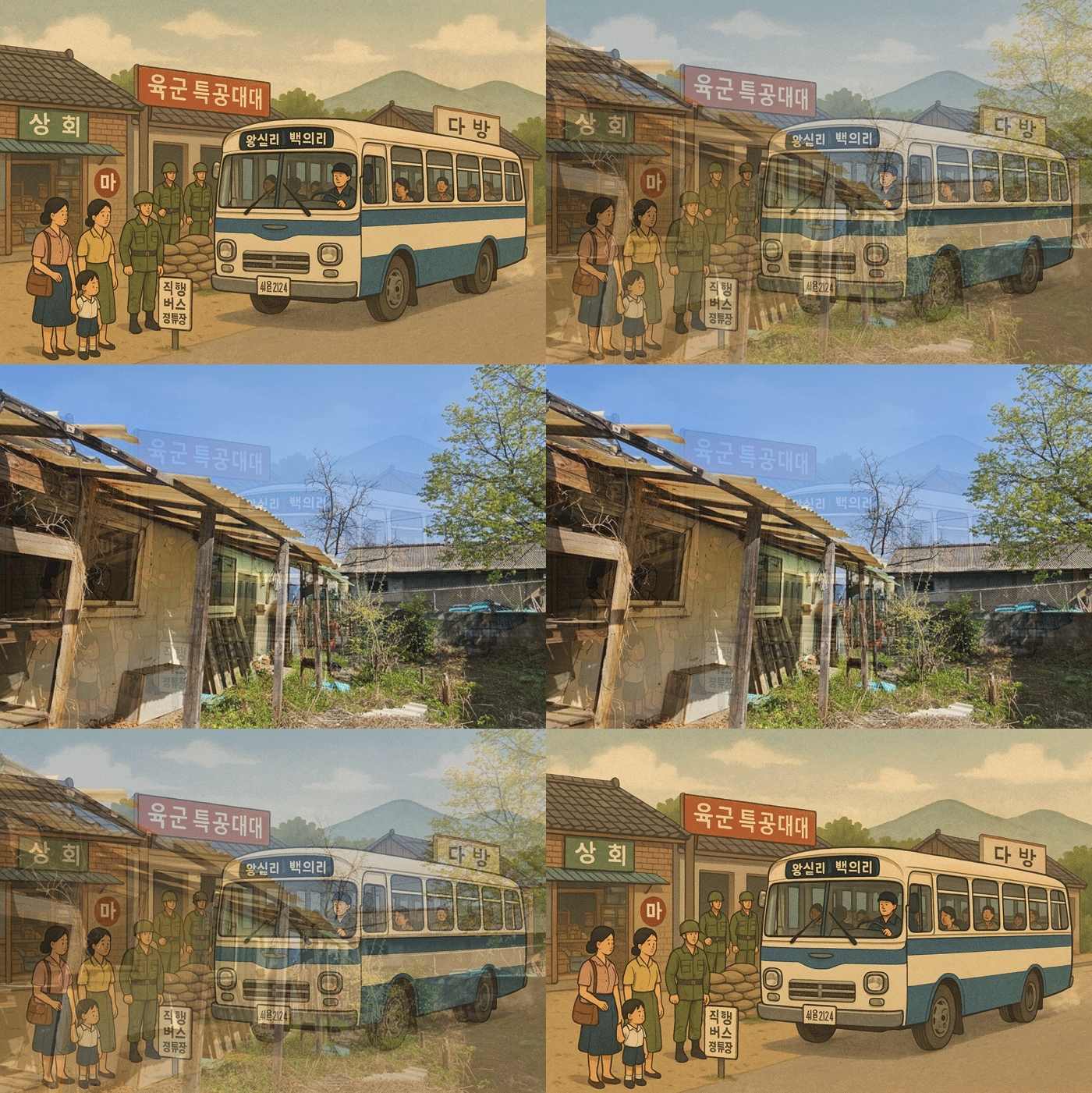
In Mr. Yoon's memory, Baegui-ri was once a vibrant village. After the Korean War, it was a base village where a U.S. military base was located. Although the U.S. military unit relocated in the 1970s, a special forces regiment of the South Korean army settled there and sustained the commercial district. As the local economy prospered in the 1980s, a direct bus ran between Majang-dong in Seoul and Baegui-ri every hour. However, when the military unit left the village, the commercial district rapidly declined. Residents, whose livelihoods became uncertain, left for the city in search of jobs. As even the remaining residents passed away due to old age, the number of vacant homes increased.
The village's only supermarket also became a vacant home. Broken walls and bricks were scattered throughout the village. Unable to just watch the village fall into slum conditions, Mr. Yoon requested the county office to demolish the vacant homes. However, the county office responded that demolition could only proceed with the owner's consent. The children who inherited the vacant homes had emigrated overseas and could not be reached. Every time Mr. Yoon sees Baegui-ri, which once thrived, fall into decline, he feels distressed. He appealed that "there are too many vacant homes and homes that will soon become vacant in Baegui-ri."
Recently, 'vacant home islands' have been emerging in county-level areas across Korea, including Baegui-ri. These are vacant homes resulting from urban decline and population decrease. This is different from urban vacant homes that arise due to failed urban development.
Village hotels and workations... Vacant home policies focused on remodeling


Local governments and government agencies have recently developed policies focused on demolishing or remodeling these vacant homes. Homes that are difficult to utilize are demolished, while those in good condition are renovated into hotels or rental housing with government budgets to attract new residents. In 2022, Yeoncheon County Office invested 3.2 billion KRW to complete the Baegui Village Cafe and guesthouses. These facilities are currently managed by a cooperative formed by Baegui-ri residents.
Government agencies are also actively working to utilize vacant homes in rural and fishing villages. The Ministry of Agriculture, Food and Rural Affairs, which oversees vacant homes in rural areas, launched a new "Rural Vacant Home Regeneration Support Project" this year. The project selects three local governments and provides funding to create residential or cultural spaces from vacant homes. The three selected areas?Gangjin-gun in Jeollanam-do, Cheongdo-gun in Gyeongsangbuk-do, and Namhae-gun in Gyeongsangnam-do?will each receive a total of 2.1 billion KRW over three years.
The Ministry of Oceans and Fisheries also began a vacant home regeneration project focused on remodeling in fishing villages this year. The approach is to convert vacant homes into shared residential housing or village rest areas. For six vacant homes in Wando-gun and Namhae-gun selected as project sites, 500 million KRW from the Rural-Fishing Village Cooperation Fund will be invested as project costs.
Government and local governments offer only stopgap measures... Even if new homes are built, there are no tourist attractions or jobs

On the 15th, an abandoned house with a collapsed entrance and roof is left in Baegui 2-ri, Yeoncheon-gun. Photo by Lee Jieun
원본보기 아이콘However, rural residents question the effectiveness of remodeling projects. They believe that simply changing the space without expanding infrastructure cannot retain the population. In fact, Baegui-ri residents said that even after opening the guesthouse, they have not felt a noticeable increase in tourists.
A representative of the Baegui Village Cooperative said, "Since there are no tourist attractions near the village, guests only come briefly during vacation seasons and then it becomes quiet again. In reality, most of our guests are parents visiting soldiers stationed at the nearby military base." Pastor Park Sangwoo (age 49), who runs a church in the village, also pointed out, "Even if vacant homes are turned into new houses, young people have no jobs to earn money, so there is no reason for them to settle in the village."
Some argue that the government and local authorities are focusing only on post-occurrence responses. They point out that the main focus is on demolition and utilization after the fact, rather than on preventing the occurrence of vacant homes in the first place.
Experts also emphasized that vacant home renovation without job linkage is only a half measure. Kangrae Ma, professor of Urban Planning and Real Estate at Chung-Ang University, said, "It is realistically difficult to increase the young resident population in rural areas with poor job prospects simply by remodeling vacant homes. Policies should focus on supplying vacant homes mainly to middle-aged people planning to return to their hometowns before retirement, while simultaneously creating small-scale local jobs."
Japan selects and manages 'vacant home reserves'

Japan, which faced the vacant home issue earlier than Korea, selects and manages 'vacant home reserves.' In Setagaya Ward, Tokyo, ward office staff select vacant home reserves mainly among elderly single-person households and visit them regularly to provide disposal consultations.
The government is also making efforts to prevent vacant homes. Since 2023, the Japanese government has designated homes with a high risk of becoming specific vacant homes (those posing safety or crime concerns) as 'neglected vacant homes.' Houses where weeds or pests are not managed or waste is left unattended for a year are subject to this designation. If designated as a neglected vacant home, the owner must improve the residential environment according to local government recommendations. Failure to comply may result in an increase in property tax or a fine of 500,000 yen (about 4.8 million KRW).
Jang Namjong, Ph.D. in engineering at University of Seoul, said, "Vacant home policy should focus as much on prevention as on post-incident measures. The public sector needs to identify places with a high likelihood of becoming vacant homes in the future, such as elderly single-person households, and support reverse mortgage linkage, inheritance, or sales consultations."
Index130,000 Vacant Houses Report
- Baegui-ri, a Rural Village Left with Only 'Vacant Homes' and 'Abandoned Houses'
-

Reporter Lee Jieun jelee0429@asiae.co.kr
-
Edit Kim Boram kbram6457@asiae.co.kr
© The Asia Business Daily(www.asiae.co.kr). All rights reserved.