Opposed to Expansion... In-Seoul and SKY Medical Schools Become a Pathway to Higher Status
The Era of Medical Student Cartels
Opposed to Expansion... In-Seoul and SKY Medical Schools Become a Pathway to Higher Status
by Jo Inkyung
by Choi Taewon
by Choi Yujeong
Published 02 Apr.2025 15:47(KST)
Updated 02 Apr.2025 15:52(KST)
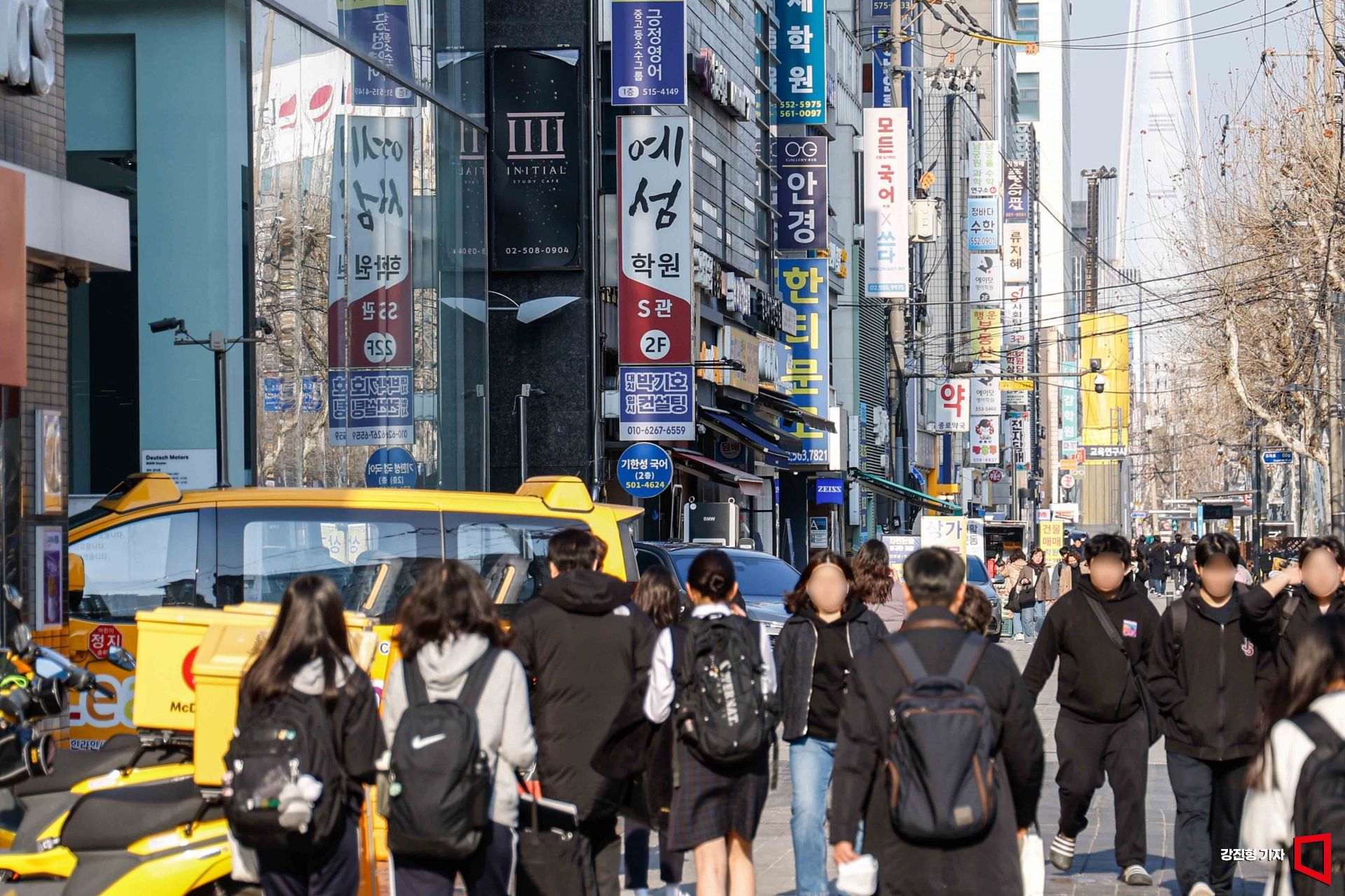
On the 20th of last month, a banner related to medical school admissions was posted in the academy district of Daechi-dong, Gangnam-gu, Seoul. Photo by Kang Jinhyung
Editor's NoteIt has been two years since the residents who left hospitals in protest against the government's policy to increase medical school enrollment in February last year have not returned. Although most medical students who followed their seniors in refusing classes and taking collective leaves of absence have formally accepted the government's and universities' warnings of academic probation and expulsion and returned, there is still a possibility that the struggle will continue through renewed leaves of absence and class boycotts. Even if the medical school field appears to be returning to normal, the side effects left by the collective actions and their power among medical students are unlikely to be erased easily. Asia Economy analyzes in six parts how and why these students are able to unite so tightly, almost like a 'cartel.'
②A Stronger Sense of Privilege in the 'Medical School Black Hole'
On the afternoon of the 26th last month, at a cram school in Seocho-gu, Seoul, a '2026 Medical and Pharmacy School Transfer Information Session' was held. Despite being a weekday afternoon, about 40 people filled the seats, ranging from young professionals in their 30s to early 20s students who still looked like college freshmen. The main topic of the session was whether the recent collective leaves of absence by medical students would increase the number of transfer spots at medical schools.
The head of the academy, who was the speaker, said, "After conducting a preliminary survey, I found that many of those attending today are already enrolled in medical-related colleges (dentistry, pharmacy, Korean medicine, veterinary medicine)," and avoided a direct answer by adding, "The scale of transfer admissions will only be determined once the policy direction regarding the return and expulsion of medical students is finalized."Another lecturer at the session predicted, "Many students have already transferred to top medical schools this year, so the number of transfer spots will likely increase compared to previous years," and added, "Even medical schools like Yonsei University College of Medicine, which have not accepted a single transfer student since the 2000s, may now open up to transfers."
The phrase 'Medical School Republic' summarizes the reality of education in Korea. From the top 1 to 3,058 science track test-takers nationwide, all medical schools from Seoul National University to Jeju National University are filled. With the increase of 1,500 medical school seats, a record number of repeat test-takers is expected for the 2025 college entrance exam. As a result, science and engineering departments have been hit hard by the medical school craze. Dropouts have surged at Seoul National University and KAIST, and even professionals who graduated long ago are flocking to night and weekend prep academies for medical school re-entrants.
It is estimated that even among those medical students who took collective leaves of absence in protest against the enrollment increase, many have successfully transferred to medical schools in Seoul or SKY universities. According to data received by Jin Sunmi, a member of the National Assembly's Education Committee from the Ministry of Education, 389 medical students dropped out of the 40 medical schools nationwide from March last year to February this year, accounting for 13% of the annual enrollment (3,058 students).
Transfer Admission Briefing for Medical and Pharmaceutical Schools at Seoul Academy Many Students from Dental, Pharmaceutical, Korean Medicine, and Veterinary Schools Attend
Yonsei University Medical School, Which Had No Transfer Students in the 2000s, May Also Admit Transfer Students
Last year, the Ministry of Education prevented academic probation and expulsion of medical students, so most of these numbers are interpreted as voluntary withdrawals. Lim Seongho, CEO of Jongro Academy, pointed out, "Nearly 400 medical students dropping out means that although the enrollment increase was focused on regional medical schools to strengthen local healthcare, even existing students are flocking back to the metropolitan area," and "the sudden policy change is shaking the entire college admissions market, from new admissions to transfers."
A professor at a metropolitan university, who requested anonymity, criticized, "While opposing the enrollment increase, medical students have turned the unprecedented chaos into an opportunity for personal advancement through re-entry."
From Kindergarten to Medical School Entrance Exams, Driven by High-Income Professional Expectations
This year, 'medical school dorms' at large prep academies, which only accept the top science-track repeaters, are thriving. The 'elementary school medical school prep class,' which began in Daechi-dong, is growing in number, and the recent trend of 'age 7 state exams' is also linked to this medical school fever.
The main reason why being a doctor is the most coveted job in Korean society is that it offers more secure economic rewards and a stable future than any other profession. According to the Ministry of Health and Welfare, the average annual salary for doctors in 2022 was 301 million won, the National Tax Service reported an average annual business income of 400 million won, and the Health and Medical Workers' Union revealed that doctors' salaries ranged from 400 to 600 million won last year.
Once you obtain a medical license, you can work for life without worrying about employment or retirement, with a guaranteed minimum income, and in the case of popular specialties, clinic owners can expect annual incomes in the billions of won. The sense of mission and fulfillment from saving lives and social respect have become secondary reasons.
As a result, more people want to become doctors, and parents want their children to become doctors. Students who have set their sights on becoming doctors since middle or high school are treated as the best talents with guaranteed high-income professional status the moment they succeed in entering medical school, and experts say they quickly become immersed in the unique culture of identifying themselves with the medical profession even before obtaining their license.
A representative of a prep academy in Daechi-dong said, "Even students who are considered quite smart start advanced math and science studies in elementary school to get into medical school. In middle school, they have to rack up awards and keep perfect records to get into special-purpose high schools or achieve nearly perfect grades and test scores at regular high schools. This process is relentless, with no time to rest. Parents also spend millions of won per month on private education, shuttling their children from one academy to another, so when they succeed in the entrance exam, they expect a return on their investment."
He added, "The moment a student receives a medical school acceptance letter, even if they start tutoring as a part-time job, their hourly wage is twice that of students in general departments at Seoul National University," and asked, "In a society where everyone looks up to doctors, isn't it natural for medical students to feel a sense of pride as top professionals and part of the elite class, as if they are already doctors unless something extraordinary happens?"
At the entrance of an academy located in Daechi-dong, Gangnam-gu, Seoul, there is a recruitment notice for the 'Seoul National University Pre-Medical Class' aimed at elementary school students. Photo by Kang Jinhyung
From 1st to 3,058th Place, Everyone Applies to Medical School
The collective action of medical students, which began in opposition to the enrollment increase, also revealed the sense of privilege and reward mentality cultivated among these future doctors.
A medical student from the Chungcheong region, identified as A, said, "Looking at my friends, most of them chose medical school because they wanted a stable job or career," and confessed, "The reason medical students now oppose essential medical service packages is that they fear they will not be able to maintain the social and economic status currently enjoyed by doctors in the future."
B, a student on leave from a metropolitan medical school, said, "I originally considered majoring in engineering, but with grades high enough for medical school, it felt wasteful to go to engineering, so I chose medicine. I can't accept the sudden deterioration in the treatment of doctors or the medical environment," and added, "As the top elites have become doctors, Korea's medical standards have improved dramatically, so if this changes, we must be prepared for a decline in the quality and standards of medical care."
However, some point out that since this medical conflict began with the government's controversial enrollment increase policy, it is important to avoid demonizing or labeling the resistance of medical students and residents as mere collective self-interest.
Lee Deokhwan, Professor Emeritus of Chemistry at Sogang University, analyzed, "In the process of pushing through flawed policies (medical reform), the government tried to shift responsibility by neutralizing the activities of the medical student association and restricting their right to take leaves of absence," and added, "By eliminating the focal point for students to freely gather and discuss solutions, only the voices of a few hardliners grew louder, resulting in them representing the entire group."



![[The Era of Medical Student Cartels] ① They Organized Silently](https://cwcontent.asiae.co.kr/asiaresize/251/2025033115182790862_1743401907.jpg)
![[The Era of Medical Student Cartel]③ Groupthink in a Culture of Hierarchy, Control, and Obedience](https://cwcontent.asiae.co.kr/asiaresize/251/2025032514040482483_1742879044.jpg)
![[The Era of Medical Student Cartel]④ "There is a compensation mentality, but the medical community and patients aim for coexistence"](https://cwcontent.asiae.co.kr/asiaresize/251/2025033117042791123_1743408267.jpg)
![[The Era of Medical Student Cartels]⑤ Professor Kim Nuri "Urgent Need to Restore Public Responsibility"](https://cwcontent.asiae.co.kr/asiaresize/251/2025032615414884808_1742971308.jpg)
![[The Era of Medical Student Cartels]⑥ Professor Kwon Yongjin "Professional Ethics Must Be Correctly Established"](https://cwcontent.asiae.co.kr/asiaresize/251/2025032710444886187_1743039889.jpg)





![[Culture Interview] "Unifying the Fragmented Music Market... Super Fans Are the Next Competitive Edge"](https://cwcontent.asiae.co.kr/asiaresize/304/2026042817051344090_1777363513.jpg)