Silent Collective Action Despite Appeals to Return... Absentees Branded as Traitors
The Era of Medical Student Cartels
Silent Collective Action Despite Appeals to Return... Absentees Branded as Traitors
by Jo Inkyung
by Choi Taewon
by Kim Yumi
Published 01 Apr.2025 15:21(KST)
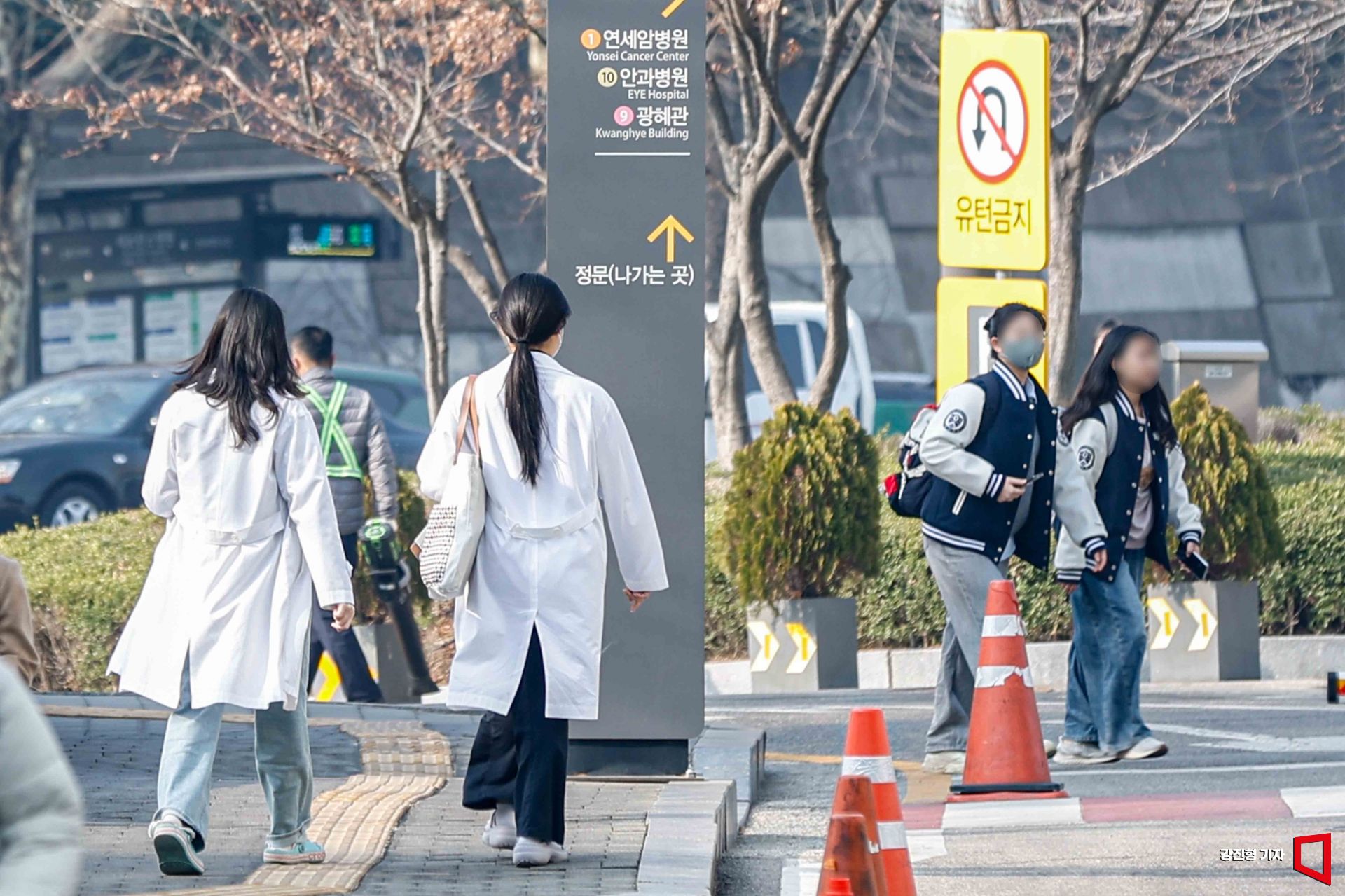
On the 21st of last month, the deadline set by some medical schools including Yonsei University, Korea University, and Kyungpook National University for students to return was approaching, and students were moving at Yonsei University College of Medicine in Seodaemun-gu, Seoul. Photo by Kang Jinhyung
Editor's NoteIt has now been two years since resident doctors, who left hospitals in protest against the government's medical school quota expansion policy in February last year, have not returned. Medical students, who followed their seniors in refusing classes and taking collective leaves of absence, have mostly accepted the government's and universities' warnings of academic probation or expulsion by formally returning. However, the possibility remains that they will continue their struggle through renewed leaves of absence or class boycotts. Even if medical schools appear to be normalizing, the side effects left by the students' collective action and its influence are unlikely to be easily erased. Asia Economy analyzes over six parts what enables and motivates them to unite as a 'cartel' so tightly.
① Their Silent Collectivization
On the afternoon of the 19th of last month, at Korea University College of Medicine in Seongbuk-gu, Seoul, the atmosphere inside the medical school building was filled with silence, in stark contrast to the excitement of the new semester on campus. In the empty hallways, only a few people in white coats?presumably professors and administrative staff?passed by. In a spacious study room, a single student sat alone, immersed in a medical textbook.
Over a Year of Collective Leave... Now Switching to "Refusal to Attend Classes After Returning"
A similar scene unfolded at Kyung Hee University in Dongdaemun-gu around the same time. As one walked past groups of laughing and chatting students at the main gate and approached the medical school building, the number of people noticeably dwindled. In the quiet lobby of the medical building, a lone staff member idly passed the time in a cafe with no customers. Upstairs, only the convenience store was brightly lit among the darkened lecture halls.
Medical Schools Remain Empty Even in the New Semester
On the 19th of last month, a student is studying alone in a study room within Korea University College of Medicine in Seongbuk-gu, Seoul. Photo by Choi Taewon
On the 19th of last month, in front of the Kyung Hee University College of Medicine building in Dongdaemun-gu, Seoul, there was such silence that no one was passing by. Photo by Choi Taewon
On the 21st of last month, which Yonsei University, Korea University, and Kyungpook National University set as the 'deadline' for medical students to return to classes, books were left in the hallway of the lecture rooms at Yonsei University College of Medicine in Seodaemun-gu, Seoul, with no one passing by. Photo by Kang Jinhyung
It has been one year and two months since medical students joined their seniors, the residents, in taking leave. After a long struggle, most have chosen the path of "returning for now," but few believe the situation has been fully resolved. Depending on future developments in the medical community, new forms of protest may still be on the table.
Anger Only in Group Chats and Online Communities... Class of '24 and '25 Take Collective Action Immediately Upon Admission
Medical students are neither holding rallies nor voicing their opinions through official channels on campus. Instead, they express their anger and organize collective action in KakaoTalk group chats for each medical school or in anonymous online communities exclusive to doctors. Their sharp criticism of professors urging them to return was also mainly voiced in online forums and article comment sections. This protest style is sometimes compared to the Chinese neologism "Tangping" (lying flat and doing nothing).
Most of the medical students from the class of '24 and '25 interviewed by Asia Economy confessed that they naturally joined collective action as soon as they entered university. Student A, a class of '24 student at a medical school in Seoul, explained, "Right after I was admitted, the government announced an increase of 2,000 medical school seats. My seniors explained that this expansion would not save essential or regional healthcare, but rather cause other problems, which convinced me to take a leave of absence." A did not deny that there was implicit pressure and persuasion that "everyone must join together to achieve the greater cause," rather than individual judgment by students.
He said, "Even when residents began resigning en masse, I thought the situation would end in a month or two. When the government offered leave approval and special training exceptions for residents, I believed the flawed expansion policy would soon be withdrawn. But as the leave continued into the second semester and new freshmen joined in 2025, the division became clear: those who joined the leave were allies, those who didn't were betrayers."
Students admitted after the quota expansion, the class of '25, felt even greater pressure to join the leave, especially as they were already under scrutiny for "benefiting from the expansion." The reality is even more evident in cases reported to the Ministry of Education's "Medical School Student Protection and Reporting Center."
"Even before the entrance ceremony, I received a notice for an online vote on joining the leave, and it was a named vote requiring both name and contact information. Although I didn't think leave was the best option, seeing posts criticizing students who attended classes made me fear being ostracized, so I eventually agreed. As a parent, it breaks my heart to see my child suffering from severe depression and loss of appetite, staying in the dorm room out of fear of being seen attending classes." (Parent of a class of '25 medical student)
"At first, the survey on whether to take leave was conducted using the anonymous poll function in the group chat. But next time, they changed it to require student ID and name. Seniors said they would never force us to take leave, but in reality, they are. I don't know what to do in this situation." (Class of '25 medical student)
Blacklist of Returning Residents... Professors Advising Students Face Harsh Criticism
Meanwhile, remarks made in the doctors' online community "MediStaff" became public, worsening public opinion. Excessive comments such as "I feel nothing even if a Joseon person dies in the ER" and "Only when more people die will there be gratitude and respect for doctors who handle life" fueled resentment toward doctors and medical students. Police launched an investigation after some residents who returned to hospitals were mocked as "true doctors" and had their personal information exposed in a blacklist.
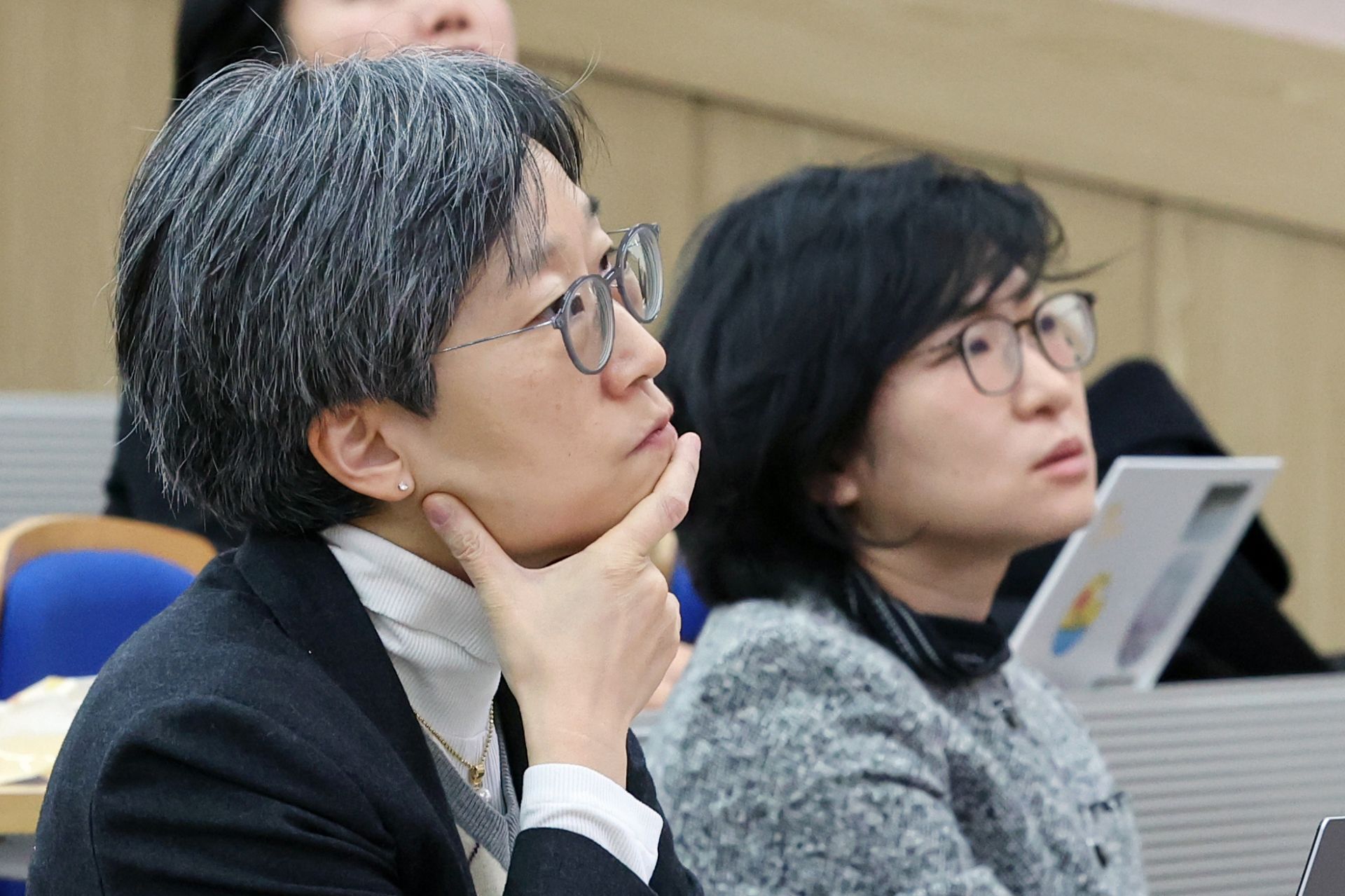
Professor Heekyung Kang (left) from Seoul National University College of Medicine and Seoul National University Hospital and Professor Eunjin Ha attended the discussion titled 'Our Current Status: Fact Check on Healthcare System Performance Indicators' held on the 18th of last month at Yang Yunseon Hall, Convergence Building, Seoul National University College of Medicine in Jongno-gu, Seoul, where they listened to presentations at the event 'Joint Action of Healthcare Consumers and Providers Creating a Better Medical System Together'.
Professors Juhwan Oh and Sewon Han from Seoul National University College of Medicine and Seoul National University Hospital, along with Professors Kang and Ha, issued a statement the previous day titled 'It is time to decide now for those who claim returning colleagues are no longer colleagues,' criticizing medical students and residents who oppose the movement for medical students to return. Yonhap News
On the 17th, when four Seoul National University medical professors, including Kang Heekyung, issued a statement criticizing the absent students and residents, saying, "Seeking professional respect with just a medical license is nothing but arrogance," even harsher criticism erupted within the medical community. Online communities were filled with comments like "Do you want to see your students just so you can dump night shifts on them?" and "If you're dabbling in politics, can you really treat patients well?"
As a result, even as the end of March?the final deadline set by the government and universities to reverse next year's quota expansion?passed, it remained unclear whether medical students would return to classes. Some suggested, "Just pay the tuition but don't attend classes to avoid expulsion," while others argued, "They can't expel so many students at once, so let's all refuse to register," or "Male students should just enlist in the military first." Such tactics and hardline stances fueled ongoing confusion.
In the process, some medical students demanded proof of non-registration in group chats, prompting the Ministry of Education to refer the matter to the police. Since those who do not provide proof are effectively considered not to be participating in the collective leave, this became a means of pressuring those applying for reinstatement.
One medical professor pointed out, "Students believe that only if all 40 medical schools nationwide act together can they achieve their demands, such as reversing the quota expansion and withdrawing the essential healthcare package. However, under school regulations, they can't refuse classes indefinitely, and disclosing the personal information of students who want to attend classes or creating anxiety is extremely violent behavior."
Leniency Despite Unauthorized Class Boycotts... Fairness Controversy with Non-Medical Students
There is also controversy over "fairness" between medical students and others. Many point out that it is hard to understand why the government is accommodating medical students by postponing academic schedules, even though most have been boycotting classes without permission for over a year since February last year, from the perspective of non-medical students.
B, an engineering student at a university in Seoul, said, "I can understand why medical students started their collective leave, but seeing the government and universities flounder as if being dragged along by medical students makes me wonder if they are a privileged class. If only medical students are allowed leniency for academic probation or expulsion, it is ignoring and discriminating against other university students," he said emphatically.



![[The Era of Medical Student Cartels]② The Strengthened Sense of Privilege Within the 'Medical School Black Hole'](https://cwcontent.asiae.co.kr/asiaresize/251/2025032023053777142_1742479536.jpg)
![[The Era of Medical Student Cartel]③ Groupthink in a Culture of Hierarchy, Control, and Obedience](https://cwcontent.asiae.co.kr/asiaresize/251/2025032514040482483_1742879044.jpg)
![[The Era of Medical Student Cartel]④ "There is a compensation mentality, but the medical community and patients aim for coexistence"](https://cwcontent.asiae.co.kr/asiaresize/251/2025033117042791123_1743408267.jpg)
![[The Era of Medical Student Cartels]⑤ Professor Kim Nuri "Urgent Need to Restore Public Responsibility"](https://cwcontent.asiae.co.kr/asiaresize/251/2025032615414884808_1742971308.jpg)
![[The Era of Medical Student Cartels]⑥ Professor Kwon Yongjin "Professional Ethics Must Be Correctly Established"](https://cwcontent.asiae.co.kr/asiaresize/251/2025032710444886187_1743039889.jpg)




![[Culture Interview] "Unifying the Fragmented Music Market... Super Fans Are the Next Competitive Edge"](https://cwcontent.asiae.co.kr/asiaresize/304/2026042817051344090_1777363513.jpg)