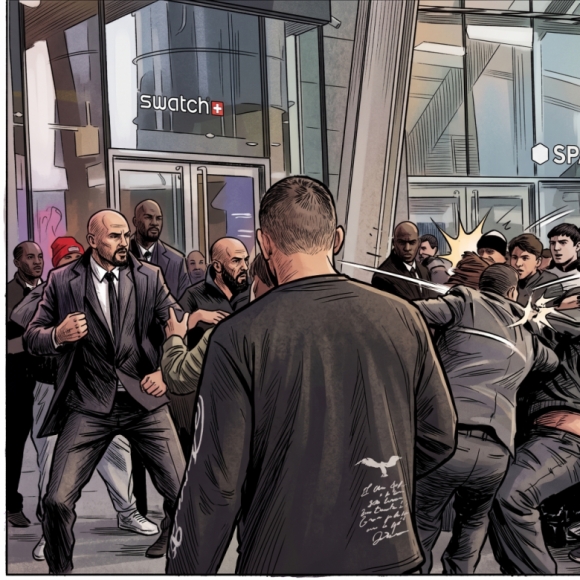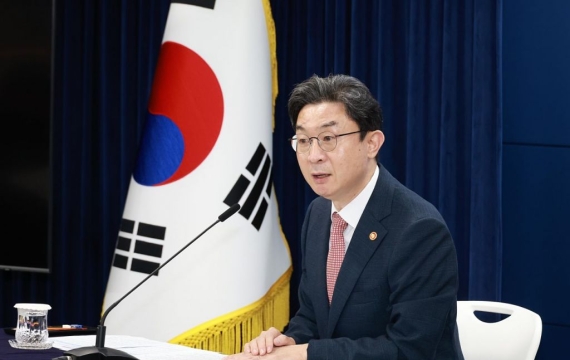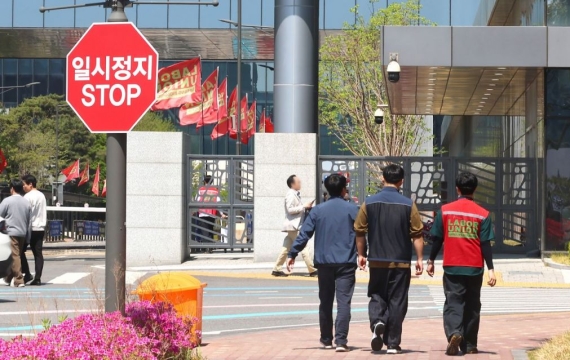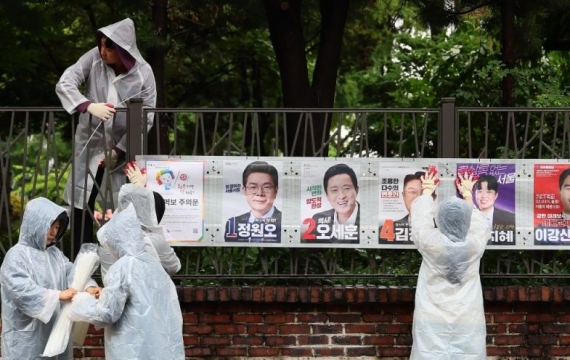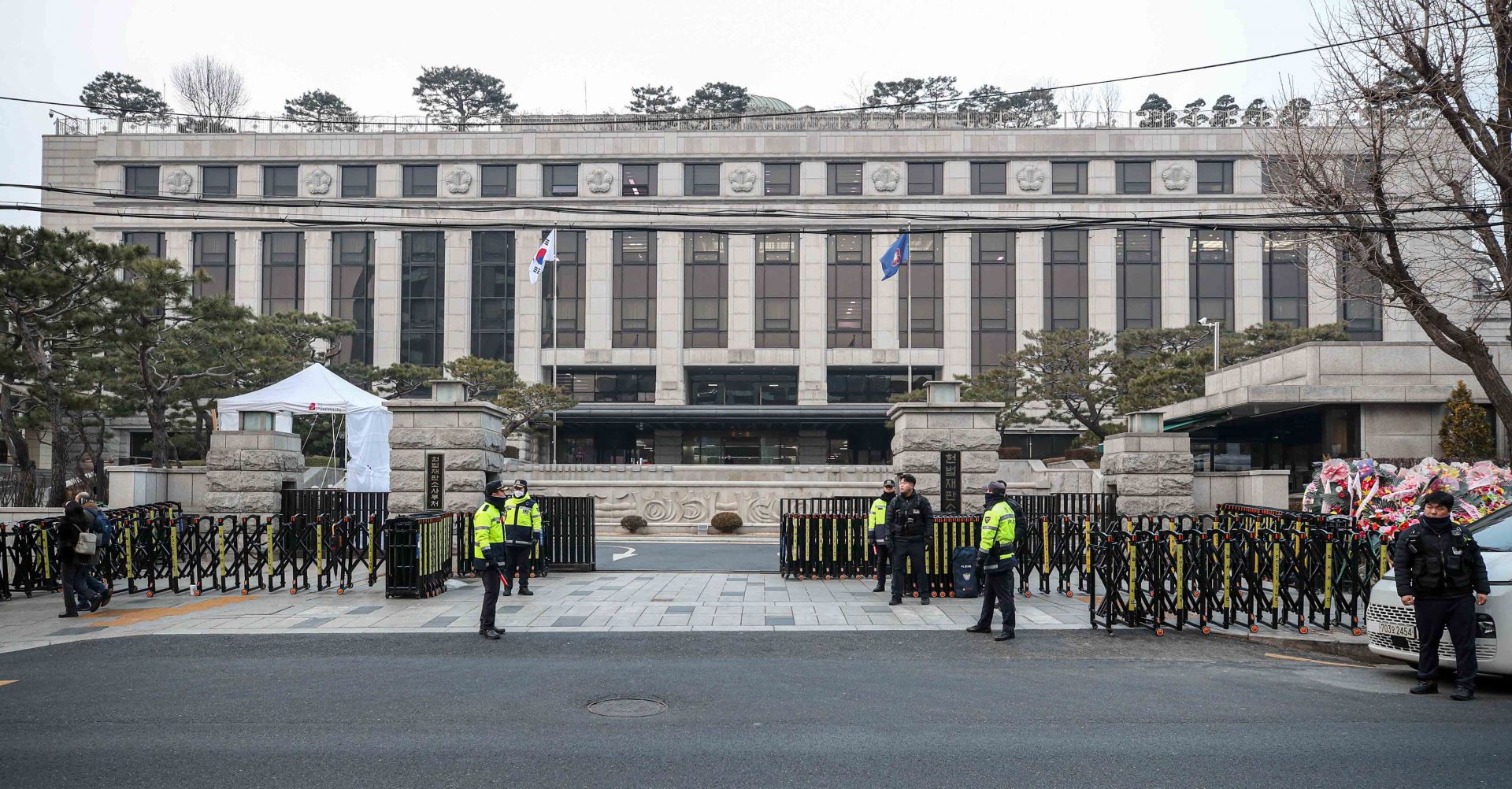

As the ruling on President Yoon Sukyeol's impeachment trial is delayed, the conflict between the opposing support groups among the public is intensifying. On the 21st, the flag of the Constitutional Court in Jongno-gu, Seoul, fluttered in the wind. Photo by Yoon Dongju
원본보기 아이콘The Constitutional Court will finally deliver its verdict on the impeachment trial of President Yoon Suk-yeol on the 4th. It has been 122 days since martial law was declared on December 3 last year, 111 days since the impeachment resolution was filed, and 38 days since the conclusion of the hearings.
During this time, the people of South Korea have been anxiously watching the Constitutional Court, wondering when the verdict on President Yoon's impeachment would be delivered. As the expected ruling dates predicted by politicians and legal experts kept being missed, questions grew over whether there were unforeseen variables, external pressures, or other reasons we hadn't anticipated. However, with the Court setting the ruling date for the 4th, the wait is over and only the result remains.
Although it was an anxious wait, in retrospect, the Constitutional Court chose the ruling date with remarkable precision. It appears the Court selected a time when the intense political conflict that peaked during the hearings had somewhat subsided, minimizing the risk of chaos regardless of the outcome. This is why even political circles are saying, "The Constitutional Court picked a perfect timing."
Let's look back at why the Court took so long to designate a ruling date and the political events that surrounded the expected dates.
There are several dates and days of the week to remember: February 25, April 18, and Friday.
First, February 25 was the day the hearings for President Yoon's impeachment trial concluded.

On the 25th, Kim Gyeri, attorney for President Yoon Sukyeol's legal team, presented the respondent's argument during the 11th impeachment trial of President Yoon Sukyeol held at the Constitutional Court in Jongno-gu, Seoul. Photo by Constitutional Court
원본보기 아이콘That's right. It was the day when Kim Gyeri, one of President Yoon's legal representatives, made the now-famous statement, "I have been enlightened."
This was the day President Yoon's Constitutional Court hearing ended. From that day, speculation about the ruling date began immediately.
The second date is April 18. April 18 is


the day when the terms of Constitutional Court Justices Moon Hyungbae (left) and Lee Miseon end. If these two justices retire, the timing of the ruling becomes uncertain. Although a quorum of six justices is sufficient for a ruling, questions about the legitimacy of the outcome would inevitably arise.
Lastly, Friday. The Constitutional Court has always delivered presidential impeachment verdicts on Friday mornings. Former President Roh Moo-hyun received a dismissal verdict at 10 a.m. on May 14, 2004, and former President Park Geun-hye was removed from office at 11 a.m. on March 10, 2017. President Yoon's verdict will also be delivered at 11 a.m. on Friday, the 4th.
Normally, the Court announces rulings on regular cases such as constitutional appeals and disputes of authority, which are reviewed by the full bench of justices, on the last Thursday of each month. While there is no law requiring Thursday rulings, the Court has preferred Thursdays. However, for presidential impeachment trials, perhaps due to their gravity, the Court has always ruled on Fridays. In past cases, the ruling date was announced 2-3 days in advance, with the verdict delivered on a Friday.
For former Presidents Roh and Park, the verdicts came 14 and 11 days after the hearings ended, respectively. For President Yoon, whose hearings ended on February 25, the most likely date was Friday the 14th, about two weeks later. However,

President Yoon Sukyeol, released from the detention center, raised his hand to supporters as he got out of the car in front of the residence in Hannam-dong, Seoul on the 8th. Photo by Yonhap News
원본보기 아이콘things became complicated when President Yoon was released on the 8th.
President Yoon's release likely had a significant impact on the Court's decision regarding the ruling date. At the time, tensions between impeachment supporters and opponents were at their peak. Moreover,


the aftermath of the Western District Court riot in January was still ongoing. In such a climate, handing down a verdict less than a week after President Yoon's release would have obviously led to chaos.
With President Yoon's release, March 14 became unlikely, and the next candidates for the ruling date were the 21st or 28th. But this was also postponed. Here's why.

Lee Jae Myung, leader of the Democratic Party, is greeting his supporters after being acquitted in the appeal trial of a violation of the Public Official Election Act held at the Seoul High Court on the 26th. Photo by Joint Press Corps
원본보기 아이콘The second turning point was the appellate court ruling for Lee Jaemyung, leader of the Democratic Party. On the 26th of last month, he was acquitted in his second trial for violating the Public Official Election Act, which had been the biggest hurdle to his early presidential bid.
In fact, Lee's appellate ruling was scheduled in advance. For this reason, there were consistent predictions that it would be difficult to deliver the impeachment verdict on the Fridays before or after (the 21st or 28th). If the verdict was delivered around the time of Lee's ruling, it would have been interpreted as politically motivated, further fueling political conflict. Thus, the ruling date had to be postponed again.
In fact, there is another major political event this week:

On the morning of April 2, the election day for the Busan Superintendent of Education re-election, citizens are casting their valuable votes at the Gwanganje 2-dong Second Polling Station, located on the second floor of the Suyeong-gu Life Culture Center in Busan. Photo by Yonhap News
원본보기 아이콘the April 2 by-elections. This is the third turning point. The by-elections are being held nationwide and are seen as a barometer of public sentiment regarding the early presidential election and the impeachment situation.
Here, the Constitutional Court made another clever move: it announced the ruling date on the 1st. In previous presidential impeachment trials, the Court typically notified the ruling date 2-3 days in advance. If the Court had announced the date on election day, the 2nd, it could have been accused of trying to influence the vote.
The timing of the announcement was also calculated. Usually, the Court announces the ruling date around 5 p.m., but this time it was announced in the morning. This shows the Court's effort to minimize any influence on the election while sticking to the chosen date.
On top of that, the Court went a step further. From the afternoon of the 1st, reports emerged from various media outlets stating that the Court's decision had already been finalized. The verdict was already decided. The Court did not deny this. In effect, the Court indirectly conveyed that it had made an objective decision, regardless of the outcome of the by-elections on the 2nd.

Acting Chief Justice Moon Hyungbae of the Constitutional Court, along with the constitutional justices, entered the grand courtroom of the Constitutional Court in Jongno-gu, Seoul, on the 25th of last month to attend the final arguments in the impeachment trial of President Yoon Seokyeol and are waiting for the trial to begin. Photo by Joint Press Corps
원본보기 아이콘The Constitutional Court appears to have deliberated extensively before setting the ruling date. Given the amount of thought that went into choosing the date, we hope the verdict will be one that unites the entire nation. We also hope that this ruling will help South Korea recover from the turmoil that has persisted since December 3 last year.