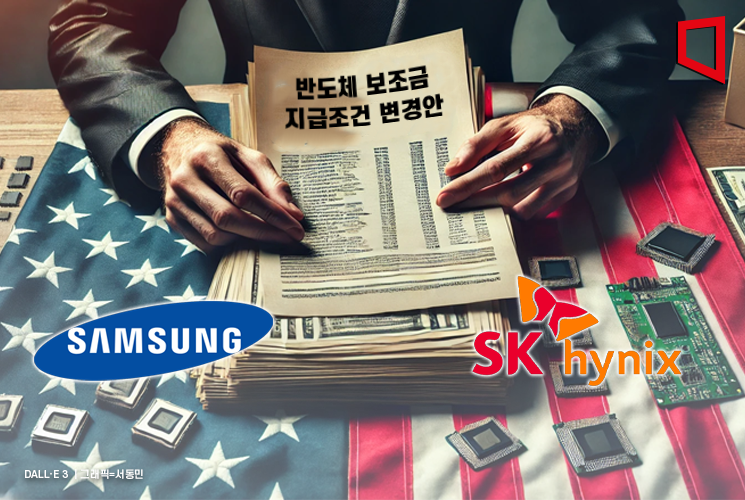
#. Samsung Electronics has launched behind-the-scenes lobbying efforts to receive subsidies under the CHIPS and Science Act (CSA) while establishing an advanced semiconductor factory in Taylor, Texas. The total lobbying expenses at the group level for the year 2024 alone amount to 6.98 million dollars (approximately 10.03 billion won). While GPA (Global Public Affairs), which oversees global government relations, is moving swiftly, the multinational law firm Covington & Burling LLP has also joined the effort. They specialize in lobbying governments and international organizations worldwide.
[Expanding Corporate Diplomacy]②
Lobbyists for the Top 5 Conglomerates Double Compared to Trump’s First Term
Former US Government, Congress, and Agency ‘Revolvers’ Deployed on the Frontlines
100 Billion Won Spent on Lobbying Over 5 Years... Hanwha Ramps Up US Push
#. Hyundai Motor Group has hired renowned law and lobbying firms such as K&L Gates LLP and Mercury Public Affairs. This is in response to the US administration’s Inflation Reduction Act (IRA). In particular, they have actively targeted lawmakers from Georgia, where Hyundai has made massive investments. Representative Buddy Carter (Republican) criticized the IRA bill that excluded Hyundai in an interview with Korean media, and Senator Raphael Warnock (Democrat) introduced an IRA amendment to make Hyundai eligible for subsidies.

◆‘Field Commanders’?Number of Lobbyists Doubled in 7 Years= Behind the quiet diplomatic efforts of Korea’s top 10 conglomerates are their ‘vanguard’ lobbyists. Like a swan gliding gracefully above water while paddling furiously below, these companies are working hard behind the scenes to ensure their positions are reflected in policy, especially by hiring a large number of former US government, congressional, and regulatory officials. Over the past five years, major companies expanding into North America have spent more than 100 billion won on lobbying.
The top five conglomerates, which operate dedicated overseas government relations teams, hire local lobbyists to communicate their needs. Lobbyists serve as the field commanders for corporate government relations.
Reliance on these face-to-face operators is steadily increasing. According to an Asia Economy analysis on the 18th, based on US Senate lobbying databases and nonprofit OpenSecrets data, the ‘top 5 conglomerates’?Samsung, SK, Hyundai Motor, LG, and POSCO?employed a total of 159 lobbyists last year. This is nearly double the 85 lobbyists employed in 2017, when the first Trump administration began. Samsung Electronics had the most with 64, followed by Hyundai Motor with 40. Notably, Hyundai Motor’s increase was particularly striking, with its number of lobbyists more than quadrupling. Last year alone, Samsung and Hyundai Motor together hired 104 lobbyists?more than the total number of lobbyists employed by all five conglomerates seven years ago. SK Group also significantly increased its lobbyist count from 15 to 31 during this period.
A key metric to note is the number of ‘Revolvers’?lobbyists who are former government officials. These are individuals hired by companies after leaving positions in the US government, Congress, or regulatory agencies. The nickname ‘Revolver’ refers to their revolving-door movement between government and the private sector. The growing proportion of Revolvers among corporate lobbyists indicates an increasing need to influence or participate in US policy and regulatory decision-making.

In 2017, 32 out of 39 lobbyists hired by Samsung Electronics were Revolvers. Last year, the number of Revolvers rose to 39, matching the total number of lobbyists Samsung had during Trump’s first term. At SK Group, 20 out of 31 lobbyists are Revolvers. Hyundai Motor had only 8 Revolvers in 2017, but this number jumped to 23 last year.
Robert Hood, who was recruited by Hyundai Motor as deputy head of its Washington office, is also a Revolver. During Trump’s first term, he served as Assistant Secretary of Defense, handling government relations between the Pentagon and Congress.
◆Companies Spend 100 Billion Won on Lobbying= Samsung, SK, Hyundai Motor, and Hanwha have spent nearly 100 billion won on lobbying over the past five years. In particular, Hanwha Group nearly octupled its lobbying expenditure during this period as it strengthened its North American operations.
Samsung increased its spending from $3.33 million in 2020 to $6.98 million (about 10.03 billion won) last year, setting a new record. SK spent $5.59 million (about 8.03 billion won). In 2021, when SK Innovation was engaged in a battery trade secret dispute with LG Energy Solution, it spent $6.12 million to prevent an import ban by the US International Trade Commission (ITC).

Hyundai Motor Group spent $3.28 million (about 4.71 billion won). After surpassing $2 million for the first time in 2022, it has continued to allocate a similar budget. Hyundai’s lobbying priorities include hydrogen and fuel cell policies, electric vehicle infrastructure and tax benefits, and Environmental Protection Agency (EPA) emissions regulations.
The most aggressive transformation has been at Hanwha Group. Its lobbying expenditure was just $450,000 in 2020, but last year it reported $3.91 million (about 5.62 billion won), surpassing Hyundai Motor. According to US Senate reports, Hanwha lobbied on solar panel tariffs. Over five years, its lobbying expenditure increased by 769%. As Hanwha continues to strengthen its North American defense industry operations, even more intense lobbying is expected.
The sharp rise in corporate lobbying is closely linked to changes in US policy. There has been a surge in efforts to expand production and investment in the US for core export industries such as semiconductors and electric vehicles. In the defense sector, which is directly tied to national security, persuading local governments is even more crucial. An industry insider said, “You have to meet local procurement policies and Department of Defense standards, and building long-term trust is key.”
However, some argue that government-level support should be expanded to prevent excessive lobbying from making Korean industry overly dependent on US policy. A former diplomat from the Korean Embassy in the US said, “In the past, Korean companies often responded to US policy changes after the fact, but now the strategy is to preemptively block risks,” adding, “As major conglomerates become global players, joint responses from the government are also needed.”
-

Reporter Jang Heejun junh@asiae.co.kr
-
Reporter Cho Seongpill gatozz@asiae.co.kr
-
Reporter Woo Sooyoun yesim@asiae.co.kr
-
Edit Kim Hyunhee faith100@asiae.co.kr
© The Asia Business Daily(www.asiae.co.kr). All rights reserved.