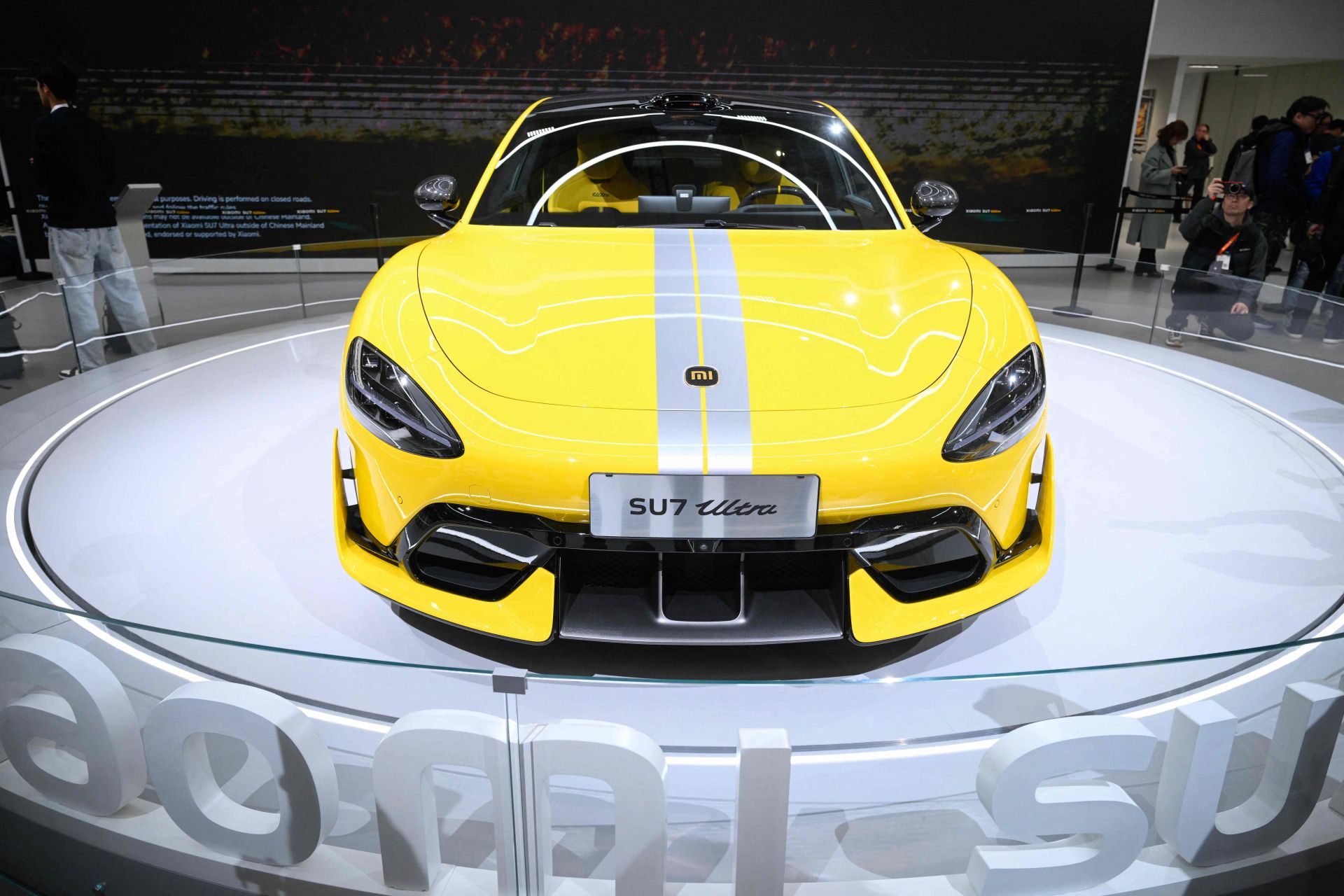
"Xiao AI, open the window." As soon as I said this while sitting in the back seat of Xiaomi's electric car SU7, the window actually opened automatically. This artificial intelligence (AI) feature, called Xiao AI, is at the core of Xiaomi's integrated ecosystem, which now extends from smartphones to automobiles.
Xiaomi's First Electric Car Ultra 'SU7'... Perfectly Linked with Smart Home
On the 4th (local time), the most eye-catching booth at the world's largest mobile communications exhibition, Mobile World Congress (MWC) 2025, held at Fira Gran Via in Barcelona, Spain, was Xiaomi's. This Chinese company showcased not only smartphones, wearables, and IoT home devices but also cars, demonstrating its capabilities as an all-round player. The main highlight was Xiaomi's first electric car, the SU7, and the latest model unveiled at MWC, the Ultra SU7. Over the course of two days, as many as 1,200 people lined up for a test drive.

On the 4th (local time) at the MWC2025 exhibition hall, a reporter test-drove the 'Xiaomi' electric car SU7 interior. When holding a Xiaomi phone and getting in, it immediately syncs, allowing the phone to be operated on the car's internal screen. Using the 'XiaoAI' feature connected through Hyper OS, you can also open the door with your voice. Photo by Park Yujin
원본보기 아이콘The reporter had a chance to ride the electric car at the Xiaomi booth. Holding a Xiaomi smartphone, it automatically connected to the car's Hyper OS, allowing control of various functions. When the car recognized that it had arrived home, a model curtain next to the vehicle opened automatically and a Xiaomi robot vacuum started operating. It was a moment that showcased a perfectly linked ecosystem between the car and the smart home. Martin, a visitor from Germany, said after experiencing the Xiaomi electric car, "I didn't know Chinese companies had such advanced technology. AI is now basic, but the key is how to apply it to real life, and it seems Chinese companies are one step ahead."
This year's MWC was dominated by AI. In Korea, Samsung Electronics partnered with Google to equip its AI assistant Gemini, but Chinese companies captured visitors' attention not just with AI, but with unique hardware and practical features.
Phones That Detect Deepfakes and 3D Laptops... China Leads MWC
"Beep. There is a 94% probability that this is a deepfake video."
This warning message appeared on the screen of the Magic7 Pro smartphone displayed at the Honor booth. When the button at the top of the screen was pressed, a "Detecting" message spun for a few seconds before instantly determining authenticity. Chris, a visitor from the UK, said, "With video phishing on the rise, this seems like a useful security measure."
Along with such security technology, Chinese companies also focused on AI-based productivity tools. At the ZTE booth, when the side red button was pressed and the command "Book a taxi to the Barcelona ○○ Hotel" was given, the smartphone opened a map application, found and displayed the hotel location, then automatically launched the Uber app to suggest the most efficient ride option.


At the TCL booth, a smartphone with a paper-like texture was on display. "It really feels like paper!" exclaimed one visitor. This "paper-texture phone" features a matte display to reduce eye strain, and when the pen-shaped button is pressed, it offers various AI document creation functions such as 'email,' 'work summary,' 'event plan,' 'invitation,' and 'summary.' When the reporter selected 'invitation' and entered 'my birthday party,' a completed invitation appeared on the screen within seconds.
The innovation competition among Chinese companies was also fierce in the display sector. At the Lenovo booth, a small button on a black laptop attracted attention. When a staff member pressed the button, the laptop screen slowly rolled upward as if coming to life. The surrounding visitors exclaimed "Oh~," and YouTubers and reporters all pointed their cameras at the rollable laptop.
At another table in the same booth, a laptop capable of displaying 3D images without special glasses was demonstrating a game screen. The car in the game appeared to jump out of the screen as if it were real. The special feature of this 3D laptop was that it could be controlled with an 'AI ring.' By wearing a black ring on a finger and rotating it, the menu on the screen changed, and clicking was possible with just finger movements.
On the tables of the Huawei booth, which occupied most of the first floor hall, the three-fold foldable phone was the star. With its innovative design that folds twice, it transforms into a 10-inch tablet when unfolded and a regular smartphone when folded. Visitors repeatedly folded and unfolded the device.
-

Reporter Park Eugenie genie@asiae.co.kr
-
Edit Yang Hyejin adoretj@asiae.co.kr
© The Asia Business Daily(www.asiae.co.kr). All rights reserved.

![[Report] "A Culinary Destination with a View of Gyeongbokgung"... Kim Dong-sun's High-End Dining Takes Over Gwanghwamun](https://cwcontent.asiae.co.kr/asiaresize/304/2026042114562634571_1776750985.jpg)
![[Gallery Stroll] Red Robe, Black Lines... Danjong Returns with the Face of Wounds](https://cwcontent.asiae.co.kr/asiaresize/304/2026042014183532691_1776662315.jpg)