[Turning My Home into a Senior House] (13-1) Even Bitter Food Tastes Sweet When Shared at the Apartment Senior Center
Lunches served 'three days a week' increased to 'five days a week' since last year,
but budgets at each senior center are tight.
"Eating at the senior center means I take my medicine and live at home."
"If there wasn't food here, I'd have ended up in a nursing home."

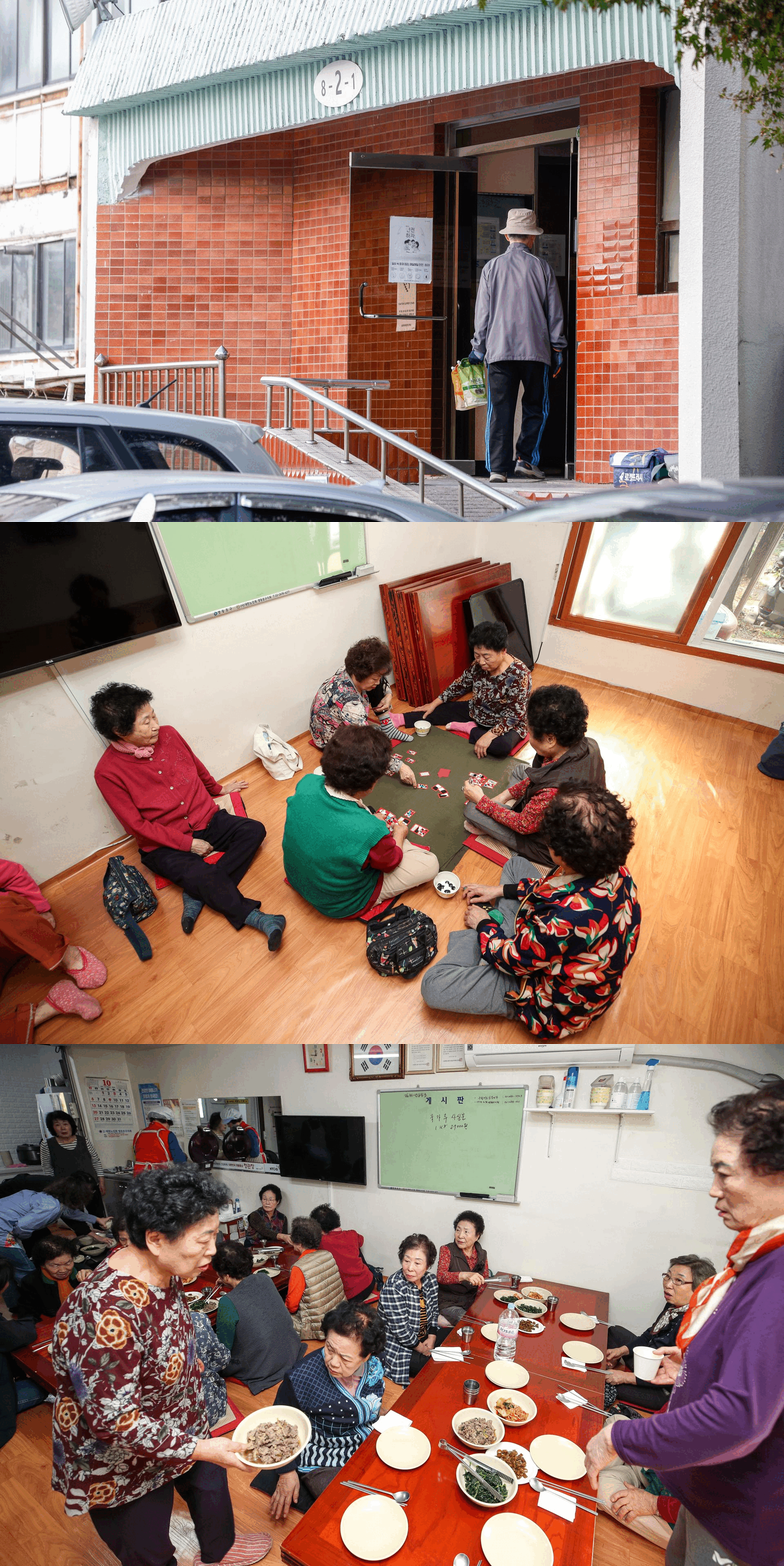
On October 25 last year, grandmothers gathered together for lunch at the Namseong Apartment Senior Center in Yeongdeungpo-gu, Seoul. Photo by Kang Jinhyung
원본보기 아이콘Rows of metal workshops coated with layers of grease line Mullae-dong, Yeongdeungpo-gu, Seoul. In this area, there is an apartment complex that has stood for over 40 years. The faded letters "Namseong" on the apartment's outer wall reflect the passage of time. There are only two buildings, totaling 390 households. Between them, the senior center stands like a permanent fixture. At noon, grandmothers and grandfathers from the complex began to gather in small groups. It is the time when warmth fills the old senior center.
"Five days a week, I have lunch here. If I were alone, I'd just eat rice in water, but here I get a proper meal. Thanks to this, I take my medicine regularly. That's why I can live alone at my age. When we eat together at the senior center, even bitter food tastes sweet."

On the 31st, Grandmothers Min Sunduk and Hwang Jeonggyu are returning home after having lunch together at the senior center in Namseong Apartment, Yeongdeungpo-gu, Seoul. Photo by Kang Jinhyung
원본보기 아이콘While eating, grandmother Bang Miok (81) glanced at the landline phone in the corner. The senior center president, Min Sundeok (76), immediately understood and picked up the phone. "Lunch is ready. Come quickly." Min said, "There's a grandmother who's ill and often loses track of time. She doesn't know when it's lunchtime, so I have to call her. She'll be here soon."
The side dishes that day were bulgogi, spinach namul, pickled chili peppers, seaweed soup, and kimchi. Some seniors can't come because they have part-time jobs at the district office, but about thirty people have lunch here every day. Until July last year, the senior center only served lunch three times a week. Following a government policy to "provide meals for seniors living at home," the number of lunches increased to five times a week from August that year.

On the 31st, elderly people gathered together for lunch at Namseong Apartment Senior Center in Yeongdeungpo-gu, Seoul. Photo by Kang Jinhyung
원본보기 아이콘As always, the budget is the problem. After increasing to five days a week, the senior center had to tighten its belt. According to Seoul City, when lunches were served three times a week, each senior center received a monthly subsidy of 350,000 won from the city and 50,000 to 750,000 won from the district office. When it changed to five days a week, only the city subsidy increased to 470,000 won, while the district subsidy stayed the same.

As a result, each senior center receives 520,000 to 1,220,000 won per month for operating expenses. Based on five days a week, the budget for one lunch is only 20,000 to 60,000 won. "At this rate, it's hard even to pay for a meal assistant," and "we have to eat ramen once a week," are common complaints from the field. As of October last year, about 50% (1,694) of all senior centers (3,489) in Seoul were serving lunch five days a week.

On the 31st, grandmothers are having coffee and chatting after finishing lunch together at Namseong Apartment Senior Center in Yeongdeungpo-gu, Seoul. Photo by Kang Jinhyung
원본보기 아이콘Even so, Yeongdeungpo-gu, where Namseong Apartment is located, is relatively well off. Two years ago, Yeongdeungpo-gu significantly increased its lunch support for senior centers. Thanks to this, the lunch budget at Namseong Apartment's senior center is about 70,000 won per meal. Rice is provided by the Ministry of Health and Welfare and the district office, which send 12 sacks a year.
With more meals to prepare, the senior center manager, grandmother Jang Gilnyeo (76), has become busier. "When we cooked lunch twelve times a month, we could afford better side dishes and snacks. Now, with twenty lunches a month, we have to tighten our belts. With so many people, every penny counts. Rain or shine, I buy vegetables wholesale at Yeongil Market every morning."

On the 31st, at Namseong Apartment Senior Center in Yeongdeungpo-gu, Seoul, an elderly woman is making phone calls to members who have not yet arrived before lunch. Photo by Kang Jinhyung
원본보기 아이콘Among the seniors coming for lunch, there is hardly one grandfather for every ten grandmothers. Even though they have seen each other for decades in the same apartment, the grandfathers feel awkward mixing with the grandmothers, so they set up a separate table in a small room at the senior center. "I've been living alone for 40 years. For breakfast and dinner, I just have boiled eggs or a protein drink. This is the only place I eat a proper meal. If the senior center didn't provide lunch, I'd have gone to a nursing home long ago. I'm grateful." Grandfather Bang Gibong (81) had already finished his bowl of rice.

On the 31st, grandmothers who finished lunch together at Namseong Apartment Senior Center in Yeongdeungpo-gu, Seoul, are playing Hwatu cards. Photo by Kang Jin-hyung
원본보기 아이콘After lunch, it's "coffee time." The grandmothers sit in a circle in the room, each with a paper cup and a packet of instant coffee, and Hwang Jeonggyu (76), who was on duty that day, poured hot water from the kettle. Stirring and sipping, they continued their conversation. "We even have assigned seats for coffee. The oldest, who is 89, gets the warmest spot. What do we do after coffee? We play go-stop for 10 won. It's the best way to prevent dementia."

IndexTurning My Home into a Senior House
- "I Want to Live in My Own Home Until the End"... Seeking the Right to Age and Die at Home
- "Can I Live Alone? That's My Worry... What You Need to Stay at Home Until 100"
- ¡°There¡¯s No Such Thing as a Free Lunch¡±: Wealthy and Highly Educated Seniors Are Coming
- "No One Is Healthy. Just Wait Until Professor Itmom Comes Home"
- "Doctor, I¡¯d be happy to pay if you could visit my home again"
- "I Felt Lost After Discharge... The Home Caregiver Saved Me Again, Ju"
- "If You Plug the Care Plug in Your Living Room... You Can Feel Secure Even Living Alone"
- "I Don't Want a Nursing Home... To Live in My Own House, I Must Avoid Dementia"
- "It's Hard to Go Out... Fitness Instructor Comes to Your Home"
- Do You Go to Senior Centers?... Come to the 'Rochiwon' Instead
- To Feel Safe Enough to Close My Eyes at Home, These Changes Are Necessary
- "It's My Neighborhood, but I'm 200th on the Waiting List"... Local Nursing Homes More Competitive Than Housing Subscriptions
- Turning Closed Schools into Nursing Homes... Why Aren't There Schools for Seniors?
- Today, Father Went Out Through the Wall, Not the Door, Again
- Senior Centers Providing Lunch: Is the Budget Only 70,000 Won for 30 People per Meal?
- Preparing for Retirement by Moving to a Smaller Home... "The Key Issue Is the Tax Burden"
- A Home in Old Age That Resembles Its Owner's Face
-
Reporter Sim NaYoung sny@asiae.co.kr
-
Reporter Park Eugenie genie@asiae.co.kr
-

Reporter Kang Jinhyoung aymsdream@asiae.co.kr
-
Edit Sung Kiho kihoyeyo@asiae.co.kr
© The Asia Business Daily(www.asiae.co.kr). All rights reserved.

![[Exclusive] "Looking Beyond Financial Statements for Future Value"... IBK Injects 170 Billion Won into 72 Innovative Companies](https://cwcontent.asiae.co.kr/asiaresize/304/2026011314545989464_1768283699.jpg)