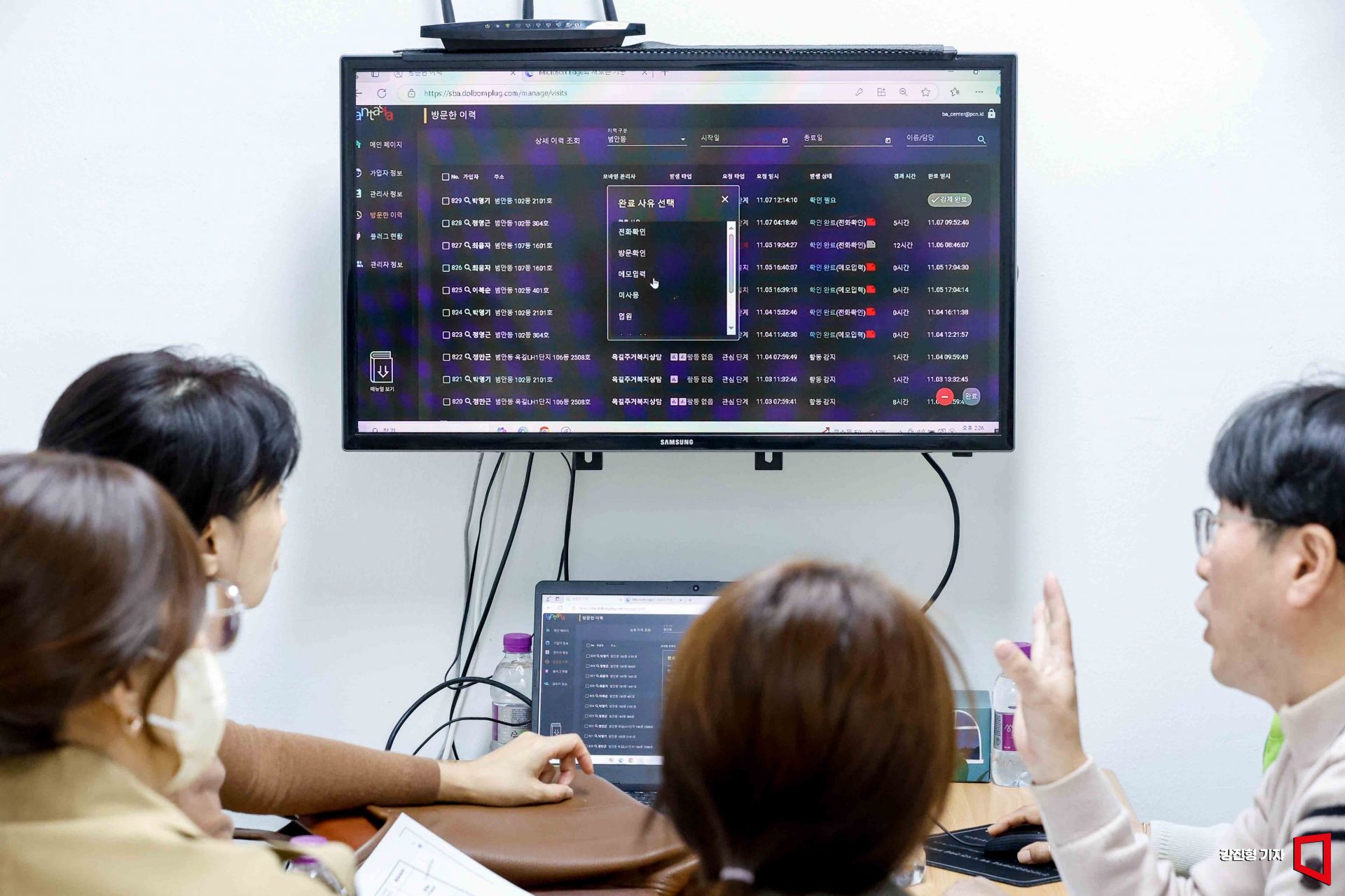
On a day in December last year when the biting cold wind was blowing fiercely, Halla 1 Complex in Jungdong, Bucheon City, Gyeonggi Province. Late at night, a 'beep beep' alarm sounded in the quiet management office. At the same time, a red danger signal blinked on the CarePlug status board.
Turning My Home into a Senior House ⑥-1 "No Need to Worry Even If I Collapse, Just Plug It into the Living Room"
The 'Care Plug' costs 2,750 KRW per month and just needs to be plugged into an outlet.
It detects electricity usage and brightness in the homes of elderly people living alone.
If no electricity is used or lights are off, it recognizes this as a danger signal.
A warning alarm sounds at the apartment management office.
Staff immediately contact and visit to check on the elderly resident's condition.
It detects electricity usage and brightness in the homes of elderly people living alone.
If no electricity is used or lights are off, it recognizes this as a danger signal.
A warning alarm sounds at the apartment management office.
Staff immediately contact and visit to check on the elderly resident's condition.
The signal originated from the home of Lee Kyungja (81) in Building 118. Kim Euncheol, the housing welfare team leader at Korea Land & Housing Corporation, called her. Beep, beep, beep. She didn't answer after three calls. He rushed straight to her home.
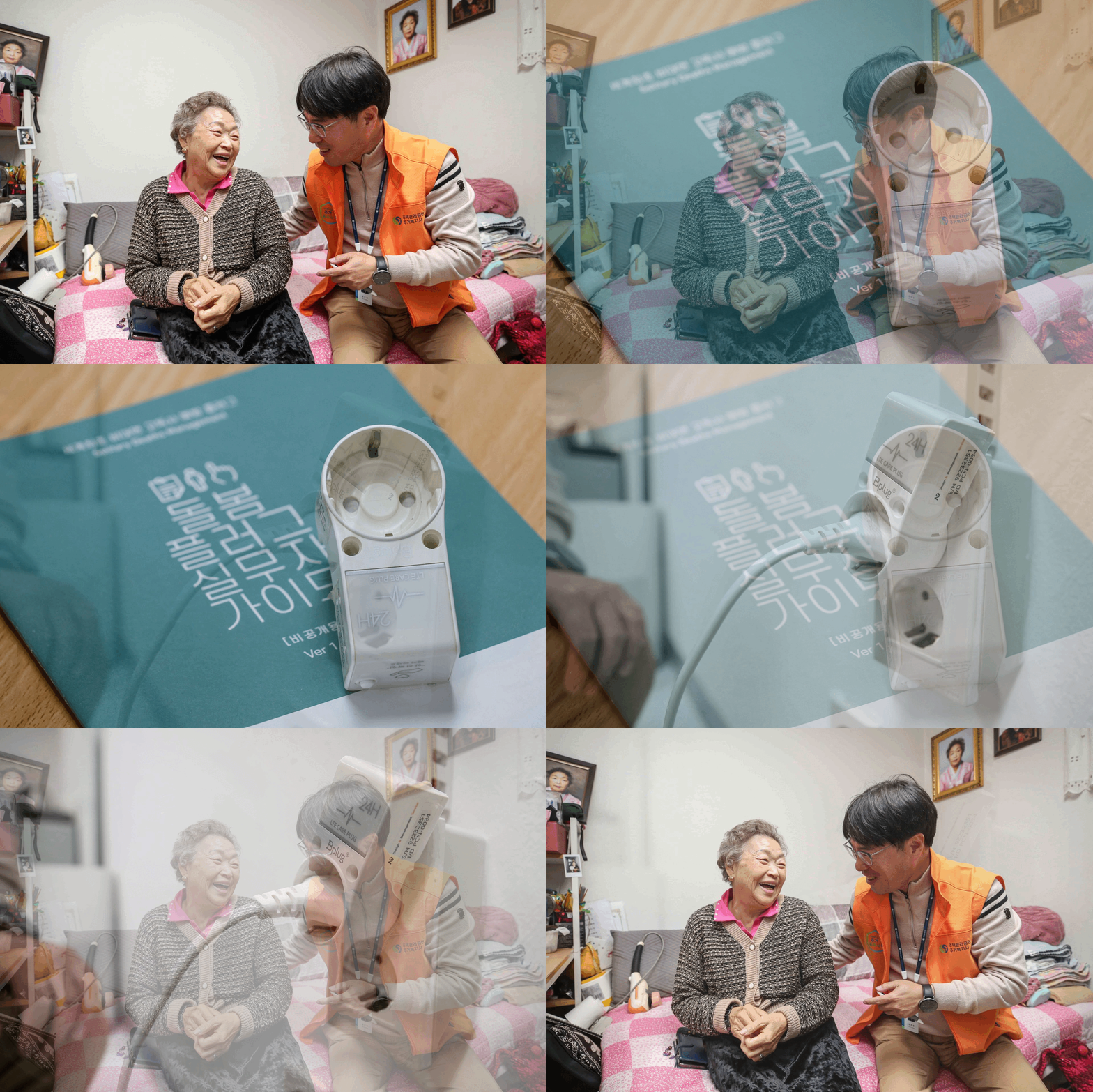
The 'Care Plug' is a small multi-tap that detects electricity usage and brightness. You just need to plug it into an outlet in the living room, kitchen, or bathroom. The sensor inside the plug detects whether the elderly person is using electricity or has turned on the lights, and sends real-time information to the apartment management office's monitoring board. That evening, the alarm was a warning about her condition.
Kim said, "I knocked on the door and rang the bell for over 10 minutes, and then she finally crawled out," recalling the situation. "If I had been even a little later, it could have been a disaster."


It was the Care Plug that saved her. Bucheon City, a pilot area for integrated care, provides Care Plugs to elderly households. Seniors who have the device installed are managed in two groups according to their health condition. Those who are relatively healthy are 'general', and those who have just been discharged from the hospital or have difficulty moving are 'high risk'. For 'general', an alarm sounds if there is no signal for 70 hours; for 'high risk', it's 14 hours. This woman, who lives alone and has symptoms of leg paralysis, falls into the 'high risk' category.
Halla Complex 1 is a permanent rental apartment, so staff from Korea Land & Housing Corporation like Kim reside there and take care of the residents. Recently, Kim visited her home again. As soon as she saw him, she became emotional, remembering that time. "It was when I had COVID-19. I had a high fever, couldn't turn on the lights or eat for two days. If no one had come that day, I wonder if I'd still be alive. The Care Plug saved me. Even if I collapse, someone will come running, so I feel safe living alone. After that day, I felt I could keep living in this home."
Elderly people of her generation tend to be frugal with themselves. Kim said, "Some households only turn on the TV instead of the lights to save on electricity bills, and some eat at the senior center so they don't use the rice cooker and only turn on the lights." He added, "We carefully monitor both the brightness and electricity usage graphs, and if we see any unusual patterns, we act immediately." Staff can also check the Care Plug dashboard on their personal smartphones, so they take turns monitoring alarms even at night.


▲Grandmother Kyungja Lee, a recipient of the Dolbom Plug service, is talking with Euncheol Kim, team leader of the Housing Management Corporation, who visited her home in Jungdong Halla Complex 1, Bucheon, on December 27 last year. Photo by Jinhyung Kang
원본보기 아이콘Bucheon City explains that the Care Plug is useful in densely populated apartment areas because it allows the status of elderly residents to be managed all at once. Bucheon is a first-generation new city, and as those who moved in 30 years ago have aged, the entire city is aging together. Of the total population (about 770,000), 18% (134,000) are elderly.
Currently, the Care Plug is being piloted in 233 households across four rental apartment complexes in Bucheon. The device costs 100,000 KRW, and the usage fee is 2,750 KRW per person per month. Hong Eunyoung, the integrated care team leader at Bucheon City, said, "There are more and more elderly people with mobility issues in private apartments and residential neighborhoods. As long as there are staff at management offices or community welfare centers to monitor, we can expand the Care Plug service to more areas."
In Halla Complex 1, where the woman lives, the health status of elderly residents is separately recorded. Kim said, "When an elderly person in critical condition is discovered and needs to be taken by ambulance, it's helpful to know what illnesses they have and what their lifestyle habits are, so we keep a record." In the 'Care Plug Recipient Status' file he always carries, this is what was written about her:
'Visual impairment, difficulty walking, symptoms of leg paralysis, gastritis.' 'Actively participates in yoga and qigong exercises.' 'Rational and positive attitude.' 'Strong will to continue living at home.'

IndexTurning My Home into a Senior House
- "I Want to Live in My Own Home Until the End"... Seeking the Right to Age and Die at Home
- "Can I Live Alone? That's My Worry... What You Need to Stay at Home Until 100"
- ¡°There¡¯s No Such Thing as a Free Lunch¡±: Wealthy and Highly Educated Seniors Are Coming
- "No One Is Healthy. Just Wait Until Professor Itmom Comes Home"
- "Doctor, I¡¯d be happy to pay if you could visit my home again"
- "I Felt Lost After Discharge... The Home Caregiver Saved Me Again, Ju"
- "If You Plug the Care Plug in Your Living Room... You Can Feel Secure Even Living Alone"
- "I Don't Want a Nursing Home... To Live in My Own House, I Must Avoid Dementia"
- "It's Hard to Go Out... Fitness Instructor Comes to Your Home"
- Do You Go to Senior Centers?... Come to the 'Rochiwon' Instead
- To Feel Safe Enough to Close My Eyes at Home, These Changes Are Necessary
- "It's My Neighborhood, but I'm 200th on the Waiting List"... Local Nursing Homes More Competitive Than Housing Subscriptions
- Turning Closed Schools into Nursing Homes... Why Aren't There Schools for Seniors?
- Today, Father Went Out Through the Wall, Not the Door, Again
- Senior Centers Providing Lunch: Is the Budget Only 70,000 Won for 30 People per Meal?
- Preparing for Retirement by Moving to a Smaller Home... "The Key Issue Is the Tax Burden"
- A Home in Old Age That Resembles Its Owner's Face
-

Reporter Sim NaYoung sny@asiae.co.kr
-

Reporter Park Eugenie genie@asiae.co.kr
-

Reporter Kang Jinhyoung aymsdream@asiae.co.kr
-
Edit Choo Myeonghoon chox2mh@asiae.co.kr
© The Asia Business Daily(www.asiae.co.kr). All rights reserved.

![[Exclusive] "Looking Beyond Financial Statements for Future Value"... IBK Injects 170 Billion Won into 72 Innovative Companies](https://cwcontent.asiae.co.kr/asiaresize/304/2026011314545989464_1768283699.jpg)