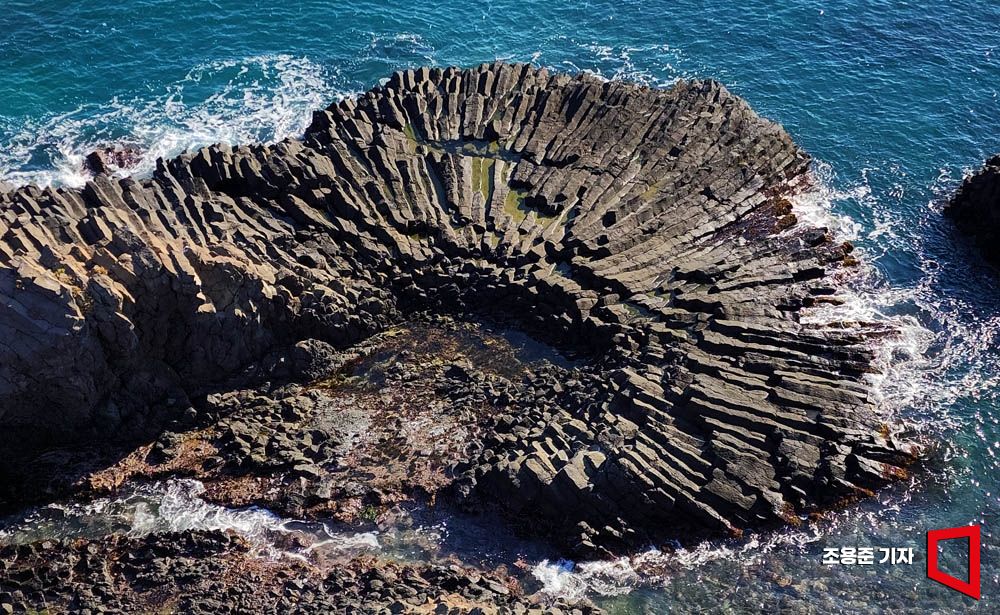
Columnar Joints Blooming Like Flowers
The 1.7km Columnar Joint Wave Sound Trail Offers a Spectacular View
Swaying Bridge, Pebble Beach, and Various Attractions
Last Year, 680,000 Visitors Made It a Prominent Marine Destination

Columnar joints spreading out in the shape of a fan flower as seen from the observation tower
원본보기 아이콘

Although the seasonal calendar says spring has begun, a fierce cold wave still lingers. I set out to experience the early spring atmosphere at a coastal village in Gyeongju, but the waves crashing against the breakwater are formidable. Pebbles, broken down by the force of the waves, tumble around in the coastal waters. Where the waves have danced, the mysterious columnar joints rise up, revealing themselves. These fan-shaped formations, known as the "flowers of the East Sea," are the Gyeongju Columnar Joints. The "Wave Sound Trail" that follows the columnar joints is a perfect place to soak in the slowly approaching spring. The trail connects the 1.7km stretch between Eupcheon Port and Haseo Port in Yangnam-myeon, Gyeongju. It doesn't matter which end you start from. Along the way, you can encounter the swaying bridge, fan-shaped columnar joints, an observation tower, pebble beach, and columnar joints that are tilted or lying down.
The Eupcheon-ri area of Gyeongju was a place rarely visited by travelers just over a decade ago. Although Gyeongju borders the sea, the countless tourist attractions and landmarks are concentrated in the city center, so few ventured out this far. Even those who visited the East Coast typically only stopped by sites like Gameunsa Temple Site or the Tomb of King Munmu before heading back. However, starting about ten years ago, something began attracting outsiders: the observation tower and the "Columnar Joint Wave Sound Trail."
The observation tower, which opened in 2017, had recorded a cumulative total of 2,143,445 visitors as of the end of December last year. Especially when including the approximately 390,000 tourists who visited the "Wave Sound Trail" along with the observation deck, a total of 680,000 people visited the columnar joints last year alone. This once-remote spot has now firmly established itself as a renowned marine tourism destination.


After parking at Eupcheon Port, a short walk brings you to the swaying bridge. Unlike a "swinging bridge," this is a "swaying" bridge. As you stand on the bridge, which floats above the sea, you'll experience undulating movements like waves. The dynamic motion is more intense than expected, making both adults and children a bit nervous. Once you get used to the swaying, it's fun to gently rock the bridge in rhythm with the regular sound of the waves. As you freely sway the bridge, it feels as if you're walking on the waves, becoming one with the sea.
Following the trail toward the observation tower, the vast East Sea and the columnar joints greet you on the left. Columnar joints are formed when lava from a volcanic eruption cools and contracts upon reaching the surface, creating polygonal column shapes through cracks. On the Wave Sound Trail, you can discover various shapes of columnar joints. Some are spread out like fans, some are "lying down" neatly like stacked firewood, and others are "tilted" like solidified hexagonal pencils leaning to one side.
The observation tower, the tallest structure along the coast, adds vibrant color to the sea. During the day, it serves as an observatory for viewing the coastal scenery, and at night, it stands as a guardian, illuminated by colorful lights.


Climbing the tower, you can see the fan-shaped columnar joints stretching out in all directions at a glance. Typically, as seen at the coast of Jeju's Gaetkkak, columnar joints stand vertically as hexagonal or quadrangular pillars. While some may be lying on their sides, it's rare to find ones that spread out in a fan or flower shape like this.
Resembling a single sea chrysanthemum, these columnar joints have earned the nickname "flowers of the East Sea." They are rare worldwide, making them valuable not only academically but also in terms of natural beauty.
Watching the rough waves of the East Sea rolling over the flower-like columnar joints, it feels as if all worries are washed away.

Leaving the tower, you head to the pebble beach. The pebble beach adds an element of fun to what could otherwise be a monotonous walking path. Smooth, rounded stones are clustered together, waiting for travelers. Step off the flat trail and try walking on the round pebbles. You can hear the sound of the pebbles rolling and clattering even more closely as the waves come in.
The wind carried by the waves seems to bring a hint of spring. As the name "Wave Sound Trail" suggests, the sound of waves breaking abundantly fills the air. Waves crashing against the rocks create milky white foam and play a lively melody. Perhaps it's the familiar sound of water, always comforting to hear. As the lullaby-like rhythm spreads, worries are broken into small pieces and scattered away with the receding waves.


Throughout the Wave Sound Trail, which combines wooden stairs, dirt paths, and pebble beach routes, there are benches, pavilions, and photo zones perfect for taking a break. When the sun sets, landscape lighting allows for nighttime visits as well. After walking along the columnar joint trail by the coast for about an hour, the lingering harmony of the waves and foam in your ears feels like a dream.
Near the Wave Sound Trail, there are must-visit sites when traveling the East Sea region of Gyeongju: the East and West Three-story Stone Pagodas at Gameunsa Temple Site (National Treasure No. 112) and the Tomb of King Munmu (Historic Site No. 158).
To the north of Eupcheon stand the Tomb of King Munmu and the stone pagodas at Gameunsa Temple Site. Cultural historian Go Yuseop once said in "My Unforgettable Sea" and "A Verse from My Gyeongju Travels" that the Tomb of King Munmu is a must-see. From Bonggil Beach, you can see the Tomb of King Munmu even more closely. The rocky islet just 200 meters from the shore is the underwater tomb of King Munmu. According to his will, "After my death, I will become a dragon to protect the nation and uphold Buddhism, so bury my remains in the East Sea," his body was cremated and buried at sea, and the rock was called Daewangam. The two stone pagodas standing majestically at Gameunsa Temple Site are also awe-inspiring.


◆Travel Notes
▲Directions= If coming from the Seoul metropolitan area, exit at Gyeongju IC on the Gyeongbu Expressway, pass through Seorabeol-daero toward the Bomun Tourist Complex. From Bomun, go through Churyeong Tunnel, Gameunsa Temple Site, and the Tomb of King Munmu toward Eupcheon Port to reach the columnar joints.
IndexCho Youngjun's Travel Log
- The Allure of a 1,000-Year-Old Man-Made Forest: The Captivating Autumn Foliage of Sangnim Forest
- Searching for a Fairy Tale Village Hidden in Winter
- Embracing the Sound of Waves... A Single Hae-guk Flower Blooms
- Blooming Beautifully... Blossoming Brightly... Spring Flower Road along the Seomjingang River
- Endless Waves... The Diverse and Contemporary Sea
-

Reporter Cho Yongjun jun21@asiae.co.kr
-
Edit Choo Myeonghoon chox2mh@asiae.co.kr
© The Asia Business Daily(www.asiae.co.kr). All rights reserved.





![[Report] "A Culinary Destination with a View of Gyeongbokgung"... Kim Dong-sun's High-End Dining Takes Over Gwanghwamun](https://cwcontent.asiae.co.kr/asiaresize/304/2026042114562634571_1776750985.jpg)

![[Gallery Stroll] Red Robe, Black Lines... Danjong Returns with the Face of Wounds](https://cwcontent.asiae.co.kr/asiaresize/304/2026042014183532691_1776662315.jpg)