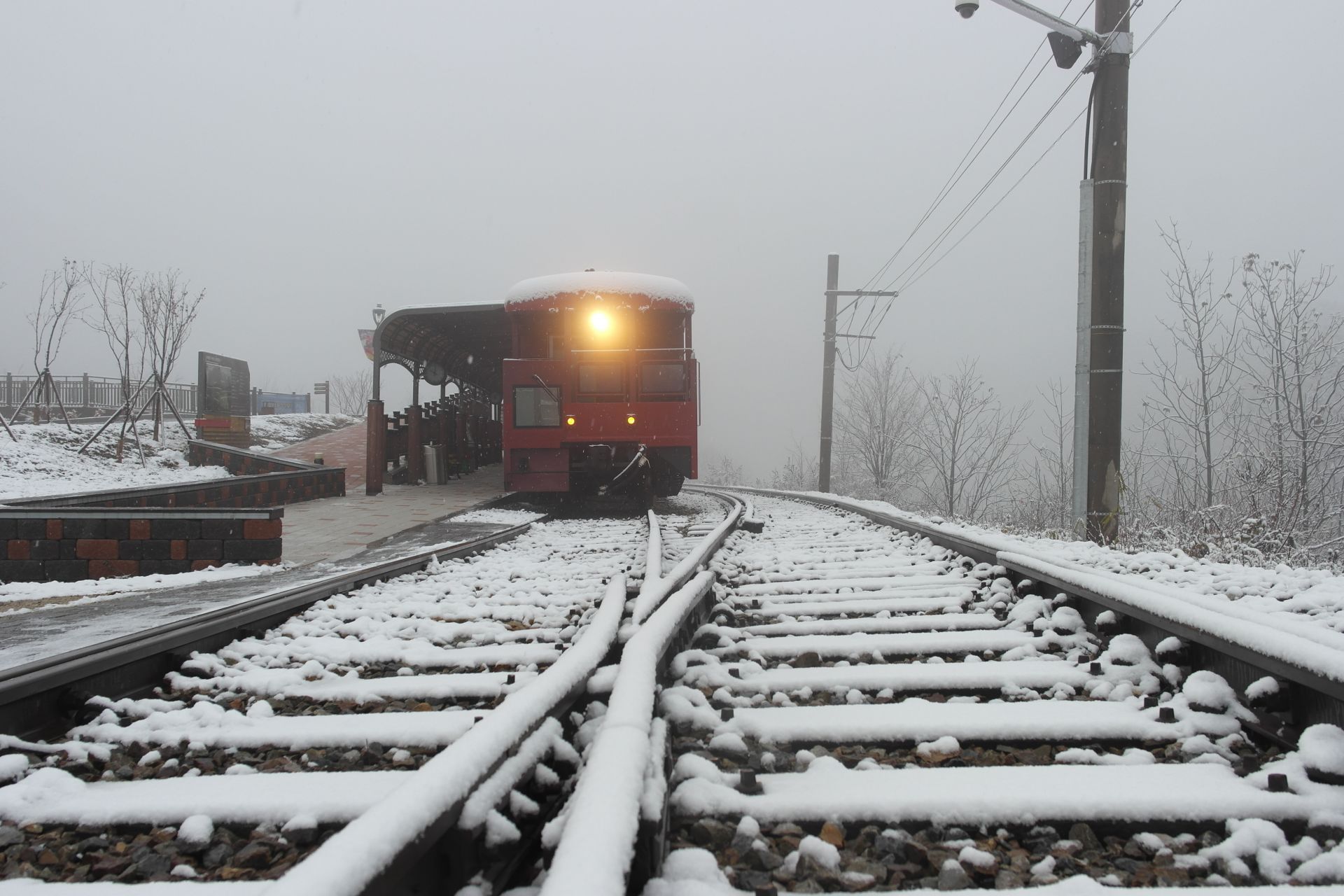

There is a village where every day is Christmas, 365 days a year. This is Bonghwa, a representative remote mountain village in Korea. With layers of mountains as a backdrop, the red roofs look cozy and charming. Along the grand and sturdy ridges of Obongsan, you can see snow blossoms blooming brightly in the mountain village. The view of snowy mountains from the switchback train zigzagging through the rugged mountain terrain is enough to make you think you are in Switzerland. And that's not all. There are also places where you can encounter your inner innocence and romance, such as Gapyeong Italian Village and Jeongeup European Village. As December arrives and the year comes to a close, how about visiting a fairytale village that feels like a dream if you're looking for a romantic destination? Here are some unique and exotic travel spots with special themes. Coincidentally, the Korea Tourism Organization has also selected 'Fairytale Villages in Winter' as its recommended destinations for December.
Bonghwa - Santa Village in Buncheon, where every day is Christmas, reached by train

There is a village where every day is Christmas. This is not a story from faraway Europe, but about Buncheon Santa Village in Bonghwa-gun, Korea. When you get off the slow-moving train at Buncheon Station, you are greeted by a quaint station with a red roof, surrounded by layers of mountains. The square in front of the station is filled with a Christmas atmosphere, regardless of the season.
The first thing that catches your eye is the cute model of Rudolph pulling a sleigh. In the sleigh pulled by four red-nosed, antlered Rudolphs, you can also spot Santa Claus with his white beard and red suit. If you get on the sleigh, you can sit next to Santa Claus and take a commemorative photo. Around the square, there are various photo zones lined up. Taking fun photos with playful Santas and colorful trains as backgrounds, you find yourself returning to the world of childhood innocence you had forgotten. You can write a postcard at the Santa Post Office to be delivered next Christmas, and enjoy riding the Rudolph Train, making the winter day feel all too short. A festival is also held starting from December 21st, centered around Buncheon Santa Village with its cluster of red-roofed houses.
If you board the V-Train (Baekdudaegan Canyon Train), it rattles along the V-shaped cliffs of the Baekdudaegan canyon. You'll see views only accessible by train, stop at Yangwon Station?the smallest station in Korea?and also at Seungbu Station, a remote mountain station famous for the saying, "Even the sky is three pyeong, and the flower garden is three pyeong." The Nakdong Jeongmaek Trail, where you can experience untouched remote scenery on foot, has also reopened after flood damage restoration. At the National Baekdudaegan Arboretum, you can meet the Baekdu Mountain tiger, and at Eokji Chunyang Market, you can experience the generous flavors and warmth of a mountain village market. There are about 650 pavilions in Korea, and 103 of them are located in Bonghwa. Enjoy the living pavilion culture at Bonghwa Pavilion Culture Center.
Samcheok - Exotic Scenery Like Switzerland, High1 Choo Choo Park

Along the grand and sturdy ridges of Obongsan, snow blossoms bloom brightly. The view of snowy mountains from the switchback train zigzagging through the rugged mountain terrain is so white it's almost blue. High1 Choo Choo Park in Samcheok is a railroad-themed resort, featuring the only switchback train in Korea, a mountain rail bike that winds down the old Yeongdong Line, a kids' cafe, an interactive indoor zoo, and private resort facilities, making it a fairytale-like train village destination. The switchback train, which first opened in 1963, ended its 50-year history in June 2012 with the completion of the Solan Tunnel, but High1 Choo Choo Park revived the switchback section. The exterior remains like a steam locomotive, while the interior is decorated in a classic style, adding to the attractions. It runs twice a day at 11 a.m. and 2 p.m. This unique train journey, which repeatedly advances and reverses in a zigzag up the steep mountain slopes, stops at Heungjeon Sakedo Village, where you can enjoy a bowl of banquet noodles sold by the village women's association, adding winter romance. High1 Choo Choo Park is also the starting point of the Coal Road Trail 7, which connects the abandoned mining areas of Yeongwol, Jeongseon, Taebaek, and Samcheok. Tongri Tantan Park, home to Korea's coal veins, is also nearby. The mine, now illuminated with media art, takes you from the "Path of Memories" to the "Path to Light," retracing the history and future of the coal mine.
Nearby, Dogye Glass Land is a cultural space that fuses art and regeneration by utilizing waste coal stone from coal mining operations, and the glassblowing demonstrations are a highlight. Facing it, Dogye Namunara is a space to easily understand forest resources and become familiar with wood, and its wooden playground is popular. In Dogye-eup, a 15-minute drive away, the Dogye-ri Longleaf Zelkova, a natural monument estimated to be over 1,000 years old, has protected the village for centuries.
Gapyeong - A Place to Meet Your Inner Innocence and Romance, Italian Village Pinocchio and Da Vinci


Italian Village Pinocchio and Da Vinci, the only Italian theme park in Korea, opened in May 2021 and recreates the architectural style of the Tuscany region of Italy on a spacious 33,000-square-meter site in Cheongpyeong-myeon. You can deeply feel the scent of Italian art and culture as you explore 23 themed spaces, each with its own story. Throughout your visit, you may feel as if you have truly arrived in Italy. As the name suggests, the main themes of Italian Village Pinocchio and Da Vinci are 'Pinocchio' and 'Da Vinci.' In official partnership with the Collodi Foundation, which honors Carlo Collodi, the author of 'The Adventures of Pinocchio,' the park offers permanent exhibitions and performances themed on Pinocchio. It also features exhibitions related to Leonardo da Vinci, the Renaissance artist, showcasing his achievements and legacy. In December, the 'Pinocchio & Little Prince Starlight Festival' is held, making the village sparkle all winter long. With a combined ticket, you can also visit the sister village, Petite France.
At Petite France, Korea's first French theme park opened in 2008, you can enjoy a themed trip inspired by Antoine de Saint-Exupery's novel 'The Little Prince.' At Jaraseom, an island created when Cheongpyeong Dam was completed in 1943, you can enjoy walking and camping. The Garden of Morning Calm, opened in 1994 near Mt. Chukryeong, offers the mystery and beauty of Korean gardens throughout the year. In the tranquil nature of Gapyeong, where art and culture coexist, why not rediscover the innocence and romance within you that has been hidden away by the hardships of life?
Daejeon - A Sunset Spot Flowing with Romance, Daedong Sky Park


On the way up to Daedong Sky Park, there is Daedong Sky Village, where houses were built close together, leaning against each other decades ago. The village was formed when people fleeing the Korean War settled in Daejeon and began building homes. Now, after many decades, you can encounter nostalgic old scenes here. Thanks to the murals painted throughout, the village feels cozy and charming. If you head in the opposite direction of the windmill, you will find Yeonae Rock. The reason for its name is interesting. As large families lived in small houses, young couples and lovers had nowhere to share their love, so they would often whisper sweet nothings at Yeonae Rock. Daedong Sky Park is home to a windmill, the symbol of the park. It is famous as a sunset spot, so make sure to arrive before the sun sets. Standing on the hill where the windmill turns, you won't want to miss the view of the sunset over the city. At the top of the stairs leading to Daedong Sky Park, you'll be greeted by a yellow star-shaped sculpture and countless colorful pinwheels. The view from in front of the newly renovated red windmill is more than worth the effort to climb up here. Take your time to enjoy the emotional sunset and the romantic night view of Daejeon's city center.
Soje-dong, where Daedongcheon flows, was a village for Japanese railway workers and engineers in the early 1900s. Today, remodeled buildings house cafes and restaurants, creating a cafe street. In September, the Daejeon Bread Festival is held here. Namganjeongsa is a Confucian school built in 1683 by Song Siyeol, a high-ranking official during the Joseon Dynasty. The yard features a small pond and a crape myrtle tree said to have been planted by Song Siyeol himself. Munchungsa is a shrine enshrining the memorial tablets of Song Byeongseon and Song Byeongsun, brothers and loyal subjects during the late Joseon Dynasty, who were ninth-generation descendants of Song Siyeol. At the entrance are a red gate and a memorial arch for loyal subjects, and inside the shrine are portraits of the brothers. Their descendants still live nearby and manage the shrine.
Jeongeup - Is it Europe or Jeongeup? European Village Engelberg


The bakery cafe on the first floor of Euromarket, reminiscent of the Engelberg Mansion in the European Village.
원본보기 아이콘There is no reason to think only of Jeongeupsa when you hear Jeongeup. European Village Engelberg will make you wonder if you are really in Jeongeup. Created by CEO Kim Byungjo as a wellness tourism resort, the village encompasses European culture with a focus on Germany. It feels as if you have suddenly traveled to Europe for the holidays.
The most accessible spot for travelers is the Euromarket Bakery Cafe. Decorated with antique props and furniture throughout, it resembles a European mansion. The bakery cafe operates an afternoon tea menu with tea and desserts by reservation only, and only those with reservations can tour the third-floor antique lounge. The lounge is filled with antique furniture and props, and you can tour it for about 30 minutes with a docent.
Within European Village Engelberg, the Oriental Tyrol Tea Museum is worth a visit. Director Lee Yangsu of Hyangwondang has collected tea utensils from Korea, China, and Japan for over half a century, and they are displayed here like the East within Europe. After leaving the tea museum, stroll through the European village. The double-pitched roofs and spires of the buildings, inspired by German villages, create an exotic atmosphere.
Other great winter destinations include Dalha, the Korean Song Village where you can learn about the history of Jeongeupsa and Korean pop music, E-Oil Space gallery cafe with permanent exhibitions of works by artists like David Hockney, and Jeongeup Ssanghwa Tea Street, where you can warm up with a hot drink.
IndexCho Youngjun's Travel Log
- The Allure of a 1,000-Year-Old Man-Made Forest: The Captivating Autumn Foliage of Sangnim Forest
- Searching for a Fairy Tale Village Hidden in Winter
- Embracing the Sound of Waves... A Single Hae-guk Flower Blooms
- Blooming Beautifully... Blossoming Brightly... Spring Flower Road along the Seomjingang River
- Endless Waves... The Diverse and Contemporary Sea
-

Reporter Cho Yongjun jun21@asiae.co.kr
-
Edit Park Chunghun parkjovi@asiae.co.kr
© The Asia Business Daily(www.asiae.co.kr). All rights reserved.



![[Report] "A Culinary Destination with a View of Gyeongbokgung"... Kim Dong-sun's High-End Dining Takes Over Gwanghwamun](https://cwcontent.asiae.co.kr/asiaresize/304/2026042114562634571_1776750985.jpg)

![[Gallery Stroll] Red Robe, Black Lines... Danjong Returns with the Face of Wounds](https://cwcontent.asiae.co.kr/asiaresize/304/2026042014183532691_1776662315.jpg)