Rotting Experiment with Signature Burgers from Six Brands
Asia Economy began a burger rotting experiment on October 7 last year, and as of the 15th, it has reached its 100th day. To verify the rumor circulating on YouTube and other social media platforms that "burgers do not rot," six major burger franchise signature products (McDonald's, Mom's Touch, Lotteria, Burger King, KFC, Five Guys) were selected as test subjects. After 100 days of observation, all products left at room temperature showed signs of decay, with varying degrees of mold growth on the buns and patties.


Over the 100 days, the order of fastest to slowest burger decay was: 1) Five Guys Bacon Cheeseburger, 2) Mom's Touch Thigh Burger, 3) KFC Zinger Burger, 4) Burger King Whopper, 5) Lotteria Bulgogi Burger, and 6) McDonald's Big Mac.
Five Guys: Unrecognizable Shape
In particular, the top buns of the first four burgers?from the Five Guys Bacon Cheeseburger to the Burger King Whopper?were covered in dark blue and yellowish mold after 100 days. The Five Guys Bacon Cheeseburger was especially unrecognizable, with cloud-like mold covering everything except some melted cheese. The Mom's Touch Thigh Burger also lost all recognizable shape of its patty and vegetables, except for the top and bottom buns.
Additionally, both the KFC Zinger Burger and Burger King Whopper had their top buns completely overtaken by mold, and the beef and chicken patties were reduced to mere shapes, with no trace of their original appearance at the start of the experiment. Most of the test burgers appeared to have stopped decaying temporarily, becoming very dry. The moisture that had condensed inside the plastic containers also disappeared.
The Lotteria Bulgogi Burger, which decayed more slowly, developed a long white band of mold on the bottom bun, and the patty had hardened to the point where no moisture could be detected.

100th Day of Hamburger Decay Experiment (clockwise from top left) Five Guys Bacon Cheeseburger, Mom's Touch Spicy Burger, KFC Zinger Burger, Burger King Whopper. Photo by Jin Hyung Kang
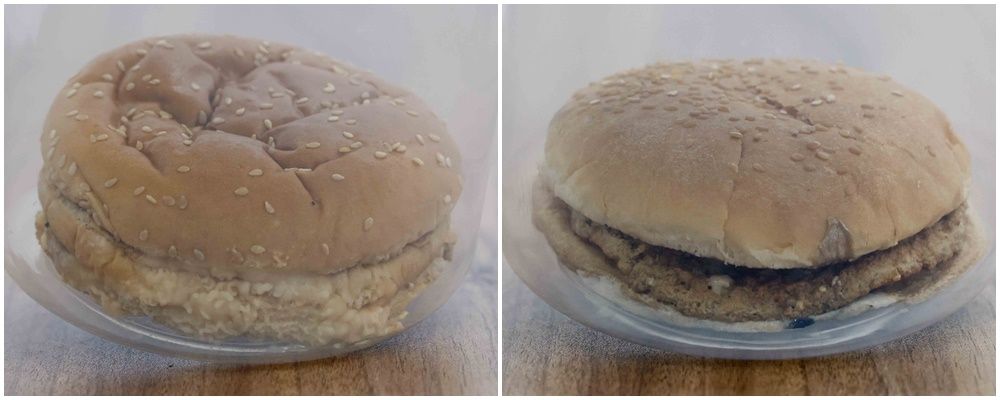
원본보기 아이콘The slowest to change was the McDonald's Big Mac. Aside from some sauce and vegetables that had spilled around the bun, there was little visible change after 100 days. The overall size of the burger did shrink slightly due to evaporation of moisture from the patty and ingredients, but the decay appeared to have stopped.
Decay Rate Varies by Moisture Content
All six burgers were tested under the same conditions over the past 100 days, but decay rates varied significantly. This appears to be due to differences in moisture content. The Five Guys Bacon Cheeseburger, which decayed the fastest, had a thick beef patty and a relatively large amount of moisture-rich vegetables such as tomatoes, onions, lettuce, and saut?ed mushrooms. For the Mom's Touch Thigh Burger and KFC Zinger Burger, the fried chicken patties retained moisture during the frying process, which the burger companies say contributed to faster decay.
On the other hand, the McDonald's Big Mac and Lotteria Bulgogi Burger contained less vegetables compared to the others, even though they included lettuce. Their patties were mostly made of beef, which is lower in moisture content.
Previously, Professor Ha Sangdo of Chung-Ang University's Department of Food Science and Engineering presented at the 2015 Public Health Academic Conference that, although there were differences in the onset of decay among fast food burger brands, all developed visible mold within 3 to 8 weeks. He explained, "For burgers that decayed more slowly even without added preservatives in the bread, it appears that the flour used was fresher and the baking temperature was higher, resulting in lower initial bacterial counts and less general bacterial contamination compared to other brands."

Big Mac Stored in Refrigerator for 100 Days: No Mold at All
Meanwhile, the Big Mac, which often appears in overseas YouTube experiments, was also kept in a refrigerator for 100 days to observe changes compared to room temperature storage. Upon inspection, its appearance was nearly unchanged from the day of purchase. Both the double patties and most of the ingredients, such as lettuce and cheese, maintained their original form. No mold was found anywhere on the burger, including the buns. There was also no significant change in smell to indicate spoilage.
Asia Economy will continue to observe under the same conditions in the new year to determine which burger resists visible decay the longest.
IndexHamburger Crispy
- Not a Single Mold Found... The 'Phoenix Hamburger' Survived for a Week
- Two Weeks of Rotting Hamburgers: "McDonald's Still Looks Fine?"
- "Phoenix Burger?"... After 3 Weeks, Only 2 Survived
- Big Mac Remains Intact After 100 Days...How It Differs from Other Burgers
-

Reporter Kim Heungsoon sport@asiae.co.kr
-
Edit Kim Yumi ymkim91@asiae.co.kr
© The Asia Business Daily(www.asiae.co.kr). All rights reserved.