

Some roads in Seoul temporarily closed... Commute is 'hell'
Record-breaking snowfall in Seoul and the metropolitan area for the first time in 117 years led to road closures in some areas and school closures in certain districts.
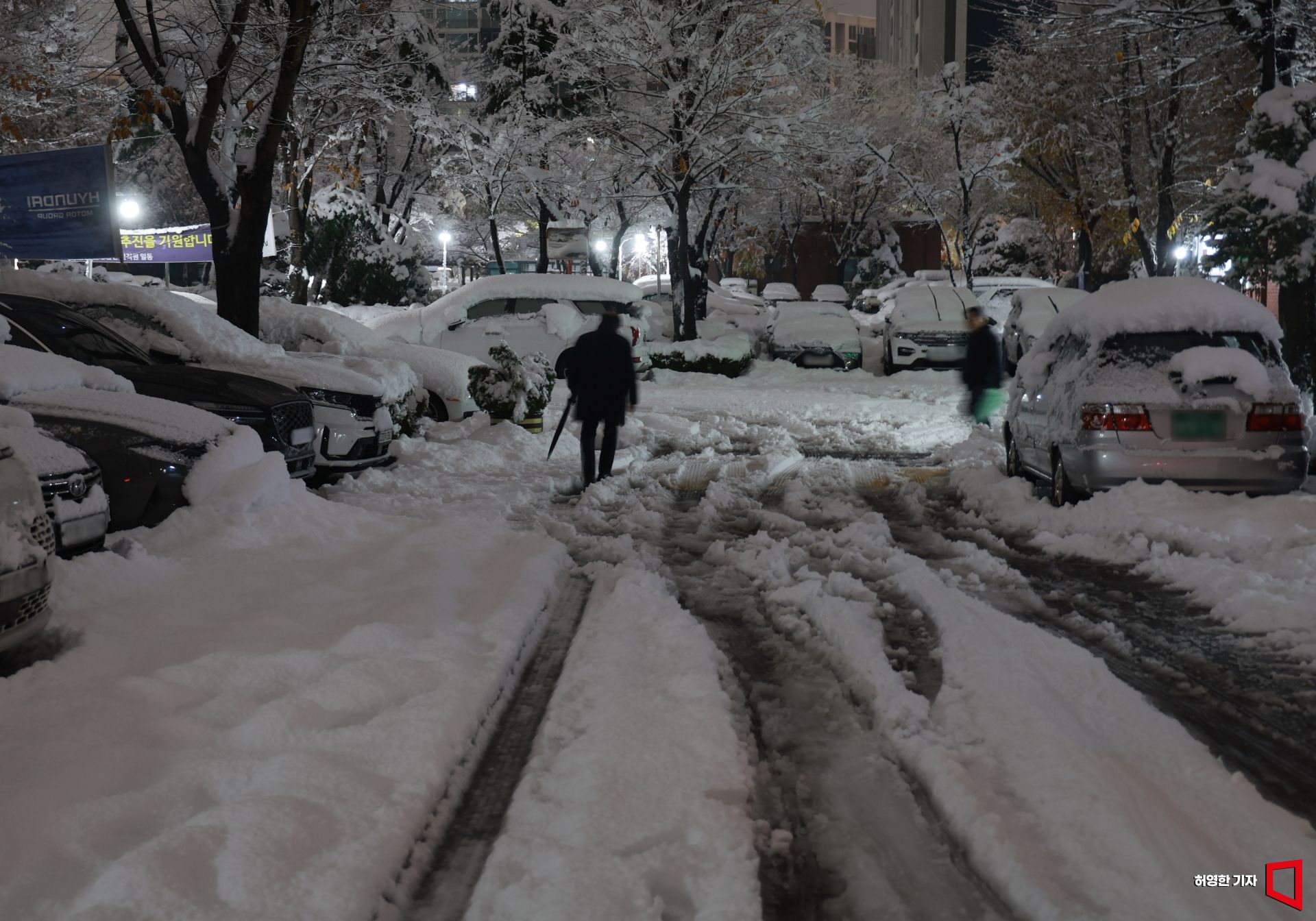
According to the Korea Meteorological Administration on the 28th, as of 8 a.m., snow accumulation reached 47.5 cm in Yongin (Baegam-myeon, Cheoin-gu), 43.0 cm in Suwon, 42.4 cm in Gunpo (Geumjeong-dong), 41.2 cm in Gwanak-gu, Seoul, and 40.7 cm in Anyang (Manan-gu), Gyeonggi Province?enough to reach the knees of an adult in most parts of the metropolitan area. Heavy and wet snow, falling at a rate of 1 to 3 cm per hour, was also forecast for central regions. Up to 15 cm of snow was expected in the mountainous areas of Jeju Island and Chungbuk. In particular, heavy snow warnings were issued for Seoul and Incheon, and snow advisories for northern Gyeonggi and inland central regions.
This type of wet snow is two to three times heavier than dry snow. If 50 cm accumulates over a 100 m² area (about 30.25 pyeong), it weighs about 5 tons. With continued snowfall on top of already significant accumulation and low temperatures preventing melting, there is an increased risk of collapse and other damages, requiring extra caution.
As heavy snow concentrated in Seoul and Gyeonggi, where residential and transient populations are high, citizens faced major inconveniences during their commutes. On this day, Seoul City closed six roads, including Waryong Park Road, Bugaksan-gil, Inwangsan-gil, Samcheong Tunnel, Seodal-ro, and Heukseok-ro. Tree removal work was underway in these sections due to fallen roadside trees.
In Gyeonggi Province, schools took measures such as closures or adjusted start times. The Gyeonggi Provincial Office of Education strongly recommended closure for about 4,700 kindergartens, elementary, middle, and high schools in the area due to the historic snowfall. School principals have the discretion to close schools in response to disasters. Especially in areas like Yongin, notices were sent to parents via e-Notification, informing them of school closures and that both care services and after-school classes would not be operated.
The Gyeonggi Provincial Office of Education sent an emergency notice to schools stating, "We strongly recommend that all school principals in Gyeonggi Province, including elementary, middle, high, special, and other types of schools, close today to prevent accidents and casualties among students on their way to and from school."
Due to the heavy snow, some residents in Gyeonggi had to evacuate to village halls and other shelters. A total of 56 people from 36 households stayed in temporary accommodations or with relatives. There were 1,280 cases of fire and safety responses due to the snow.
Roads, flights, and sea routes 'frozen'... 70,000 tons of de-icer used
With the heaviest November snowfall in Seoul in 117 years, the unprecedented 'first snow' caused significant disruption, especially to transportation. Local governments increased bus and subway operations, but train delays still occurred due to snow accumulation.
As heavy snow concentrated in Seoul and Gyeonggi, where residential and transient populations are high, citizens complained of severe inconvenience during their commutes. On this morning, both directions of the Suin-Bundang Line experienced train delays, as snow had accumulated on the trains at the depot and on the tracks, requiring de-icing operations. Air and sea routes were also blocked. A total of 99 passenger ships on 76 routes, including the Incheon-Baengnyeong route, were suspended, and 93 flights were canceled.
Local governments and Korail increased the frequency of buses and trains. Seoul extended rush hour intervals by 30 minutes to increase public transportation services. Korail also added 10 extra subway runs in the metropolitan area: 6 on Line 1, 2 on the Gyeongui-Jungang Line, 1 on the Gyeongchun Line, and 1 on the Gyeonggang Line.
Due to the heavy snow, some residents in Gyeonggi had to evacuate to village halls and other shelters. A total of 56 people from 36 households stayed in temporary accommodations or with relatives. There were 1,280 cases of fire and safety responses due to the snow.
From the afternoon of the 26th to the morning of the 28th, a total of 71,639 tons of de-icer was spread on roads nationwide. A workforce of 14,937 people and 6,900 pieces of equipment were mobilized for snow removal. The Ministry of the Interior and Safety and local governments sent emergency text alerts urging people to refrain from outdoor activities and driving, and to use public transportation for commuting.
Power and water outages... Damage in Mapo, Yongin, Hwaseong
On the 28th, power and water outages continued in parts of Seoul and Gyeonggi Province.
According to Korea Electric Power Corporation, power outages were reported in parts of Seoul around 6 a.m. Outages occurred in Yeomni-dong, Gongdeok-dong, and Seongsan-dong in Mapo-gu, cutting power to 750 households, with 68 still without power as of 8:20 a.m.
Power outages also occurred in Gyeonggi Province. Korea Electric Power Corporation stated that outages occurred in Naeri, Bongdam-eup, Hwaseong City at 2 a.m., and in Hongbeom-ri, Seosin-myeon at 4 a.m., prompting restoration efforts. In Seocheon-dong, Giheung-gu, Yongin, outages at two apartment complexes affected over 1,200 households.
A KEPCO official explained, "Some outages occurred due to problems with utility poles or power lines caused by the heavy snow. Restoration is difficult because access for personnel and equipment is limited by the snow." KEPCO is working to identify the causes and exact number of affected households while carrying out restoration.
In Changjeon-dong, Mapo-gu, water outages also occurred due to the heavy snow. According to the Seoul Arisu Waterworks Headquarters, water supply to 270 households in Changjeon-dong was cut off from 3 a.m. to 7:30 a.m. A tree fell due to the snow, severing the power line connected to the reservoir, which caused a blackout and subsequent water outage. Restoration has now been completed.
With another heavy snowfall overnight, snow accumulation in the metropolitan area exceeded 40 cm. As of 8 a.m. on the 28th, accumulation was 47.5 cm in Yongin (Baegam-myeon, Cheoin-gu), 43.0 cm in Suwon, 42.4 cm in Gunpo (Geumjeong-dong), 41.2 cm in Gwanak-gu, Seoul, and 40.7 cm in Anyang (Manan-gu), Gyeonggi Province. In Suwon, this is the highest recorded snowfall not only for November but for the entire winter since weather observations began in 1964. Suwon had already accumulated about 30 cm the previous day, and with more snow overnight, the total exceeded 40 cm.
-

Reporter Kim Youngwon forever@asiae.co.kr
-

Reporter Lee Jieun jelee0429@asiae.co.kr
-

Reporter Yoo Byeongdon tamond@asiae.co.kr
-

Reporter Seo Jiyeong zo2zo2zo2@asiae.co.kr
-

Edit Park Chunghun parkjovi@asiae.co.kr
© The Asia Business Daily(www.asiae.co.kr). All rights reserved.