Editor's NoteThe freedom of assembly and association is a fundamental right guaranteed by the Constitution. However, as the inconvenience caused by assemblies clashes with the pursuit of happiness?another basic right?public consensus has started to fracture. Some assemblies even exploit loopholes in the law. Asia Economy examines the various debates and alternatives surrounding the "Act on Assembly and Demonstration" (Jipsibeop) in a four-part series.
① Overlapping Noise, Difficulties in Identifying the Source
Manipulating Speaker Volume to Evade Regulations
Experts: "Loudspeaker Regulations Need to Be Revised"
"My ears hurt as if they are going to be torn apart."
On the 9th, Gwanghwamun Square in Jung-gu, Seoul, was crowded with an estimated 100,000 people according to the organizers (around 30,000 according to the police). It was not the protesters but the noise they made that broke through the police's defensive barrier. When the organizers turned on the speakers, the rally chants echoed across the entire 12-lane road of Gwanghwamun.
Citizens avoiding the protest stopped in their tracks and covered their ears. Dong Jin Lee (29), who runs a cafe near Gwanghwamun, said, "I come to work every weekend with the mindset to endure and persevere, but it seems the noise is getting worse."
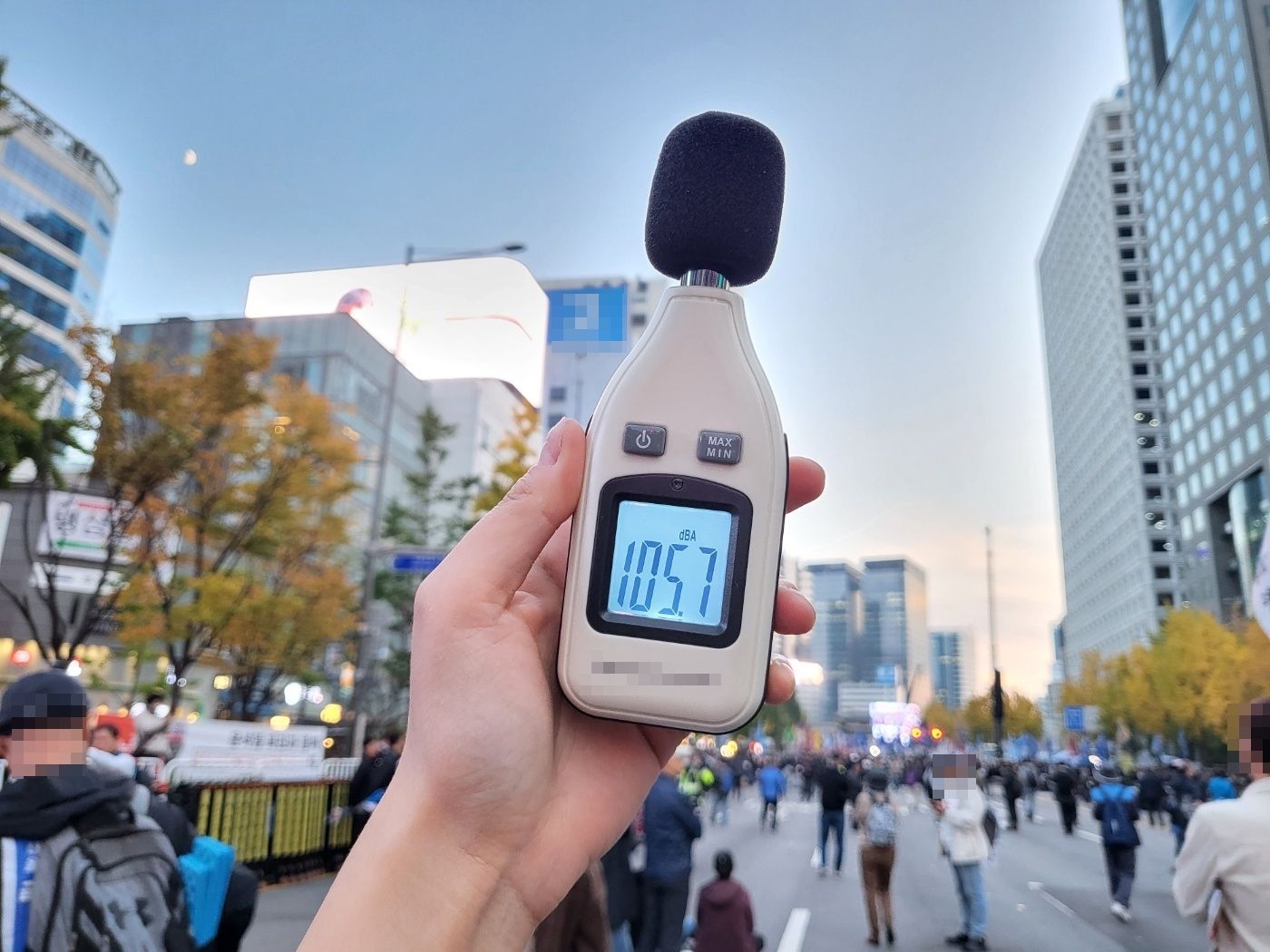
On that day, the noise at the rally in Gwanghwamun Square was directly measured, showing a maximum noise level of 105.7 dB and an equivalent continuous noise level of 95 dB over 10 minutes. This noise level is similar to that inside a factory.
Making Noise for Five Minutes, Then Resting... Police Struggle to Crack Down on Assembly Loopholes
The police measure noise in two ways according to standards set by presidential decree: equivalent continuous noise level and maximum noise level. The equivalent continuous noise level is the average noise over a 10-minute period, and in urban areas such as plazas?excluding residential areas?it must not exceed 70 dB during the day.
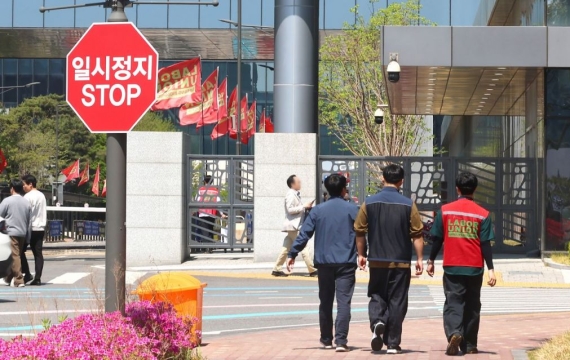
The maximum noise level is considered a violation if it exceeds 90 dB three or more times within an hour. When this happens, the police issue an initial noise maintenance order to the assembly organizers, and if the noise continues, they can order the assembly to stop.
The problem arises when multiple groups generate overlapping noise simultaneously. Especially during large-scale assemblies, it is common for several groups or individual protesters to use loudspeakers, making it difficult to identify the source of the noise. Current laws do not provide regulations for separating and calculating overlapping noise for enforcement, so when noises from several groups are mixed, it is difficult to impose sanctions even if the permitted level is exceeded.
In fact, on this day at Gwanghwamun Square, some individual protesters using loudspeakers could be seen among the crowd. A police official explained, "When three or four loudspeakers are used simultaneously at an assembly site, it becomes difficult to measure the equivalent continuous noise level, which requires averaging noise values over ten minutes," adding, "We monitor the protesters all day and issue a noise maintenance order if the maximum noise level is violated."
Some protesters cleverly evade noise measurement standards. A police officer encountered at an assembly site in Seocho-gu, Seoul, said, "Some have figured out that to measure the equivalent continuous noise level, the same dB noise must be maintained for ten minutes, so they avoid sanctions by turning the speakers on and off at intervals," and added, "Some protesters adjust the sound almost like audio experts, staying right at the ambiguous boundary of the noise regulations."
To crack down on such tactics, the National Police Agency in 2020 announced a revision to the enforcement decree of the Jipsibeop, including maximum noise level as a measurement standard. However, the officer said, "Since the maximum noise level is only considered a violation if the standard is exceeded three or more times within an hour, some avoid sanctions by stopping the noise after exceeding the limit twice."
Recommendation to Rest 1.5 Times the Loudspeaker Usage... Immediate Response to Noise in the US and Japan
On the 9th, protesters demanding the resignation of the administration and police faced off across the road at Gwanghwamun Square in Jongno-gu, Seoul.
In Japan, if the instantaneous maximum noise at a point 10 meters from the protest site exceeds 85 dB, police can order a stop. Failure to comply can result in up to six months in prison or a fine of up to 200,000 yen (about 1.8 million KRW). Additionally, most local governments specify in ordinances that after using a loudspeaker for 10 minutes, it must be stopped for at least 10 minutes or for 15 minutes.
In New York, USA, a separate noise permit application must be submitted in addition to the assembly notification when using loudspeakers. If the assembly continues for several days, the noise permit must be renewed daily. Lee Woonghyuk, professor of police studies at Konkuk University, emphasized the need for improvement, saying, "Given the tranquility citizens should enjoy in their homes, the current dB standards are too lenient."
Lee Heehun, professor of law and police studies at Sunmoon University, said, "It could be an alternative to make it mandatory to report the type and number of loudspeakers in advance when filing for an assembly," and added, "The police should set maximum dB limits according to the type of loudspeaker, and impose sanctions the moment those limits are exceeded."



!["Please Help Us": How Much Do Those Bowing 90 Degrees These Days Actually Earn? [Data Pick]](https://cwcontent.asiae.co.kr/asiaresize/323/2026052010120870131_1779239528.png)