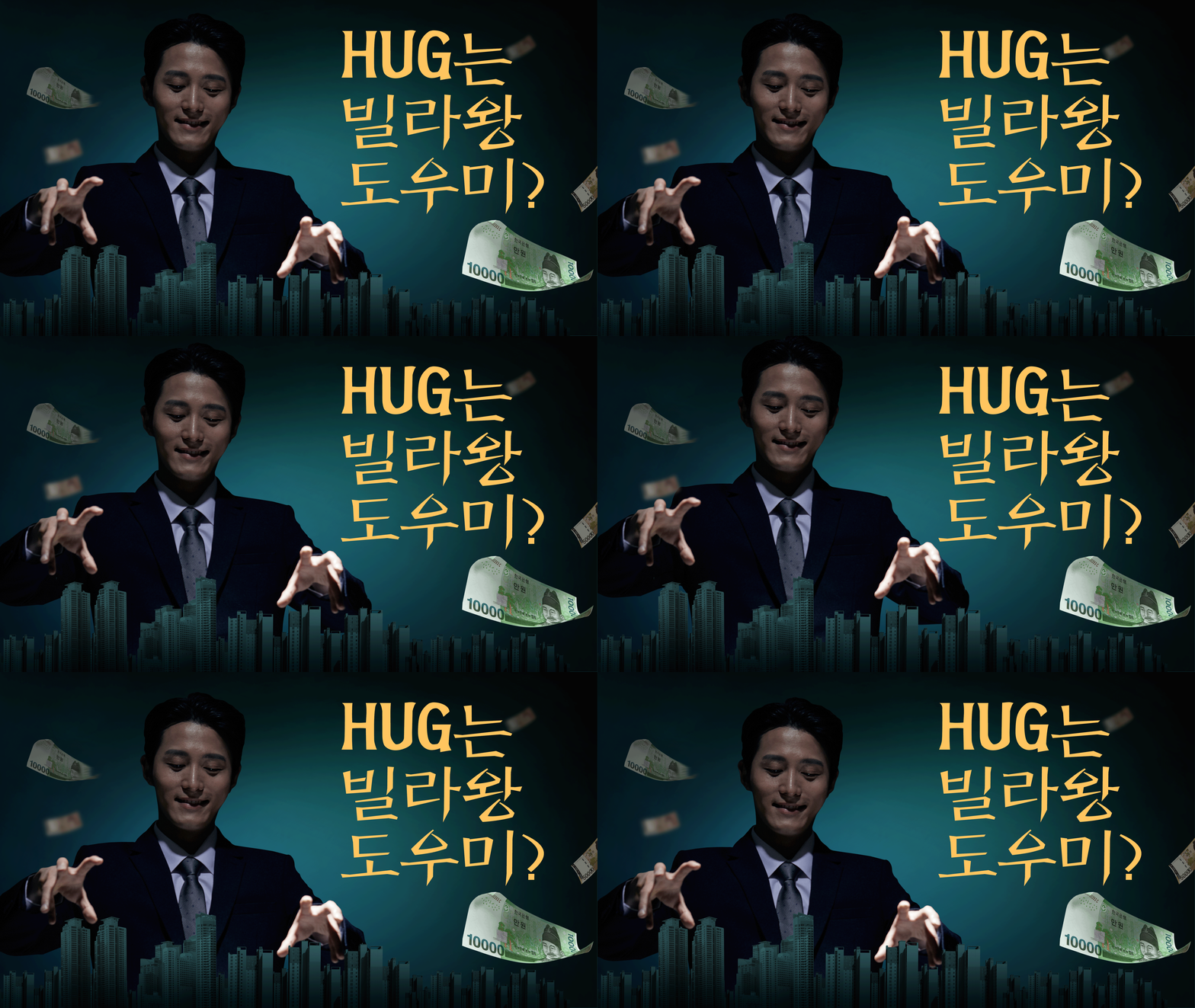
The Korea Housing & Urban Guarantee Corporation (HUG), which received over 4 trillion won in government funds to resolve the nationwide Jeonse fraud crisis, has failed to recover these funds, effectively encouraging the emergence of so-called "Villa Kings"?the very source of the crisis. There is growing criticism that HUG, by effectively 'encouraging' corporations that won only Jeonse scam villas (multi-family and row houses) at court auctions to re-lease them, is increasing the risk of a second wave of Jeonse fraud.

HUG's Complicity in Zero-Capital Gap Investments in Jeonse Fraud Properties
According to the "HUG Deposit Recovery Manual for Auction Winners" obtained by Asia Economy through the office of Kim Eunhye, a member of the National Assembly's Land, Infrastructure and Transport Committee, HUG allows auction winners to voluntarily repay (arbitrary repayment) their debt (deposit) to HUG by signing new lease contracts or securing funds through other means. In other words, HUG is encouraging auction winners to re-lease auctioned properties.
As a housing guarantee institution, HUG returned Jeonse deposits to tenants (those who applied for HUG's Jeonse Deposit Return Guarantee) on behalf of landlords who failed to return the deposits after Jeonse contracts ended, following the Jeonse fraud crisis that erupted in 2022. HUG then acquired the tenant's claim (right to receive money) and attempted to recover the substitute payment (deposit) by auctioning the property. For auction winners, this meant that after paying the auction price to the court, they were supposed to return the deposit supported by HUG (if the victim tenant had both the right to oppose and the right of preferential repayment, and had registered the leasehold).
However, auction winners who acquired Jeonse scam villas and re-leased them did not repay the funds HUG had provided to previous tenants. Since there is no institutional mechanism for HUG to recover the rental income from auction winners, they used the new lease deposits to acquire more Jeonse scam villas. With legal safeguards lacking and HUG not actively pursuing collection, these auction winners became Villa Kings through zero-capital gap investments.

What Happens to New Tenants’ Deposits if HUG Re-Auctions?
In this situation, if HUG attempts to recover its funds, new tenants who moved into the auctioned villas could find themselves out on the street. HUG may re-auction the property to recover its funds, but the new tenant's right to claim their deposit is subordinated, making it difficult for them to get their money back. If the new owner asserts ownership after HUG’s re-auction, tenants could be forced to vacate with no recourse.
Han Mundo, a professor in the Department of Real Estate at Soongsil Cyber University, said, "HUG’s sluggishness in recovering deposits can be seen as turning a blind eye to the re-leasing of scam villas by auction winners in order to get their money back," adding, "There needs to be a strong measure to prevent auction winners from bringing in tenants unless they have fully repaid the deposit to HUG."
Representative Kim emphasized, "There is a growing risk of a new form of Jeonse fraud," and "Institutional improvements are needed to block malicious auction participants who exploit auctions as a means of Jeonse fraud."
Of the 8,929 villas in the Seoul metropolitan area (Seoul, Gyeonggi, Incheon) for which HUG applied for auction between 2022 and the end of September this year, only 547 units (6%) had their deposits fully recovered from auction winners. For the remaining 8,382 units (94%), the recovery process is still ongoing. This means that either the auction is still in progress or, despite being auctioned, the deposit has not yet been recovered.
Lee Juhyun, a senior advisor at real estate auction specialist company GGI Auction, pointed out, "Once auction winners realized they didn’t have to return the deposit after winning one or two units, they started increasing their purchases," adding, "If corporations had been required to repay billions of won in deposits each time they acquired a villa, would they have been able to buy so many?" He continued, "HUG’s complacent response to Jeonse scam property auctions has essentially created the Villa Kings."
The number of properties submitted for auction is rapidly increasing, but the number of cases where the deposit has been fully recovered remains stagnant. The recovery rate dropped from 15% (233 out of 1,525 units) in 2022 to about 9% (303 out of 3,258 units) last year, and as of September this year, only 11 out of 4,146 units (0.3%) had their deposits fully recovered.
The number of cases in which HUG, unable to recover the deposit from the auction winner, re-auctioned the scam villas over the past two and a half years was only 11: three in 2022, four in 2023, and four in 2024. HUG initiates a re-auction if the auction winner fails to voluntarily repay the deposit within six months. From 2022 to the end of September this year, there were a total of 1,244 cases where HUG failed to recover the Jeonse deposit through auction and ended up winning the property itself. Of these, 659 were in Seoul, 361 in Incheon, 223 in Gyeonggi (Bucheon, Gimpo, Goyang, Paju, Anyang, Suwon), and one in Busan.
The government now faces criticism for failing to prevent the signs of a second Jeonse fraud crisis due to HUG’s complicity, as well as for wasting taxpayer money. According to the office of Min Hongcheol, a member of the National Assembly's Land, Infrastructure and Transport Committee, the government has provided a total of 5.4739 trillion won to HUG over the past four years to address deficits caused by the Jeonse fraud aftermath.
-

Reporter Kwon Hyeonji hjk@asiae.co.kr
-
Edit Park Chunghun parkjovi@asiae.co.kr
© The Asia Business Daily(www.asiae.co.kr). All rights reserved.