'K-Wind' with 70% Domestic Components Aims for Greater Competitiveness Than Europe [Pursuing Independence in Wind Power] ①
A Visit to Doosan Enerbility’s Changwon Wind Power Plant
Annual Production Capacity of 30 Turbines
A Network of 150 Wind Power Partners
Formation of ‘K-Wind’ Team Korea
‘K-Wind’ Under National Project Development
10MW Offshore Win

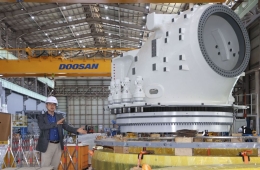
Main frames, hubs, and other key equipment for wind turbines are waiting to be assembled at Doosan Enerbility's wind power factory in Changwon. Doosan Enerbility
View original imageOn April 15, upon entering the Doosan Enerbility Changwon Plant in Changwon, Gyeongsangnam-do, several massive wind turbine main frames placed on safety work platforms immediately caught the eye. When generators and various electronic devices are attached to these main frames and the hub is combined, the wind turbine system is completed.
Doosan Enerbility originally operated this facility as a boiler steam piping plant for thermal power stations but converted it into a wind turbine factory in 2023 to align with the era of renewable energy. A crane capable of lifting up to 150 tons was installed on the ceiling. Nam Kyungmin, head of the Doosan Enerbility wind power plant, said, "We now have the capacity to produce about 30 wind turbines a year," adding, "If we expand our facilities in the future, we could increase output to up to 40 units."
A plant that once manufactured thermal power equipment has now been transformed into a place that produces wind turbines. This scene was a clear indication that the center of gravity for Korea's heavy industry is gradually shifting.
On one side of the Doosan Enerbility Changwon Plant, a 10MW offshore wind turbine—currently being developed as a national project—could be seen. The 10MW-class turbine development project, known as 'K-Wind,' aims to use more than 70% domestically produced components. The target is to set the supply price at 2 billion won per MW, making it price-competitive with European products. The main European turbine makers are known to price theirs at 2.5 to 3 billion won per MW.
Doosan Enerbility's 10MW-class wind turbine is a model tailored for Korea's low-wind-speed environment. It can achieve a utilization rate of over 30% even at an average wind speed of 6.5 meters per second. The rotor diameter is 205 meters (with blades 100 meters long), and the overall height reaches 230 meters, equivalent to about an 80-story apartment building.
This product received type certification from the international certification body UL in July last year. It was the first case of a Korean company receiving international certification for a 10MW offshore wind model. International certification is the final gateway to commercialization. This turbine is scheduled to be installed in the Handong Pyeongdae Offshore Wind Farm (100MW), the Dadaepo Offshore Wind Farm (99MW), and the Aphae Offshore Wind Farm (80MW), all of which were selected in last year's government wind power fixed-price contract competitive bidding.
Production of 8MW turbines was also in full swing at the Changwon wind power plant. This product is scheduled to be delivered for the first time to the Yeonggwang Yawol Offshore Wind Farm in Jeollanam-do. At the 104MW-class Yeonggwang Yawol Offshore Wind Farm, 13 units of Doosan Enerbility's 8MW-class generators will be installed. This marks the first instance of domestically produced 8MW-class turbines being installed.
In December last year, Doosan Enerbility also signed an engineering, procurement, and construction (EPC) supply contract for the development of the Yawol Offshore Wind Power Complex.
!['K-Wind' with 70% Domestic Components Aims for Greater Competitiveness Than Europe [Pursuing Independence in Wind Power] ①](http://www.asiae.co.kr/news/img_view.htm?img=2026042807325842563_1777329178.jpg)
The 10MW-class turbine currently being developed as a national project is an expanded-capacity version based on the 8MW-class turbine. In addition, the proportion of domestically produced components has been increased from the previous 30% to 70%. The aim is to expand the domestic supply chain for wind power.
For example, the yaw and pitch drives used in the turbines are supplied by Woolim PTS, the yaw and pitch bearings by Silla Precision, the circuit breakers by Intech Electric & Electronic, and the control cabinets by LSK. The blades are provided by Human Composite, and the towers are supplied by Sunghyun as a partner. Doosan Enerbility works with about 150 partner companies in the wind power sector, effectively forming a kind of "K-Wind Team Korea."
However, there are some elements that cannot be domestically sourced. The hub, a key component connecting the turbine and blades, must be sourced from China. Plant manager Nam explained, "There have been no companies in Korea producing hubs because there was no domestic demand until now."

Jiwoong Park, Team Leader of Wind Power Sales Team 1 at Doosan Enerbility, is explaining the 8MW wind turbine being produced at the Changwon wind power plant. This product is scheduled to be installed at Yawol Offshore Wind Farm. Doosan Enerbility
View original imageWind power equipment companies are facing difficulties due to insufficient market demand. Most of them manufacture other products alongside wind power components, as it is difficult to sustain a business by producing only wind power equipment. Dongkuk S&C, a company that manufactures towers for wind turbines, temporarily suspended tower production at the end of last year. Some companies have even withdrawn from the business entirely.
To expand the domestic wind power supply chain, companies must have confidence in the market's sustainability. Jiwoong Park, Team Leader of Wind Power Sales Team 1 at Doosan Enerbility, emphasized, "Because there hasn't been a domestic market so far, we've had to painstakingly persuade partner companies to supply domestic components," adding, "To encourage investment from companies, we must send a clear signal that the market will continue to exist."
The remaining challenge for Doosan Enerbility is scaling up. Doosan Enerbility plans to address this by partnering with Siemens Gamesa. In March last year, Doosan Enerbility signed a business agreement with Siemens Gamesa to establish a new production line for wind turbines.
During the visit to the Changwon plant, groundwork was underway to reinforce bearing capacity for the production of Siemens Gamesa's 14MW turbines. The weight of the turbine section—where the nacelle and hub, which house the main components, are finally assembled—reaches 600 tons, making production impossible at existing facilities.
Plant manager Nam stated, "The Siemens Gamesa partnership plant is expected to be completed in October, with assembly to begin in November." A total of 38 Siemens Gamesa 14MW turbines are scheduled to be supplied to the Anma Offshore Wind Farm. The facility will have the capacity to assemble up to 72 Siemens Gamesa wind turbines annually.
At the Changwon plant, new storage sites are also being prepared to store Siemens Gamesa wind turbine components and finished products. When combining the in-house production plant, the Siemens Gamesa assembly plant, and the outdoor storage area, a total of 52,000 pyeong (approximately 171,900 square meters) will be dedicated to wind turbine production.
Doosan Enerbility is not merely assembling Siemens Gamesa turbines. Through this process, it will also receive technology transfer for large-scale wind power. Currently, dozens of Siemens Gamesa employees are residing in Changwon, providing training. Doosan Enerbility plans to establish its own production system for large wind turbines of 14MW or greater through a licensing agreement.
Hot Picks Today
 "Pay for the Postpartum Care Center with My Car...
- "Post Comments, It's an Order from the Organization Division"... Samsung Biologi...
- Found a Cockroach in Tteokbokki Order... Headquarters Apologizes for Discomfort,...
- "Skipping Diamond Rings... Gen Z in the US Opts for Finger Tattoos"
- Back After 3 Years and 5 Months with a 'Shark Nose Surgery'... Hyundai Unveils T...
Team Leader Park said, "Currently, the components for the Siemens Gamesa 14MW turbines are being sourced from overseas, but if Doosan Enerbility takes over direct production in the future, we plan to gradually increase the proportion of domestic components."
© The Asia Business Daily(www.asiae.co.kr). All rights reserved.