Court Partially Grants Injunction to Prohibit Industrial Action at Samsung BioLogics
Strikes Prohibited for Concentration, Bulk Solution Charging,
and Buffer Production
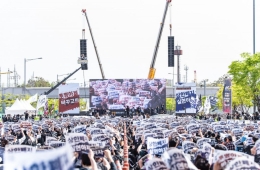
The court has put a halt to the full-scale strike announced by the labor union of Samsung Biologics.

On April 23, the 21st Civil Division of the Incheon District Court partially granted Samsung Biologics' request for an injunction to prohibit industrial action by its own labor union. The court ruled, "The union must not issue instructions or guidelines during the industrial action period that would cause union members or third parties to halt any part of the work to prevent the deterioration or spoilage of thawed cell strains," and added, "The union must not obstruct employees from engaging in this work through the use of force or threats of harm."
According to the court's decision, strikes are prohibited in three areas: concentration and buffer exchange, drug substance filling, and buffer manufacturing and supply related to these processes. The court rejected the injunction regarding processes such as cultivation and purification.
Samsung Biologics stated, "We have received the court's decision and confirmed that it was partially accepted," and added, "We have immediately appealed the parts that were not granted."
Previously, in last month's strike vote, 95.52% of union members voted in favor, signaling a strike. If labor and management fail to reach an agreement, collective action would begin on April 22, followed by a strike starting May 1. The union at Samsung Biologics has 3,689 members, accounting for approximately 75% of all employees.
Hot Picks Today
 US Defense Chief: Maritime Blockade Against Ira...
- "I Just Want to Sleep": Prime Minister Takaichi's Struggles?Frozen Meals, Two Ho...
- "You Can Only Have This in Korea": Which National Museum Cafe Menu Is Captivatin...
- Netanyahu Says He Is Fully Recovered After Early Prostate Cancer Diagnosis... "I...
- "Never Hike Alone as a Woman" "Even Two Are at Risk"... Growing Fear of Crime on...
The main issues are wages and performance bonuses. The union is demanding a 14% increase in base salary and that more than 20% of operating profit be paid as Outperformance Incentive (OPI). It is also reported that the union has requested an incentive of 30 million won per employee and allocation of company stock over three years. The company has proposed a total wage increase rate of 6.2%, a 200% incentive, and expanded shift allowances. For OPI, the company is sticking to the group guidelines of either 10% of operating profit or 20% based on Economic Value Added (EVA).
© The Asia Business Daily(www.asiae.co.kr). All rights reserved.