[Local Election Interview] Yoo Jung-bok: "Turning Incheon into a Regulation-Free Zone... A Mayor Needs Competence, Not Presidential Connections"
Interview with Yoo Jung-bok, People Power Party Candidate for Incheon Mayor

Yoo Jung-bok, the People Power Party's candidate for Mayor of Incheon, is being interviewed by The Asia Business Daily at the Incheon Michuhol-gu election campaign office. 2026.5.11 Photo by Kim Hyunmin
View original image"The opposing candidate is called a 'powerful ruling party nominee,' but that power only benefits Incheon if it is devoted to its citizens. If it is focused on the President, it becomes toxic for Incheon instead. Would a mayor who follows presidential orders, rather than serving the citizens, truly help the development of Incheon?"
Yoo Jung-bok, candidate for Mayor of Incheon from the People Power Party, stated this during an interview with The Asia Business Daily at his election office in Michuhol-gu, Incheon, on the 14th. He emphasized, "It is the mayor, not the President, who is responsible for Incheon's municipal administration. Above all, the mayor needs to have the capability." Yoo previously served as the 6th and 8th popularly elected Mayor of Incheon, and is now aiming to become the city's first-ever three-term mayor.
Born in Dong-gu, Incheon, Yoo graduated from Jemulpo High School and Yonsei University, passed the civil service exam, and served as the government-appointed head of Gimpo County and Seo-gu District of Incheon, as well as the elected Mayor of Gimpo for the first and second terms. He later served as a member of the 17th to 19th National Assembly, and as Minister of Agriculture, Food and Rural Affairs and Minister of the Interior and Safety. For these reasons, he is often referred to as a 'master of administration.'
Regarding his bid for another term as mayor, Yoo said, "There is little disagreement about my strong performance as Mayor of Incheon. In various municipal evaluations, the ratio of positive assessments has hovered around 50 percent," adding, "Compared to the ruling party, my personal competitiveness as a candidate is clearly superior."
About his opponent, Park Chan-dae of the Democratic Party of Korea, he commented, "Running on the platform of being close to the President is essentially admitting a lack of capability and competence," and added, "For issues like the proposed integration between Incheon and Korea Airports Corporation, he claims to oppose it but says things like 'it's just agitation' or 'nothing has been decided yet.'"
Regarding the current polling gap, Yoo remarked, "People are beginning to realize the unconstitutional and anti-democratic move by the Lee Jae-myung administration to quash prosecutions through a special counsel, and there is a growing sentiment that it must be stopped," adding, "Ultimately, voters will base their decisions and evaluations on which candidate can best develop Incheon's future."
On Incheon's key issues, Yoo has pledged to enact a 'Special Act for Incheon International Free City.' He explained, "Currently, only Songdo, Cheongna, and Yeongjong are included in the Incheon Free Economic Zone. If elected, I will push for a special law to make all of Incheon a so-called 'regulation-free zone.'" He emphasized, "We will boldly reduce regulations across Incheon and create an attractive environment for investment, propelling the city to lead Korea's future growth on the foundation of its world-class airport and seaport."
Yoo also stated, "During my site visits, policies such as the 1,000-won housing initiative, 1,000-won parcel delivery, and 20% cashback at all gas stations have received strong positive responses from citizens," adding, "I will confidently present my policy vision and be evaluated by the people of Incheon."
The following is a Q&A with candidate Yoo Jung-bok.
▲There is a notable gap in public opinion polls between you and Park Chan-dae, candidate of the Democratic Party of Korea.
=The current gap in support is essentially a result of party affiliation. I believe the party factor is excessively reflected in the numbers. However, this Incheon mayoral election is about selecting a mayor who will be responsible for the future of the city, so support rates are bound to change. In the end, evaluation and judgment will inevitably focus on which candidate can best develop Incheon's future. Given my clear edge in personal competitiveness, the numbers will soon shift.
▲There are considerable concerns about the People Power Party's direction after the 12·3 Martial Law.
=This is an election to choose the Mayor of Incheon, not a party leader. It is not appropriate to discuss this issue here. The party must strive to earn the trust and love of the people, and Incheon must wisely choose someone to take responsibility for its municipal administration. Regardless of the situation at the central party, Incheon will walk its own path.
▲Do you believe the atmosphere has changed after the ruling party's move to quash prosecutions with a special counsel?
=Taking advantage of this situation, the Lee Jae-myung administration is pushing anti-constitutional and anti-democratic legislation that paralyzes the legislative, executive, and judicial branches. People are beginning to recognize this, and a sense that it must be stopped is spreading. Now, the President is saying, "Let's proceed after sufficient deliberation," based on public sentiment, but this is merely an attempt to avoid exposing negative issues before the election. It is a trick to deceive the people twice. What is wrong must be acknowledged as wrong—this is not the time for tricks.
▲How would you evaluate your opponent, Park Chan-dae?
=Park's strengths are that he has served as the Democratic Party's floor leader and is close to President Lee Jae-myung. That is certainly true. The real issue, however, is what impact this will have on his ability to serve as Mayor of Incheon. The mayoral election is not about electing a party leader or a member of the National Assembly, but about choosing someone who will take responsibility for the city. Running on the platform of being close to the President seems to be an attempt to substitute his lack of capability and competence with the party's name. He emphasizes being a powerful ruling party politician, but that power only has meaning when dedicated to Incheon's citizens—if it is devoted to the President, it can be harmful. The mayor must work for the people; following presidential orders does not help Incheon's development.
▲If elected as an opposition mayor, would there be any problems communicating with the central government?
=I have served as Mayor of Incheon for a long time. A capable mayor can logically and persuasively work with central government officials, and that is why there have been no problems so far. The President does not oversee Incheon's municipal administration. When the mayor has the necessary skills, everything is possible. If a project has a justifiable cause, sound logic, and serves both national and regional interests, it can be resolved. Simply asking the President to "do this or do that" does not solve anything.
▲How do you plan to engage in policy debates with Park Chan-dae?
=Elections are the cornerstone of democracy, and candidates must provide information so that voters can make informed choices. This is the purpose of various debates and discussions. Park is refusing to participate, which raises doubts about his qualifications as a mayoral candidate. I hope he will also confidently present his own policy vision and be evaluated by the citizens.
▲The proposed integration of Incheon International Airport Corporation, Korea Airports Corporation, and the Gadeokdo New Airport Project Group has become a major issue.
=Of course, I must oppose this from the standpoint of Incheon citizens. However, Park dismisses it as "baseless suspicion" or "not yet decided," and claims "the opposition is agitating." Such remarks are disrespectful to the people. If this is agitation, then the Incheon Airport labor union and over 100 civic groups in Incheon should also be questioned. In the end, this only exposes his own incompetence and irresponsibility.
▲Your personal approval rating is higher than your party’s.
=I believe this is the result of policies that citizens can truly feel during my tenure. During the election campaign, I observed strong positive responses to policies such as the 1,000-won housing initiative, 1,000-won parcel delivery, and 20% cashback at all gas stations. Especially in traditional markets, there has been much recognition for raising the local gift certificate cashback limit to 20% in Incheon alone when the supplementary budget for high oil price support was allocated. There is little debate about my performance as mayor. Even with a significant gap in party support, the positive response rate to my administration exceeds 50 percent.
▲Manufacturing sectors in areas such as Namdong Industrial Complex and Bupyeong are facing difficulties. Do you have any alternatives?
=Currently, only Songdo, Cheongna, and Yeongjong are included in the Incheon Free Economic Zone. If elected, I will push for the Special Act for Incheon International Free City to make all of Incheon a so-called "regulation-free zone." While the special acts for administrative integration in Jeonnam and Gwangju focus on simple city and provincial mergers, the special act for Incheon provides the foundation for the city to become Korea's core engine of future growth, leveraging its world-class airport, port, and free economic zone. By boldly reducing regulations and creating an attractive investment environment, Incheon will grow into a true international city. We will develop a framework for both old and new downtowns to advance together.
▲How will you address the sense of alienation in older neighborhoods like Jemulpo-gu and the northeastern part of Incheon?
=The groundwork for revitalizing old downtown areas is already well underway. The most notable examples are the plans to move the Gyeongin Expressway and Gyeongin subway underground. Removing the barriers that bisected the city will mark a turning point for major development. First, outdated Jung-gu and Dong-gu have been integrated into Jemulpo-gu, and demolition around Dongincheon Station is ongoing. Redevelopment of the 1st and 8th piers at Incheon Inner Port has also been confirmed and is in progress. The Jemulpo Renaissance Project is a prime example. Bupyeong and Gyeyang will also become new central hubs. Not only Seoul Subway Line 7, but also a multi-modal transfer center for the GTX-B line is being developed, and the relocation and redevelopment of Camp Market and the 507th Infantry Brigade in Bupyeong are underway, transforming Bupyeong into a new city center. Gyeyang, too, will be developed as a self-sufficient city where high-tech industry and residential districts coexist, centered on the Gyeyang Technovalley.
Hot Picks Today
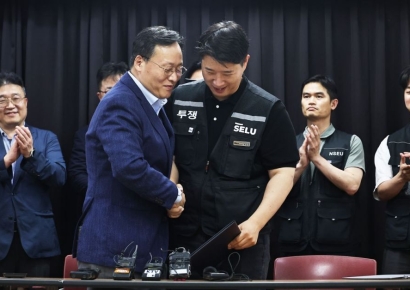 Up to 600 Million Won for Semiconductors, 160 Million Won Bonus for Loss-Making Non-Memory… Samsung Electronics Labor and Management Reach Tentative Deal on Unprecedented Performance Compensation (Comprehensive)
- "Could I Also Receive 370 Billion Won?"... No Limit on 'Stock Manipulation Whistleblower Rewards' Starting the 26th
- "From a 70 Million Won Loss to a 350 Million Won Profit with Samsung and SK hynix"... 'Stock Jackpot' Grandfather Gains Attention
- [Scientists Are Disappearing]④A Shaky Regional Research Ecosystem... "Professors Now Take the Initiative"
- "Who Is Visiting Japan These Days?" The Once-Crowded Tourist Spots Empty Out... What's Happening?
▲There have been various criticisms about hosting the Incheon F1 City Circuit.
=Frankly, this is just nitpicking. F1 is considered one of the world’s top three mega sporting events, alongside the World Cup. While some point to the Jeonnam Yeongam case, this F1 event is a completely different city circuit. Most importantly, the feasibility study showed a B/C (benefit/cost) ratio exceeding 1.45. This project will be a breakthrough event for Incheon’s internationalization. Partial national funding is not a problem. If people understood the facts, I believe no citizen would oppose it. It will become a key strategic asset for Incheon in the future.
© The Asia Business Daily(www.asiae.co.kr). All rights reserved.
!["Please Help": How Much Do Those Bowing 90 Degrees Really Earn? [Data Pick]](https://cwcontent.asiae.co.kr/asiaresize/307/2026052010120870131_1779239528.png)