People Power Party Goes on the Offensive Amid Tight Race in Yeongnam...All-Out Attack Over 'Prosecution Cancellation' and 'National Dividend'
On May 14, Joo Jinwoo, Chairman of the Special Committee to Stop the Prosecution Cancellation Act,
Files countercharges for false accusation against lawmakers including Seo Youngkyo
In local election polls for regions such as Yeongnam and the greater Seoul area, the People Power Party is closing the gap with the Democratic Party of Korea to within the margin of error, highlighting a pronounced consolidation among conservative voters. The People Power Party is intensifying its offensive against the government and the ruling party by making issues such as the controversy over presidential prosecution cancellation, real estate policy, and the proposed national semiconductor dividend the focal points of debate.
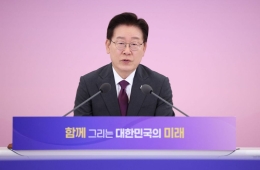
On May 14, Joo Jin-woo, Chairman of the Special Committee to Prevent the Prosecution Cancellation Special Investigation Act under the People Power Party Central Election Committee, held a press conference at the National Assembly and announced that he would file criminal charges of false accusation against Democratic Party lawmakers Seo Young-kyo, Yang Bu-nam, Lee Geon-tae, and Kim Dong-ah.
Chairman Joo asserted, "Regarding the 'salmon drinking party' allegations, the prosecution also excluded this matter from the grounds for disciplinary action against Prosecutor Park Sang-yong," adding, "The prosecution's judgment is also that these allegations are unsubstantiated." He went on to say, "This is a counter-complaint for the false accusations against 31 individuals who either testified truthfully or had legitimate reasons for their absence."

Joo Jin-woo, Chairman of the Special Committee to Prevent the Prosecution Cancellation Special Investigation Act under the People Power Party Central Election Committee / Photo by Yonhap News
View original imageJang Dong-hyuk, leader of the People Power Party, has also been bringing the issues of prosecution cancellation and real estate to the forefront on a daily basis. The controversy surrounding Kim Yong-bum, policy chief at the Blue House, and his remarks about a 'national dividend' from semiconductor profits has also become a major topic, with the People Power Party expanding the scope of its offensive against the ruling party.
Leader Jang has even omitted the presidential title recently, further ramping up the intensity of his attacks. On May 12, he wrote on Facebook, "(The Lee Jae-myung administration) has finally revealed its true communist colors by mentioning a 'national dividend.' If the government takes the money I earned through my own efforts and distributes it, that is nothing less than a communist rationing economy," he claimed.
Policy chief Kim later clarified that he was describing a way to utilize excess tax revenue, not excess corporate profits, but the opposition continued to push back. Song Eon-seok, floor leader of the People Power Party, criticized, "The government treated the achievements of semiconductor companies as if they were resources for government distribution," and argued, "By conflating excess tax revenue with corporate surplus profits, the administration has created further confusion in the market."

Jang Dong-hyuk, leader of the People Power Party, is speaking at the Supreme Council meeting held at the National Assembly on May 14, 2026. Photo by Kim Hyunmin
View original imageIn the Yeongnam region, candidates are also focusing on the prosecution cancellation issue to reinforce their message of conservative unity. Within the party, there is growing optimism that the renewed consolidation among conservative voters in the TK (Daegu-Gyeongbuk) and PK (Busan-Gyeongnam) regions could also influence the race in the capital area.
Recent polls show that the gap between the ruling and opposition parties in the Yeongnam region has narrowed to within the margin of error. According to a survey conducted by Gallup Korea at the request of News1 on May 10-11 among 801 adults living in Busan (response rate 14.7%), Jeon Jae-soo, candidate of the Democratic Party of Korea, received 43% support, while Park Hyung-joon, candidate of the People Power Party, received 41%.
The Daegu mayoral race is also highly competitive. In a survey conducted on May 9-10 among 803 adults living in Daegu (response rate 20.3%), Democratic Party candidate Kim Boo-kyum received 44% support, while People Power Party candidate Chu Kyung-ho received 41%. The survey was conducted using mobile phone virtual numbers provided by the three major telecommunications companies and telephone interviews (CATI). The sampling error for Busan and Daegu was ±3.5 percentage points at a 95% confidence level. For more details, refer to the website of the National Election Survey Deliberation Commission.
Observers note that the outcome in the Yeongnam region is closely tied to the future political standing of the party leadership, including Leader Jang. However, within the People Power Party, there is also the view that relying solely on the mobilization of hardline supporters is insufficient for broader appeal, and that outreach to moderate voters must be pursued in parallel.
Hot Picks Today
 At President Lee's Call to "Give Enough to Shock," Whistleblower Rewards Become a Real Lottery
- If a Samsung Electronics Employee with a 100 Million Won Salary Receives a 600 Million Won Performance Bonus, Taxes Total 247.19 Million Won
- Lived as Family for Over 30 Years... Daughter-in-Law Cast Aside After Husband's Death
- "White House Blocks Repatriation of 'Ebola-Infected' Doctor... Ultimately Transferred to Germany"
- "4.15 Million Won Prada Jacket Shows White Spots After One Wear"...Korea Consumer Agency Orders Full Refund
On this day, Park Hyung-joon, who brought in Assemblyman Ahn Cheol-soo as joint honorary election committee chairperson to broaden the party’s centrist appeal, also emphasized 'conservative unification' and 'defending the Nakdong River front' as his first messages after registering his candidacy. He stated, "With the banner of conservative unification, I will defend the Nakdong River front and stop the runaway Lee Jae-myung administration."
© The Asia Business Daily(www.asiae.co.kr). All rights reserved.