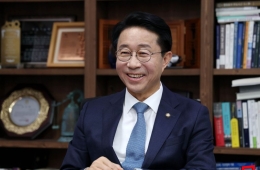
Wi Sung-lak: "OPCON Transfer Roadmap to Be Completed This Year... Reviewing U.S. Maritime Freedom Initiative for Hormuz"
"Constant Monitoring of 26 Vessels and 160 Crew Members in Hormuz"
"Swift Investigation into the HMM Namu Incident"
"Defense Exports Rebound to $15.4 Billion"
"Reviewing CPTPP Membership and Resumption of Korea-Mexico FTA"
On May 13, National Security Office Chief Wi Sung-lak stated regarding the transfer of wartime operational control (OPCON), "This year, we are completing the master roadmap for OPCON restoration and pushing ahead to finalize the verification of Full Operational Capability (FOC)." Concerning the issue of freedom of navigation in the Strait of Hormuz, he explained that while the government is reviewing international cooperation measures such as the U.S.-proposed "Project Freedom," the main focus is on the Maritime Freedom Concept (MFC).

At a keynote speech during a luncheon hosted by the Korea News Editors’ Association at the Seoul Press Center that afternoon, Chief Wi said, "The defense and military authorities of South Korea and the United States are expediting the transfer of OPCON," and elaborated on these points.
Chief Wi added, "Our military is pursuing transformation toward a democratic force aligned with the future security environment," and "We are seeking to enhance our capabilities, including an increase in the defense budget, so that the Korean military can take a leading role in the defense of the Korean Peninsula." He continued, "Under a robust combined defense posture, we will strengthen our independent capabilities through progress in cooperation with the United States on nuclear potential, enrichment and reprocessing, shipbuilding, as well as swift reform of advanced weapons systems and transition to a smart and strong military."
Regarding the Middle East conflict and tensions in the Strait of Hormuz, he emphasized that ensuring the safety of Korean citizens and seafarers is the top priority. Chief Wi stated, "From the very onset of the Middle East conflict, securing the safety of our citizens has been our highest priority, and we have mobilized all available resources." He added, "About 1,500 of our citizens were able to evacuate to safe locations or return home with direct government support."
He continued, "For the safety of 26 Korean vessels and 160 crew members stranded inside the Strait of Hormuz, we are maintaining a constant communication system with related shipping companies and seafarers," and "We are also working closely with key countries."
Regarding the recent attack on the HMM Namu, Chief Wi explained, "We worked in close cooperation with the UAE authorities to ensure the vessel was towed to port, the crew disembarked, and a joint government investigation was conducted swiftly and smoothly." He also said, "As soon as our local diplomatic mission learned that one crew member had been injured, we provided support to ensure that the individual received prompt and safe medical attention."
Chief Wi also stated that South Korea is actively participating in international cooperation to guarantee freedom of navigation in the Strait of Hormuz. He noted, "There is an initiative led by the United Kingdom and France, and on April 17, the President participated in a video conference with other leaders and expressed our intention to make a tangible contribution."
Regarding the U.S.-proposed Maritime Freedom Concept (MFC) and "Project Freedom," he said, "Our government is reviewing the Maritime Freedom Concept as we do with other forms of international cooperation." This suggests that while South Korea is participating in international discussions on freedom of navigation in the Strait of Hormuz, it intends to approach participation in initiatives with a strong military dimension with caution.
He also mentioned achievements in the defense industry. Chief Wi stated, "By establishing an inter-agency defense industry control tower centered at the presidential office, we enabled defense exports to rebound after a two-year decline and achieved $15.4 billion in defense export results." He added, "Going forward, we will further diversify defense cooperation so that K-Defense continues to serve as a driving force for security and peace, and we will continue to promote the application of innovative technologies such as drones, robots, and artificial intelligence (AI) in the defense sector."
As diplomatic achievements over the past year, he cited the restoration of summit diplomacy and the stabilization of relations with neighboring countries. Chief Wi said, "In the past year, we restored summit diplomacy early and successfully demonstrated that democratic Korea is back on the multilateral stage," and "We stabilized relations with major neighboring countries and established a foundation for pragmatic diplomacy centered on national interests."
Specifically, he mentioned the shortest-ever reciprocal visits between South Korean and U.S. leaders, the first visit by the Chinese president to South Korea in 11 years, the early resumption of South Korea-Japan shuttle diplomacy, the successful hosting of the Asia-Pacific Economic Cooperation (APEC) summit in Gyeongju, and consecutive invitations to the Group of Seven (G7) summits. Chief Wi said, "We are pursuing cooperation with major countries to strengthen future competitiveness in areas such as nuclear power, defense, and AI, thereby building the foundation for public welfare and pragmatic diplomacy."
For the second year, he presented the expansion of economic security diplomacy as a key task. Chief Wi stated, "To expand markets and strengthen diplomatic safety nets, we are considering joining the Comprehensive and Progressive Agreement for Trans-Pacific Partnership (CPTPP), resuming free trade agreement (FTA) negotiations with Mexico, and advancing talks to improve the Comprehensive Economic Partnership Agreement (CEPA) with India." He added, "We will further solidify economic security, including critical minerals and energy supply chains, and will regularly operate public-private joint export and order diplomacy support teams to help Korean companies secure the largest possible orders for nuclear power plants and infrastructure projects."
Regarding the Korean Peninsula, Chief Wi stated, "We will make every effort to restore inter-Korean relations, but will avoid moving too hastily." He continued, "We will continue efforts to draw North Korea into dialogue based on close South Korea-U.S. cooperation, seek diplomatic opportunities for U.S.-North Korea engagement, and prepare for future talks by closely consulting with the United States on ways to pursue dialogue and denuclearization with North Korea."
Hot Picks Today
 Even with High Oil Price Relief Payment, Additional 300,000 Won Per Person to Be Provided... Applications Open from the 18th in This Region
- "Invested 95% in Hynix and Reached 10 Billion Won"... Japanese Investor's Proof Post Goes Viral
- "Did He Think This Was a Chauffeur Service?"... Drunk Driving in Tesla with Autopilot Activated
- "I'm Younger and Fitter Than Your Husband, Get a Divorce"... Suspicious Messages Between Wife and Fitness Trainer
- "That Thing Wakes Up Every Night" ... Suspicious Object Covers Rural Village
Chief Wi said, "Unexpected diplomatic and security situations continue to arise, but we will pursue our diplomatic and security policies based on public support," and "We will strive to ensure that this period is recognized as one in which our diplomatic and security policies contributed to a great transformation and leap forward for the Republic of Korea."
© The Asia Business Daily(www.asiae.co.kr). All rights reserved.



![[Breaking] KOSPI Closes Up 200.86 Points at 7,844.01... Highest Closing Price on Record](https://cwcontent.asiae.co.kr/asiaresize/307/2026051213515559364_1778561515.jpg)