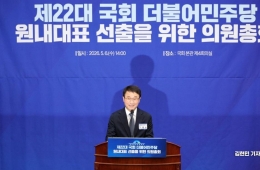
[Interview] Park Ji-won, Running for Speaker: "I Am Clearly Pro-Lee and Pro-Blue House... I Want to Paint the Sunset Red"
Interview with the Speaker Candidate
Highlights Final Service with Experience in Administration, Legislation, and Intelligence
"If Co-governance Fails, Will Not Hesitate to Pursue Responsible Politics or Winner-Takes-All"
Ranks First
"Throughout history and across cultures, the Speaker has always been the elder statesman of the National Assembly. I have accumulated experience across the executive, legislative, and intelligence branches. I want to dedicate my final wisdom and experience to serving the National Assembly and the nation, and end my career painting the sunset red."
Park Ji-won, the oldest member (age 83) of the 22nd National Assembly and a five-term veteran, is running as a candidate for Speaker in the latter half of the Assembly's term. In an interview with The Asia Business Daily on April 30, 2026, Park expressed his ambition to run for the Speaker's position. In addition to his five terms in the National Assembly, Park has served as Chief Presidential Spokesperson, Minister of Culture and Tourism, and Presidential Chief of Staff under President Kim Dae-jung, as well as Director of the National Intelligence Service under President Moon Jae-in. The key themes Park emphasized in declaring his candidacy were 'co-governance' and the 'K-National Assembly.'
When asked about the value the Speaker should uphold throughout their term, Park answered 'co-governance.' He said, "If we pursue co-governance and communicate, everything can be solved. Untangling complicated knots is what politics is all about." However, he added, "When co-governance fails, we must practice responsible politics. Politics must be restored, but if one side unilaterally blocks progress, I would also consider a winner-takes-all approach."

Park Jiwon, a member of the Democratic Party of Korea, is being interviewed by The Asia Business Daily at the National Assembly. April 30, 2026. Photo by Kim Hyunmin
View original imageHe stated, "President Lee Jae-myung is doing a great job, and the President's success is an act of patriotism. A President who works well alongside a National Assembly that works well will create a K-National Assembly, alleviating public concerns and leading national development. That is what I envision as the K-National Assembly." Regarding the issue of standing committees rarely convening when opposition lawmakers chair them, Park said, "The National Assembly should apply the no work, no pay principle to lawmakers, and if they do well, incentives such as bonuses should be provided."
He expressed hope that his extensive political experience would help pave the way between co-governance and responsible politics. Park said, "Like the Saemaul spirit, the National Assembly should fight when it needs to and work when it needs to. Having walked both the path of roses and the thorny path, I will do my best to lead the National Assembly toward a better future."
Park recounted that during the past impeachment crisis, when the appointment of Constitutional Court justices led to a deadlock, he negotiated with Acting President Han Duck-soo and Choi Sang-mok. He added, "Even President Lee recognizes me, but some people ask whether I am pro-Myung (pro-Lee Jae-myung) or pro-Chung (pro-Chung Cheong-rae). I am clearly pro-Myung and pro-Chung," clarifying, "Here, pro-Chung means pro-Blue House."
He also commented on his rivals in the Speaker race. Regarding Cho Jeong-sik, a six-term lawmaker, and Kim Tae-nyeon, a five-term lawmaker, Park said, "Both are excellent, but they are in their early sixties, so they will have plenty of opportunities. I believe it is better for me to take on this role, even for their sake." This was an appeal for one last opportunity. Concerning concerns about his health due to his advanced age, being born in 1942, he said, "Health is a concern for both young and old, but I am healthy enough to serve as Speaker of the National Assembly."

Park Ji-won, a member of the Democratic Party of Korea, is being interviewed by The Asia Business Daily at the National Assembly. 2026.4.30 Photo by Kim Hyun-min
View original imageThe following is a Q&A.
- If you become Speaker, how will the National Assembly change?
▲ First, I will build a National Assembly that works. President Lee Jae-myung is doing a great job, and the President's success is an act of patriotism. A President who works well and a National Assembly that works well will create a K-National Assembly, reducing public concerns and driving further national development. That is the K-National Assembly.
- What are the prospects for constitutional amendment?
▲ The People Power Party attended the May 18 Democratic Uprising memorial ceremony, waved the national flag, sang 'March for the Beloved,' and proposed to include the Bu-Ma Democratic Protests and other events in the preamble of the Constitution, so why are they opposed to this constitutional amendment? There is no reason to oppose strengthening local autonomy or the requirements for martial law. Speaker Woo Won-shik opened the door to constitutional amendment, and I hope it will be accomplished this time. If it fails, I will eliminate the doubts held by the opposition, including the People Power Party, and complete a comprehensive constitutional amendment, including the power structure, by the next general election.
- The opposition responds to even bipartisan livelihood legislation with filibusters. In such cases, the Vice Speaker from the People Power Party refuses to preside over the session?
▲ A strong Speaker would be able to resolve such issues in various ways. While co-governance and reviving politics are important, if all efforts fail, the Speaker must be strong. Although this is a constitutional matter, I believe it is time to try having three Vice Speakers, representing both parties and women, for example.
- How can parliamentary diplomacy be strengthened?
▲ The National Assembly Secretariat should establish a dedicated support office for parliamentary diplomacy. While the government maintains official diplomatic relations with Iran, the National Assembly can engage much more broadly. If U.S. congressmen raise issues about Coupang, our parliamentary delegation should go and explain. We need to refine parliamentary diplomacy with Russia and Ukraine now to help with postwar recovery and energy issues. I have networks with North Korea, the U.S., and China. On North Korea, I have networks and know-how that could create an opening, even a tiny one.
- You said you have overwhelming support from both party members and the public, but what about votes from lawmakers?
▲ The media has published several opinion polls showing strong support among the public and party members. I believe my leadership in fighting for President Yoon Suk-yeol’s impeachment, settling insurrection issues, and pursuing the three major reforms is being highly evaluated. When I meet lawmakers, support is at 100%, but when they turn away, it drops to 0%. You may know the depth of water, but not the depth of a lawmaker’s heart. Still, as lawmakers were elected through the collective intelligence of the public and party membership, I believe they will ultimately follow the public’s will.
- There is talk of a Speaker from the Honam region.
▲ Honam overwhelmingly supported President Lee Jae-myung’s election and continues to show the highest level of support. Yet, among the five key government positions, none are from Honam. That is why there are high expectations for Park Ji-won.
- You are called 'Sae-soon' (New Shoot) and 'Gold Boy.'
▲ When I appeared on 'Maebul Show,' the host called me 'Sae-soon'—meaning not an octogenarian, but a 'new shoot,' full of bright ideas and humor. Jeong Dong-young, Minister of Unification, also recently called me and said, "No one calls us 'old boys' anymore because we are working hard." I have to remain at the Legislation and Judiciary Committee to prevent the opposition from convening the Agenda Coordination Committee. If I leave my seat, the right to preside passes to the opposition, and bills cannot be passed. I am the gatekeeper. During President Yoon Suk-yeol’s impeachment and the three major reforms, I stayed at the committee for 10 or even 12 hours, fighting. The people appreciated this, which is how I got these nicknames.
Hot Picks Today
!["Stock Set to Double: This Company Smiles Every Time a Data Center Is Built [Click e-Stock]"](https://cwcontent.asiae.co.kr/asiaresize/93/2026050416112750184_1777878687.jpg) "Stock Set to Double: This Company Smiles Every...
"Stock Set to Double: This Company Smiles Every...
- Even Wealthy Investors in Cheongdam and Apgujeong Are Turning to Stocks After Se...
- “Did They Bet Too Early?” Losses Snowball for ‘Geopverse Ants’ as KOSPI Soar...
- "Going to Seongsu-dong?" Japanese Girl Group Faces Taxi Refusal in Seoul
- Who Called It an 'Old Man's Hobby'? "Tired of the Usual," Millennials & Gen Z Bu...
- Any final thoughts?
▲ It is important to create a National Assembly where President Lee Jae-myung can succeed—a K-National Assembly that works. If President Lee Jae-myung ever needs advice, I will provide it as the head of the legislative branch for the nation. However, unlike with President Kim Dae-jung, I will not do so publicly. I will do everything possible for the success of the country and the President.
© The Asia Business Daily(www.asiae.co.kr). All rights reserved.