Government Maintains "NCND" Stance... US-Korea Currency Swap Resurfaces Amid Iran War

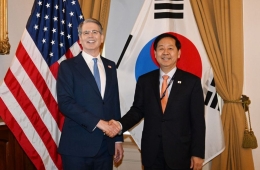
Deputy Prime Minister and Minister of Finance and Economy Koo Yoon-chul visited the U.S. Department of the Treasury on the 17th (local time) to attend the G20 Finance Ministers' Meeting and the International Monetary Fund (IMF) and World Bank (WB) Spring Meetings, where he held a bilateral meeting with U.S. Treasury Secretary Scott Bessent. Ministry of Finance and Economy
View original imageIt has been identified that South Korea is among the countries exploring the possibility of a currency swap with the United States in response to the aftermath of the U.S.-Iran conflict in the Middle East. This development comes as the U.S., which previously rejected the request for a currency swap with South Korea during bilateral investment negotiations by stating that “South Korea has sufficient U.S. dollars,” is now expanding cooperation with numerous countries severely impacted by the Iran war shock, including discussing foreign exchange supply measures, in order to strengthen the dollar’s hegemony.
According to political sources and related ministries on April 28, Deputy Prime Minister and Minister of Strategy and Finance Koo Yoon-chul and U.S. Treasury Secretary Scott Bessent met in Washington, D.C. on April 19–20 during the G20 Finance Ministers and Central Bank Governors Meeting to discuss plans for cooperation in the foreign exchange market. Koo’s delegation included the Assistant Secretary for International Finance, the Director of Foreign Currency Funds, the Head of the International Currency Team, and the Director of Financial Cooperation in charge of currency swaps. Discussions regarding a currency swap are said to have taken place at this meeting.
Regarding the pursuit of a currency swap, an official from the Ministry of Strategy and Finance stated, “It is difficult to comment specifically on what is being discussed between the two governments,” adding, “We can neither confirm nor deny (NCND).” This cautious stance appears to reflect concerns that talks on a currency swap with the United States could send the wrong signal to the market, implying a possible dollar shortage.
Previously, Secretary Bessent had met with Khaled Mohamed Balama, Governor of the Central Bank of the United Arab Emirates (UAE), who visited Washington for the G20 event, to discuss the idea of establishing a currency swap line. The UAE side conveyed concerns that the impact of the Iran war is spreading from the energy market to the financial market, making measures to address a dollar shortage necessary. It was also reported that the UAE is increasing its bargaining power with the U.S. by emphasizing that if a dollar shortage becomes a reality, it may have no choice but to switch oil sales and transaction settlements to Chinese yuan.
Hot Picks Today
 "Pay for the Postpartum Care Center with My Car...
- "Skipping Diamond Rings... Gen Z in the US Opts for Finger Tattoos"
- "Forged IDs Easily Bypass Convenience Stores, Bars, and Motels... Delinquency En...
- Vice Minister of Oceans and Fisheries Sungbeom Kim Resigns... Expected to Run in...
- Back After 3 Years and 5 Months with a 'Shark Nose Surgery'... Hyundai Unveils T...
While South Korea’s foreign exchange reserves amount to USD 423.6 billion and its net external financial assets remain in surplus above USD 1 trillion—indicating sound external financial health—the combination of USD 350 billion invested in the United States and the external shock of the Middle East war has created a high exchange rate environment. In this context, concluding a currency swap with the United States could be a significant factor in stabilizing market sentiment and influencing the direction of the exchange rate.
© The Asia Business Daily(www.asiae.co.kr). All rights reserved.