President Lee: "Korea Is Vietnam's Optimal Partner for Achieving Developed Nation Status"... To Lam Welcomes Investment in Infrastructure and Nuclear Power (Comprehensive Report 2)
Korea and Vietnam Leaders Announce Joint Press Statement Following Summit
Targeting 222 Trillion Won in Bilateral Trade by 2030
Accelerating Cooperation to Boost Agricultural and Livestock Trade
Expanding Collaboration in Intellectual Property
Cooperation on Supply Chain Instability from Middle East Developments
Strengthening Infrastructure Partnerships in Railways and New Airports
Joint Research in AI, Semiconductors, and Biotechnology
Supporting Multicultural Families and Overseas Koreans
Enhancing Vietnam's Healthcare Capabilities
Promoting the 'Central Region Emergency Medical System Enhancement Project'
To Lam: "Substantive Cooperation in Key Areas Including Diplomacy, Defense, and Security"
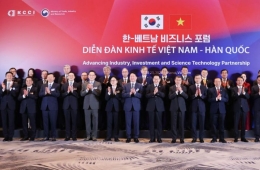
President Lee Jae-myung held a summit with General Secretary of the Communist Party of Vietnam and State President To Lam in Hanoi, Vietnam, on the 22nd, and agreed to expand trade and investment cooperation with the goal of increasing bilateral trade volume to 150 billion dollars (approximately 222 trillion won) by 2030. In particular, both countries decided to cooperate on energy security and other issues to stabilize supply chains, which have been destabilized by recent developments in the Middle East. They also agreed to strengthen cooperation in infrastructure and future industries, such as railways, new airports, semiconductors, artificial intelligence (AI), and biotechnology. Secretary General To Lam stated that Vietnam would support Vietnamese companies to participate in the production supply chains of Korean companies and welcomed increased investment from Korean businesses in sectors such as infrastructure development, semiconductors, nuclear power, and the construction of smart and next-generation ports.

At the joint press conference following the summit, President Lee stated, "Korea is pursuing comprehensive cooperation with Vietnam as the optimal partner for realizing Vietnam's vision of becoming a high-income advanced nation by 2045, ranging from hardware sectors such as logistics, transportation, energy, and infrastructure, to future industries such as science and technology, intellectual property, and creative industries." He added, "The summit further solidified the 'Comprehensive Strategic Partnership' cooperation." Vietnam is Korea’s third-largest trading and investment partner, with more than 10,000 Korean companies operating across a wide range of industries including petrochemicals, shipbuilding, steel, and electronics, achieving a high level of economic cooperation.
Through this summit, the two countries agreed to broaden the scope of trade and investment with the aim of reaching a trade volume of 150 billion dollars by 2030. President Lee explained, "For the first time, the two countries agreed to mutually export heat-processed poultry." He continued, "Based on the 'Memorandum of Understanding (MOU) on Cooperation in Animal Health and Quarantine' signed this time, we will accelerate cooperation to promote trade in agricultural and livestock products." In addition, through the 'MOU on Cooperation in Food, Pharmaceuticals, Cosmetics, and Medical Device Safety,' the two countries aim to enhance food safety and activate trade, while the 'MOU on Deepening Cooperation in Intellectual Property' will establish a cooperation system to block counterfeit goods and prevent trademark infringement. As a result, the signing of the MOU on safety cooperation for food, pharmaceuticals, cosmetics, and medical devices has laid the foundation for expanding into Vietnam’s 4.3 billion dollar pharmaceutical import market and 11 billion dollar meat market.

President Lee Jae-myung is speaking at a joint press conference with Secretary General and State President Vo Lam in the Presidential Palace in Hanoi, Vietnam, on the 22nd (local time). Photo by Yonhap News.
View original imageEnergy and infrastructure cooperation were also key topics at the summit. President Lee, citing the increased instability of supply chains due to recent developments in the Middle East, stated that "the necessity of cooperation between the two countries has become even greater," and announced that both sides will work closely together to strengthen energy security and stabilize supply chains. The two countries plan to reinforce cooperation for supply chain stability by combining Vietnam’s abundant resources with Korea’s technological prowess, centered around the 'Critical Minerals Supply Chain Center.'
In particular, President Lee introduced that the contract for the export of railway cars for Ho Chi Minh City’s urban metro system is scheduled to be signed on the 23rd, and expressed hope that this would lead to expanded cooperation across Vietnam’s major transportation and logistics infrastructure projects. Both countries also agreed to continue communication to set a model for infrastructure cooperation in new city and new airport projects. The export contract for railway cars for Ho Chi Minh Metro Line 2 is valued at 110 million dollars. In addition, the government plans to support Korean companies’ participation in projects such as Zone 1 of the Southeast New City development and consulting for the operation of the Ja Vinh New Airport.

President Lee Jae-myung and General Secretary of the Communist Party of Vietnam and President of the State Vo Van Thuong are holding an expanded summit at the Presidential Palace in Hanoi on the 22nd (local time). Yonhap News Agency
View original imageIn the field of future industries, the two sides agreed to strengthen joint research and support for nurturing research talent in semiconductors, secondary batteries, and biotechnology, based on the Science and Technology Innovation Cooperation Master Plan. The digital cooperation MOU signed during the summit is focused on expanding cooperation in digital fields such as AI and semiconductors, as well as establishing a foundation for Korean IT companies to enter the Vietnamese market. Cooperation on climate change and environmental response was also included. The two countries signed a 'Water Security Cooperation MOU' to prevent flood damage and ensure water security. In the cultural and educational sectors, they agreed to strengthen cultural cooperation, including media, and to promote the expansion of Korean language education in Vietnam.
The expansion of people-to-people exchanges and support for overseas Koreans and multicultural families were also addressed as separate topics. Vietnam is the second most visited country by Koreans worldwide, with about 4.5 million Koreans visiting annually, and it ranks first as a destination for international marriages. President Lee stated, "Vietnam is the 'country of in-laws' with 100,000 multicultural families, and it is home to the largest population of overseas Koreans in ASEAN." He added, "Secretary General To Lam said he would support the safety of Korean citizens visiting Vietnam, as well as the convenience of local overseas Koreans and Korea-Vietnam second-generation residents." In addition, President Lee pledged to continue efforts to enhance the rights and interests of Vietnamese workers and marriage immigrants residing in Korea.
The two leaders exchanged views on peace and stability in the region, including the Korean Peninsula. President Lee explained his vision for building a Korean Peninsula where South and North Korea coexist peacefully and grow together, stating, "Secretary General To Lam highly appreciated our government's willingness to resume dialogue and cooperation, and expressed his intention to contribute to peace and stability on the Korean Peninsula." President Lee added, "The two countries have also agreed to expand cooperation through close communication in the international arena, including the United Nations (UN)."
Secretary General To Lam: "Promising Sectors for Korean Investment Include Infrastructure Development, Nuclear Power, and Smart Ports"
Earlier, Secretary General To Lam stated during the joint press conference that the two countries would expand substantive cooperation in key areas such as diplomacy, defense, and security, as well as closely cooperate on non-traditional security and transnational crime issues. In the economic field, he explained that both countries would facilitate access to each other's markets for their products, support Vietnamese companies’ participation in Korean companies’ production supply chains, and cooperate in establishing an independent economic base in Vietnam.
He specifically mentioned infrastructure development, smart cities, semiconductors, large-scale AI data centers, nuclear power, smart ports, and next-generation port construction as promising sectors for Korean investment. He added, "The Vietnamese government will create an open and transparent investment environment and provide maximum convenience to ensure that foreign investors, including Korean companies, can invest in Vietnam stably and sustainably."
Secretary General To Lam also addressed the strengthening of cooperation in science and technology. He proposed, "Let us jointly study a cooperation framework to expand AI application research based on shared AI computing infrastructure," and announced plans to promote technology cooperation and technology transfer focusing on Korea’s strengths in semiconductors, quantum technology, and life sciences. In addition, he stated that cooperation in education, digital transformation, and the cultural and entertainment industries would be strengthened.
Furthermore, Secretary General To Lam noted that the two countries would jointly pursue security, economic stability, and development agendas within the ASEAN (Association of Southeast Asian Nations)-Korea cooperation framework, and would strengthen mutual support at international and regional forums. He said, "The two countries have agreed to closely cooperate and further enhance mutual support at international and regional forums and organizations in which we jointly participate and share interests," and added, "We will continue to promote effective cooperation within the ASEAN-Korea cooperation framework, working together for security, economic stability, and development."
During the closed-door meeting, President Lee, according to Senior Secretary for Public Relations and Communications Lee Gyuyoun, stated that the Korean government plans to expand cooperation to strengthen Vietnam’s healthcare capabilities and improve residents’ access to medical services. In particular, President Lee announced plans to implement the 'Central Region Emergency Medical System Enhancement Project' to significantly improve emergency medical systems in central regions, which are medically underserved and frequently visited by Korean citizens. Secretary General To Lam expressed his gratitude and hope for continued support through Korea’s development cooperation initiatives.
Senior Secretary Lee stated, "This state visit by President Lee to Vietnam follows visits to Singapore and the Philippines this year, as well as the state visit of the Indonesian president to Korea, as part of ASEAN relay summit diplomacy. It has provided an opportunity to establish the optimal partnership with Vietnam, our key cooperation partner, across all fields including politics, economy, and culture." He added, "By expanding cooperation in future growth sectors such as energy, infrastructure, and science and technology with Vietnam, which serves as a driving force for ASEAN’s economic growth and a key hub in the global supply chain, we expect to contribute to the mutually beneficial and sustainable development of both countries."
Hot Picks Today
 The Quoted 800,000 Won, the Bill Was 5 Million....
- "How Do Six People Sleep in a 44㎡ Apartment?" Subscription Point System Controv...
- They Say They'd Rather Go to Japan Than Travel Domestically... But a 'Surprising...
- Came to Shop for Clothes, Ended Up Singing and Getting an Eye Exam... Inside Mus...
- "Never Hike Alone as a Woman" "Even Two Are at Risk"... Growing Fear of Crime on...
Meanwhile, on the occasion of this summit, the two countries exchanged 12 MOUs and cooperation documents to broaden the foundation for cooperation in a wide range of areas, including security and safety, digital, science and technology innovation, intellectual property, electric power infrastructure, water security, animal health and quarantine, culture, underwater cultural heritage, safety of food, pharmaceuticals, cosmetics, and medical devices, nuclear power development, and financial cooperation for nuclear power projects.
© The Asia Business Daily(www.asiae.co.kr). All rights reserved.
![The 'Epic' 1,500 Trillion Won Bill... In the End, the Poor Pay the Price [Data Pick]](https://cwcontent.asiae.co.kr/asiaresize/307/2026042310001637425_1776906017.jpg)