Robust Earnings, Foreign Investor Comeback, and Strong ETFs: The Power Behind KOSPI Surpassing 6,400 Points
Solid Fundamentals in Semiconductors and Other Sectors Drive Gains
Returning Foreign Investors and ETFs Bolster Market Liquidity
Standby Funds Surrounding the Stock Market Are Also on the Rise
The KOSPI index broke through the 6,400-point mark during the session but then retreated, entering a consolidation phase. The recent relative strength of the KOSPI has been supported both by strong corporate earnings from domestic companies and favorable supply-demand dynamics. Foreign investors, who had been on a major selling spree, turned into net buyers this month. While foreign investors were absent, exchange-traded funds (ETFs), which have served as a pillar for the domestic stock market, have remained robust, and standby funds seeking entry into the market are increasing as the KOSPI rally resumes.

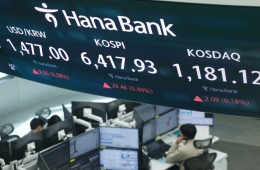
The KOSPI rose early in the session, reaching a new all-time high once again. Yonhap News
View original imageOn April 22, the KOSPI opened at 6,387.57, down 0.01% from the previous session, and extended its decline to trade at 6,360.56, down 0.44% as of 10:05 a.m. During the session, it briefly surpassed 6,400 points for the first time ever but failed to maintain its gains. The KOSDAQ is trading at 1,164.43, down 1.24%.

There is analysis that while expectations for semiconductor sector earnings remain high, a rotational rally is spreading warmth to sectors such as secondary batteries, nuclear power, and defense. In particular, for secondary batteries, the Middle East war has heightened concerns over crude oil supply, raising expectations for increased sales of electric vehicles and energy storage systems (ESS), which is being reflected in stock prices. The secondary battery sector remains strong today, following yesterday's gains. As of 9:21 a.m., Samsung SDI is trading at 678,000 won, up 5.12% from the previous session, while LG Energy Solution (up 1.36%), Lotte Energy Materials (up 5.47%), and Ecopro (up 0.67%) are also on the rise. Choi Taeyong, a researcher at DS Investment & Securities, stated, "A solid upward trend in lithium prices, expectations for new ESS orders, and a rebound in electric vehicle demand are prompting a revaluation of secondary battery sector stocks."
There are also opinions that attention should be paid to sectors where the consensus operating profit growth rate for the second quarter is improving compared to the first quarter. According to Kiwoom Securities, some sectors, such as banks, have started to see fundamental improvements since April. Han Jiyoung, a researcher at Kiwoom Securities, explained, "Not only leading sectors like semiconductors but also banks, software, hotels, and automotive sectors, which are expected to see improved operating profit in the second quarter, are worth attention in terms of rotational plays."
In addition to earnings, supply-demand conditions are also positive. According to the Korea Exchange, foreign investors have been net buyers of 5.2479 trillion won in the KOSPI market this month. After recording a net purchase of 118.5 billion won in January, foreign investors went on a massive selling spree in February and March, selling 21.0731 trillion won and 35.8806 trillion won, respectively. However, this month, they have changed course, buying more than 5 trillion won worth of shares.
Noh Donggil, a researcher at Shinhan Investment & Securities, analyzed, "The core of this rebound is not just a recovery from previous declines," adding, "It is a supply-demand rally driven by the return of foreign investors who had reduced their share of Korean stocks in February and March."
Foreign buying is being concentrated in semiconductors. In the first quarter of this year, foreign investors were net sellers of 37.087 trillion won of Samsung Electronics and 17.5023 trillion won of SK hynix, but so far this month, they have been net buyers of 2.1648 trillion won of SK hynix and 1.3191 trillion won of Samsung Electronics as of the previous day. Funds are also flowing in through U.S. semiconductor ETFs, which allocate about half of their portfolio to Samsung Electronics and SK hynix. On April 2, the "Roundhill Memory ETF (DRAM)" listed in the U.S. surpassed 1.06 billion dollars (about 1.57 trillion won) in assets under management just 18 days after its listing.
Recently, the ETF market has grown to the 400 trillion won range, and its role in the domestic stock market’s supply-demand structure is increasingly significant. Financial investment (securities) firms, whose funds are presumed to come from ETFs, have been net buyers of 10.8446 trillion won in the KOSPI market this month. Last month, they also bought 2.1122 trillion won, and alongside individuals, who were net buyers of 33.569 trillion won, they absorbed the foreign selling and helped defend the market from a decline. The average daily trading value of ETFs this year is about 17.3 trillion won, more than triple last year's 5.5 trillion won, and the share of ETFs relative to the KOSPI has expanded from 44% last year to about 60% this year.
Hot Picks Today
 "Chairman Chey Tae-won's Warning Comes True"......
With the stock market's strength, standby funds are also increasing. According to the Korea Financial Investment Association, as of April 20, investor deposits stood at 121.8172 trillion won. Investor deposits refer to funds entrusted to securities firms by investors intending to purchase stocks and are regarded as standby funds poised to enter the market. Although deposits surpassed 130 trillion won early last month, they fell below 120 trillion won due to the fallout from the Middle East war, but have been increasing again recently. As of April 20, margin trading balances also swelled to a record-high 34.2592 trillion won.
© The Asia Business Daily(www.asiae.co.kr). All rights reserved.