Is It Fair That "Gold Spoon" Asset Holders Dominate Gangnam Public Rental Housing, Even With an Asset Cap of 640 Million Won?
Public Contributions from Reconstruction Used as Public Rental Housing
Jeonse Deposits for New Gangnam Apartments Approach 1 Billion Won
"Benefits Limited to Residents; Effectiveness Needs Improvement"
Seoul City: "Need to Maintain th
At the Raemian Onepentas complex in Seocho-gu, Seoul, where a cabinet minister nominee who withdrew earlier this year resides, there are 37 public rental housing units owned by the Seoul Housing & Communities Corporation. During urban renewal projects such as reconstruction and redevelopment, local governments with approval authority can receive new homes as compensation for incentives such as increased floor area ratio and utilize them as public rental housing.
The jeonse deposit for the 59-square-meter public rental units at Onepentas is 975 million won. Although this is significantly lower than the market jeonse prices for similar-sized units, which were around 1.5 billion won at the time of occupancy in the second half of 2024, it is still much higher than the typical deposit for public rental housing.
To apply for residency here, the applicant and all household members must be without home ownership, with an average monthly income of 7.63 million won or less for a three-person household (as of the 2025 announcement), and the total assets of all members must not exceed 640 million won. No household member can own a car valued at more than 38 million won.

The maximum loan limit using public funds such as the Bogeumjari Loan is 200 million won. This means that unless one already has significant assets, even saving ten years’ worth of income without spending a single won would still make it difficult to cover the deposit. This has led to criticism that these rental units are in effect targeted at a very limited group of so-called “gold-spoon” asset holders who can rely on parental support.
There have been ongoing criticisms regarding whether it is appropriate for a small privileged group to fully benefit from assets secured through public systems. At a recent seminar, Lee Taehee, a research fellow at the Korea Institute of Construction Industry, argued that such rental housing policies need to be reconsidered. He stated, “There is a high probability that those moving into public rental units secured through public contributions from reconstruction projects in the Gangnam area are not from vulnerable groups. Even if that is not the case, the current system, which allows residents to exclusively enjoy these benefits, does not contribute to maximizing social utility.”
He then suggested that public contributions could be collected in the form of cash rather than housing units. By using the resulting funds for housing welfare, a greater number of people could benefit. In the Gangnam area, conflicts often arise within and outside of reconstruction associations over the proportion and composition of rental housing. These disputes frequently delay projects because they cannot be resolved. Tensions are expected to intensify further, especially since it is anticipated that, like regular members, rental housing units will also be allocated through public lotteries in the future.

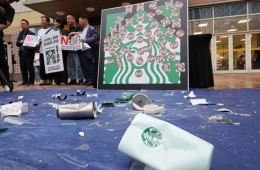
Representatives of the Disaster Inequality Memorial Action, consisting of 177 labor and civil society organizations including the Solidarity for a Poverty Society and the Korean Confederation of Trade Unions, held a press conference near the presidential office in Yongsan, Seoul, in 2022, condemning the Yoon Seokyeol administration's drastic budget cuts to public rental housing./Photo by Hyunmin Kim kimhyun81@
View original imageThe Seoul Metropolitan Government is also grappling with this issue. There is still widespread aversion to rental housing, and allowing public contributions in the form of cash or other assets rather than housing could further exacerbate this phenomenon. A Seoul city official commented on the idea of accepting public contributions in cash, saying, “This goes against the purpose of the social mix, which is to mix owner-occupied and rental units within the same complex. However, considering the main target demographic, we are accepting small and medium-sized homes and utilizing them as public rental housing.”
According to the current Urban and Residential Environment Improvement Act and the Seoul Metropolitan Government’s Basic Plan for Urban and Residential Environment Improvement, in general residential areas (Type 3) in the Gangnam region, public contributions are required for any floor area ratio exceeding 230%. As explained by Seoul city officials, when the floor area ratio increases by 20 percentage points—for example, from 230% to 250%—a portion of the increment can be donated in cash or other forms of assets.
Hot Picks Today
 "Only Two Per Person" Garbage Bag Crisis Was Just Yesterday... Japan Also Faces Shortage Anxiety
- "Samsung Electronics Employee with 100 Million Won Salary Receiving 600 Million Won Bonus... Estimated Tax Revealed"
- Lived as Family for Over 30 Years... Daughter-in-Law Cast Aside After Husband's Death
- 'Will Demand Finally Decline Due to High Prices?'... "I'll Just Enjoy Nearby Trips" as Japan and China See a Surge
- "Wore It Once, Then This? White Spots All Over 4.15 Million Won Prada Jacket... 'Full Refund Ordered'"
However, if the floor area ratio exceeds 250%, public contributions become mandatory, and half of the additional housing units must be provided as public contributions. In this case, it is not permitted to provide cash or other forms of assets instead. Lee Taehee noted, “Given that the primary policy objective is to ensure housing stability for vulnerable groups, it is possible to devise ways to use secured cash to improve infrastructure and provide benefits to a greater number of people.”
© The Asia Business Daily(www.asiae.co.kr). All rights reserved.