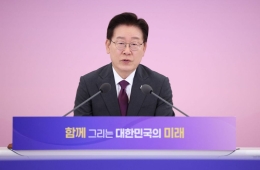
Seocho District Mayor Jeon Seongsu: "Seocho Offers Both Youth Platforms and Senior Lounges"
Interview with Mayor Jeon Seongsu
"From Lounges Instead of Senior Centers, to Home Instead of Nursing Facilities"
Fostering Digital Youth Talent Next to the AI Special Zone
Seocho District in Seoul won the top prize at the 'Korea Healthy and Age-Friendly City Policy Awards,' a distinction achieved by only 6 of the 226 local governments nationwide. This marks the second consecutive year Seocho District has been recognized, following its top honors in the education and welfare sector at last year's Local Government Administration Awards.
The judging panel paid particular attention to the so-called "Seocho-style model," which broke away from the outdated, senior center-based welfare framework by integrating intergenerational spaces with an artificial intelligence (AI) care platform. Two days before the award announcement, on March 10, The Asia Business Daily interviewed Seocho District Mayor Jeon Seongsu to discuss the district’s senior citizen and youth policies as it prepares for a super-aged society.

Seongsoo Jeon, mayor of Seocho District, explained the district’s senior citizen policies and youth policies in an interview with The Asia Business Daily on the 10th. Courtesy of Seocho District Office.
View original image"Seniors are not merely recipients of welfare, but people to be respected"
Seocho District boasts the highest healthy life expectancy among Seoul’s 25 districts at 73.02 years. Its overall life expectancy of 87.99 years ranks first nationwide. Mayor Jeon Seongsu noted, “Healthy life expectancy is more valuable because it refers not just to living longer, but to the period one can live healthily, free from illness. Our persistent efforts to implement policies spanning health, welfare, and leisure for seniors have contributed to these results.”
The starting point of Seocho's senior policies is "the right to age in familiar surroundings." Mayor Jeon explained, “What seniors really want is not institutional care, but to remain comfortably and safely in the homes and neighborhoods they know.”
To realize this, the Seocho Care Welfare Foundation was launched in December last year. Seocho District is the only autonomous district in Seoul to include "care" in the name of its welfare foundation. Acting as a control tower, it connects 55 services across five key areas—healthcare, wellness, nursing, care, and housing—with about 140 institutions in the district. It has established a collaborative network with medical, pharmacy, Korean medicine, and dental associations. This forms the core of the 'Seocho On (溫) Care' system, designed in line with the integrated care policy rolling out nationwide on March 27.
Home medical care is also expanding rapidly. Mayor Jeon remarked, “It is as difficult as picking a star from the sky to find a doctor who makes house calls.” Last January, Seocho Agape Clinic was designated as a home medical care center; this year, both an ophthalmology clinic and a rehabilitation medicine clinic joined, increasing the number of partner institutions to three.
Gaps in care are being filled with technology. An "AI Biometric IoT Care Service" that uses contactless radar sensors to detect heart rate, breathing, and falls every five seconds has been installed in 22 households of elderly people living alone.
“If you get up from bed too quickly, you might fall and be unable to get up. So, we enabled voice-activated lighting.”
The district also runs an "AI Automated Reassurance Call" service, where an AI welfare worker calls once a week, and provides AI body-type analysis-based customized exercise prescriptions at its eight senior welfare centers. The AI exercise care service, which last year served about 400 elderly people living alone, will expand to 600 participants this year.
The demand for digital education has also exceeded expectations. The Smart Senior Education Center, which opened in February last year, offered 280 courses attended by 4,668 people. Mayor Jeon shared an anecdote, laughing as he recalled that when he recently asked attendees at an AI class whether they had used ChatGPT, nearly all 50 participants raised their hands.
The spatial approach to senior centers has also changed. The newly remodeled "Senior Lounge," which converted an entire floor of an existing senior center, is an intergenerational space featuring children's play areas, table games, and massage chairs. “Traditional senior centers are closed-off, making it difficult for newcomers. So, we opened up the space.” The district has thus created a place where grandparents can look after their grandchildren. For active seniors, the Neutinamu Rest Area will expand to seven locations, including a new branch opening in Jaun-dong in the latter half of the year.
Youth and seniors alike say, "It's great to live in Seocho"
Mayor Jeon believes a neighborhood that is good for seniors should also be good for young people. “Youth policies should not be limited to support; they must provide a foundation for young people to stay, challenge themselves, and grow together. A comprehensive growth system is needed, where career, employment, cultural activities, and policy participation are organically connected,” he said.
The Seocho Youth Center, which opened in April 2024, offers everything from career and entrepreneurship counseling to AI interview simulations and youth housing consultations, all in one place. Since opening, it has seen a cumulative 60,000 users, with more than 150 young people visiting daily on average. The "Seocho Youth Network," which allows young people to voice their opinions directly to the district government, has reached its 8th iteration with 426 participants. The "Youth Popcorn" initiative, in which project teams propose ideas when departments request policy reviews, has led to 13 suggestions being implemented in district administration.

District Mayor Jeon Seongsu said, "I will do my utmost so that all generations can live in Seocho and feel truly proud of it." Provided by Seocho-gu.
View original imageEmployment support is also more detailed. The "Career Design Project" helped 65 people secure jobs last year, and since last year, Seocho became the first basic local government to host international organization job fairs, with 10 organizations, including the United Nations World Food Programme, participating.
This year, the district will introduce internship programs. Seocho offers the highest level of support among Seoul districts, covering up to 200,000 won per person for exam fees, across more than 900 types of certifications. “The initial budget of 70 million won was depleted almost instantly, so it was increased to 140 million won in last year’s supplementary budget,” Mayor Jeon said.
Talent development linked to the Yangjae AI Special Zone also stands out. The AI College, operated jointly with KAIST, boasts an 88% rate of graduates either finding jobs in related fields or advancing to graduate school. The e-Sports Academy, launched last year in partnership with T1, saw 5 out of 19 first-term graduates hired by relevant companies. The district continues to broaden opportunities for young artists, providing annual exhibition opportunities at the Seoul Arts Center’s Hangaram Art Museum, and 60 teams—selected through a 5-to-1 competition—participate in the rotating performance program at religious facilities.
Hot Picks Today
 At President Lee's Call to "Give Enough to Shock," Whistleblower Rewards Become a Real Lottery
- If a Samsung Electronics Employee with a 100 Million Won Salary Receives a 600 Million Won Performance Bonus, Taxes Total 247.19 Million Won
- Lived as Family for Over 30 Years... Daughter-in-Law Cast Aside After Husband's Death
- "White House Blocks Repatriation of 'Ebola-Infected' Doctor... Ultimately Transferred to Germany"
- "4.15 Million Won Prada Jacket Shows White Spots After One Wear"...Korea Consumer Agency Orders Full Refund
Mayor Jeon concluded, “We will spare no effort to give young people the chance to take on new challenges, provide seniors with a dignified later life, and ensure that everyone, across generations, can feel a true sense of pride in living in Seocho.”
© The Asia Business Daily(www.asiae.co.kr). All rights reserved.