High-Level Delegation Visits U.S. to Address Trade Issues After Trump Tariff Ruling and Coupang Investigation
Minister Kim Jeong-Kwan and Trade Minister Yeo Han-Koo Meet with U.S. Secretary of Commerce and USTR Representative
Discussion of Tariff Agreement Implementation and Coupang Petition Among Key Trade Issues

Kim Jeong-Kag, Minister of Trade, Industry and Energy, held a meeting with Howard Lutnick, United States Secretary of Commerce, last July in the Commerce Department meeting room in Washington DC, discussing progress in US-Korea tariff negotiations and ways to strengthen cooperation in the industrial sector. Yonhap News Agency.
View original imageIn the wake of the U.S. Supreme Court’s ruling that tariffs imposed under the International Emergency Economic Powers Act (IEEPA) were unlawful, uncertainty is mounting over U.S. tariff policy. With concerns now being raised about the possibility of a "Section 301" investigation targeting Korea, the Korean government has launched high-level trade consultations in response.
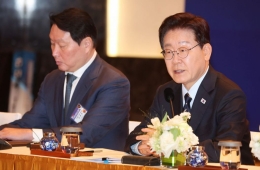
According to the Ministry of Trade, Industry and Energy on March 7, Minister Kim Jeong-Kag and Trade Minister for Negotiations Yeo Han-Koo met separately with Howard Lutnick, U.S. Secretary of Commerce, and Jamieson Greer, Acting U.S. Trade Representative (USTR), in Washington D.C. on March 6 (local time) to discuss key trade issues.
During his meeting with Secretary Lutnick, Minister Kim shared updates on Korea’s implementation of the Korea-U.S. tariff agreement, including discussions on enacting a special law for investment in the U.S., and explored ways to strengthen strategic investment cooperation between the two countries. He also conveyed Korea’s position that the existing terms of the Korea-U.S. tariff agreement must be effectively upheld in the process of any further U.S. tariff measures following the IEEPA ruling, including those under Section 122 of the Trade Act and Section 232 of the Trade Expansion Act.
Minister Yeo met with USTR representative Greer to discuss implementation plans for non-tariff measures included in the joint statement by the Korea-U.S. leaders in November last year. They agreed to convene the Korea-U.S. Free Trade Agreement (FTA) Joint Committee at an appropriate time to finalize related implementation plans.
A key agenda item in these meetings was also the petition filed by Coupang investors requesting a Section 301 investigation. Previously, Coupang investors had asked the USTR to initiate a Section 301 investigation, claiming that Korea’s digital regulations discriminate against U.S. companies. The USTR is required to decide within 45 days of receiving the petition whether to initiate an investigation, with the notification deadline set for March 7.
It has been reported that Minister Yeo made significant efforts to explain the facts regarding the scale of Coupang’s personal data leaks to U.S. officials. While Coupang disclosed approximately 3,000 cases of personal data leakage to the U.S. Securities and Exchange Commission (SEC), the Korean government’s investigation identified over 30 million cases. The government has officially communicated the relevant legal provisions and findings to U.S. authorities in writing.
The scope of the USTR’s review extends beyond the Coupang case to include digital service taxes, online platform regulations, intellectual property rights, and other aspects of digital regulation. As a result, there is a sense of caution within the Korean government that, in addition to the individual Coupang case, the U.S. may take issue with Korea’s overall digital regulatory framework.
Minister Yeo also stated at a National Assembly meeting that “situations where Korea becomes subject to investigations under Section 232 or Section 301 of the Trade Act must be avoided,” and emphasized that “various trade issues are being managed to this end.”
Hot Picks Today
 KOSPI Hits All-Time High, but "Why Is My Accoun...
The government intends to continue consultations with the U.S. side, manage trade issues affecting the U.S., and work to reduce the uncertainty faced by Korean companies.
© The Asia Business Daily(www.asiae.co.kr). All rights reserved.