Governor Kim Dongyeon Rushes to Sejong: "Line 5 Gimpo Extension Is a Matter of Residents' Right to Survival"
Governor Kim Dongyeon Attends Line 5 Gimpo-Geomdan Extension Preliminary Feasibility Subcommittee
"350 Passengers on a Train Designed for 172... Serious Safety Risks"
Emphasizes "Transportation First, Housing Later" Principle
A Decisive Move for the Line 5 Gimpo Extension
Kim Dongyeon, Governor of Gyeonggi Province, personally visited the site of the Ministry of Economy and Finance’s Fiscal Project Evaluation Subcommittee in Sejong City to emphasize the importance of the Seoul Subway Line 5 Gimpo-Geomdan extension project and to secure its approval in the preliminary feasibility study (hereinafter referred to as “preliminary feasibility review”).

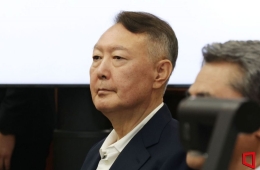
Kim Dong-yeon, Governor of Gyeonggi Province, is explaining the details after attending the Fiscal Project Evaluation Subcommittee held at the Korea Development Institute in Sejong City on the 5th. Provided by Gyeonggi Province
View original imageThe subcommittee is the final step in the review process, where each local government is given the opportunity to present its position before a decision is made on whether the project will pass the preliminary feasibility review. It is highly unusual for a metropolitan government head, rather than working-level staff, to attend the subcommittee in person, which underscores both the significance of the matter and the strong commitment to securing approval.
On the afternoon of the 5th, at the Fiscal Project Evaluation Subcommittee held at the Korea Development Institute in Sejong City, Governor Kim stated, “If we set the congestion rate of the Gimpo Gold Line at 100%, the capacity is 172 people. However, the average congestion rate is around 200%, meaning 350 passengers board a train designed for 172, creating serious safety risks. Moreover, among the 13 cities with populations exceeding 500,000 in Gyeonggi Province, Gimpo is the only city without a metropolitan rail line directly connected to Seoul. This is why today’s review is so important,” he explained, providing the background for his attendance.
Governor Kim continued, “Gimpo has a population of about 500,000, and currently, eight public housing sites are being developed. Once all of these developments are completed, we expect the population to increase by up to 200,000. This will only worsen the existing transportation crisis. The extension of Line 5 to Gimpo-Geomdan is also crucial in terms of the national government’s principle of providing transportation infrastructure before residential occupancy. I must stress how essential it is for this project to pass the preliminary feasibility review,” he appealed.
He added, “If the project proceeds smoothly, we will also consider having it operated directly by Gyeonggi Transportation Corporation, a public institution in Gyeonggi Province. Gyeonggi Province will spare no administrative or financial support within its power.”
The Seoul Subway Line 5 Gimpo-Geomdan extension project is a large-scale metropolitan rail project extending 25.8 kilometers from Banghwa Station in Seoul, connecting to Incheon (Geomdan New Town) and Gimpo (Gimpo Hangang 2 Compact City).
The project is expected to cost 3.3302 trillion won. It is anticipated to play a significant role in alleviating congestion for users of the Gimpo Gold Line (a two-car light rail connecting Gimpo City and Seoul Gimpo Airport, notorious for severe overcrowding and passenger safety issues). The preliminary feasibility review has been underway since September 2024.
The preliminary feasibility review is a procedure that evaluates the economic feasibility (B/C ratio) and policy relevance of large-scale fiscal projects.
The B/C (benefit/cost) ratio is an indicator of economic feasibility, and a ratio above 1 generally means that the project is considered economically viable. The policy relevance assessment quantifies how appropriate and necessary the project is from a policy perspective, excluding economic feasibility, using both qualitative and quantitative indicators.
In the case of Gimpo City, following the revision of the preliminary feasibility review guidelines in July last year, the weight given to the economic feasibility assessment will decrease by about 5 percentage points, from 30-45% to 25-40%.
Previously, Gyeonggi Province had continuously advocated for improvements to the preliminary feasibility review system, which was seen as discriminatory against the Seoul metropolitan area, and as a result, the Line 5 Gimpo extension project became the first to benefit from these changes.
During the meeting, Governor Kim focused on the policy relevance assessment, emphasizing that, given the extreme congestion of the Gimpo Gold Line (with an annual average congestion rate of 215%) and the expected surge in transportation demand from the planned 115,000 residents of the Gimpo Hangang 2 Compact City, the Seoul Subway Line 5 Gimpo-Geomdan extension is not merely an expansion of the transportation network but a matter of residents’ “right to survival.”
Hot Picks Today
 The Quoted 800,000 Won, the Bill Was 5 Million....
- Tragedy in Luxury Apartment: Woman in Her 20s Found Dead, Suspect Identified
- They Say They'd Rather Go to Japan Than Travel Domestically... But a 'Surprising...
- "You Can Only Have This in Korea": Which National Museum Cafe Menu Is Captivatin...
- "Never Hike Alone as a Woman" "Even Two Are at Risk"... Growing Fear of Crime on...
The results of this subcommittee’s review will be finalized through the Fiscal Project Evaluation Committee of the Ministry of Economy and Finance. If the preliminary feasibility review is approved, Gyeonggi Province plans to promptly and seamlessly establish a basic plan for the urban railway, which will specify route, station locations, facility scale, project cost, and funding methods in accordance with national standards.
© The Asia Business Daily(www.asiae.co.kr). All rights reserved.