Seongbuk-gu Shaken by '90% Disappearance of Jeonse Listings'... The Seoul City Numbers Had a Hidden Trap
Fact-Checking the Claim: "Seongbuk-gu Jeonse Listings Plunged Due to Government Policy"
The Real Story of the Jeonse Market That the Seoul Mayor Missed
The Numbers Are Correct, but the Context Is Different
"A year ago, there were 1,300 jeonse (long-term lease) listings in Seongbuk-gu, but now there are only 124—a dramatic 90.6% decrease. Gwanak-gu saw a 78% drop, Jungnang-gu 72%, and Nowon-gu 68%. The decline in the outer districts of northern Seoul is truly severe."
This is a statement made by Seoul Mayor Oh Se-hoon during the 334th temporary session of the Seoul Metropolitan Council on February 25. On March 5, The Asia Business Daily fact-checked Mayor Oh's claim, specifically the "disappearance of jeonse listings in Seongbuk-gu." When comparing the figures he presented with actual data, the numbers themselves were found to be accurate.

Seoul Mayor Oh Se-hoon is explaining the detailed contents at the "85,000 Rapid Construction" housing project key supply strategy announcement held at Seoul City Hall on the 26th of last month. Photo by Yonhap News.
View original imageAccording to data from the real estate big data platform "Asil" as of March 4, there were 135 jeonse listings in Seongbuk-gu, a decrease of 1,238, or 90.2%, compared to 1,373 listings during the same period last year. This aligns with Mayor Oh's cited figure of a 90.6% decrease (from 1,300 to 124 listings) as of February 20, both in scale and trend.
'Base Effect'...Was It Ignored Deliberately, or Simply Unnoticed?
Mayor Oh diagnosed the sharp decline in jeonse as "a serious issue that may be due to structural factors caused by policy changes and a reorganization of the supply-demand structure." He explained, "Once people move in, they try not to leave, so no new listings come onto the market. Because there are so few listings, prices rise in the limited transactions that do occur." He pointed to the implementation of the right to request lease renewal and the government's recent real estate policies as causes.
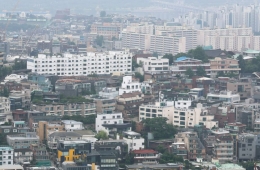
However, a closer look reveals discrepancies with Mayor Oh's explanation. A review of the statistics points to the real cause. The core reason for the sharp drop in Seongbuk-gu apartment jeonse listings is the "base effect" from last year's "Jangwi Zaai Radiant" (Jangwi District 4, 2,840 households) mega-complex move-in, which caused an "abnormal surge in supply."
Jangwi District 4, which began move-ins on March 31 last year, is the largest apartment complex supplied in Seongbuk-gu over the past decade. Based on Asil's data, jeonse listings in Seongbuk-gu peaked at 1,447 in mid-March last year, just before move-ins began. By July of the same year, after most residents had moved in, the number of listings fell to the 500s.
This was because 30–40% of the total units were suddenly put on the jeonse market just before the move-in date. The "1,300 listings" used as a comparison by Mayor Oh represent the peak of this abnormal supply surge.
During the same period, move-ins overlapped at the nearby Dongdaemun-gu Imun-Hwigyeong New Town "Raemian La Grande" (3,069 households, move-in scheduled for January 2025), causing a massive, simultaneous increase in jeonse supply across the entire northeastern region. As a result, the jeonse price for a new 84-square-meter apartment dropped to about 500 million won at that time.
A representative from a real estate agency in Jangwi-dong explained, "When a large apartment complex is about to begin move-ins, jeonse listings start to appear 3–6 months in advance. As many owners seek tenants to finance their final payments, the supply peaks about one month before move-in. January to March of last year was exactly that period."

The Main Cause of the Jeonse Shortage: Drought of New Apartment Move-Ins
The larger the scale of the complex and the more move-ins overlap with neighboring complexes, the more explosive the increase in supply. In Seongbuk-gu, after March (2,840 households) and May (191 households) last year, there have been no scheduled apartment move-ins until the end of August this year, resulting in a "move-in drought."
An official from Seongbuk-gu criticized, "Interpreting statistics without considering temporary supply-demand fluctuations from large new apartment move-ins and using them as evidence of policy failure is a clear statistical misinterpretation. All it does is fuel unnecessary anxiety among local residents."
This impact of move-in volume can also be observed when looking at Seoul as a whole during the same period. From January to June last year, there were move-ins at 21 new apartment complexes in Seoul, totaling 20,389 households. However, for the first half of this year (including expected move-ins), there are only 9 complexes and 2,964 households—a sharp 90.2% decrease compared to the same period last year.
Hot Picks Today
 Chilling Timing "Did They Know Again?"... $640 ...
- Trump: "Iran in a Crazy Situation... Orders to Fire on Mine-Laying Vessels in th...
- "I Spent Money in a Truly Meaningful Way"... How an SK hynix Employee Donated 10...
- "If You Have This at Home, Remove It Immediately"... 'This Item' Is as Harmful a...
- Foreign Vessels Once Swept Up the Seas Every Season... Now Face Fines of Up to 1...
A real estate expert pointed out, "The fact that the volume of new apartment move-ins in Seoul this year is less than half the five-year average is a major factor behind the jeonse shortage. Before blaming the government, we need to accurately understand and analyze the real causes to devise effective solutions."


© The Asia Business Daily(www.asiae.co.kr). All rights reserved.