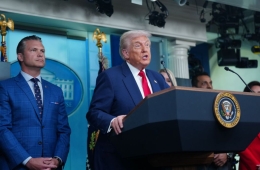
[US-Iran War] Trump Hints at 'Ground Troop Deployment'... Considering Full-Scale War With Iran? (Comprehensive)
If Ground Troops Are Deployed, Territorial Control and Regime Change May Follow
Contradicts the "Nuclear Deterrence" Objective of Iran Airstrikes
Hints at the Possibility of a Mid- to Long-Term War with Iran
"It Will Take 4-5 Weeks... Could

On the 2nd (local time), President Donald Trump of the United States indicated that he does not rule out the possibility of deploying ground troops to Iran. Deploying ground forces would mean engaging in a full-scale war with Iran, which could change both the nature and duration of the conflict compared to the original objectives.
In an interview with the New York Post that day, President Trump addressed the possibility of sending ground troops, stating, "Other presidents have said, 'There will be no ground troops,' but I do not hesitate about sending ground troops," adding, "I say it will 'probably not be necessary,' or, if needed, 'I can send them.'
The Nature of War Would Change With Ground Operations... Contradicts the Goal of 'Preventing Nuclear Weapons'
President Trump's remarks are interpreted as signaling his willingness to consider sending ground troops to Iran if necessary. Deploying ground forces would mean that the conflict with Iran could escalate into a full-scale war. This would not be limited to simply destroying Iran's key nuclear facilities, but could involve seizing Iranian territory and even contemplating regime change.
These comments contradict the military objectives toward Iran that President Trump has previously stated. In the interview, he explained that the reason for the military operation against Iran was intelligence indicating that Iran had resumed its nuclear development project.

President Trump emphasized, "Iran tried to make nuclear weapons, so we completely destroyed those facilities," and added, "But we discovered they were working to make nuclear weapons through enrichment at an entirely different location. That is why the time had come for a decisive action."
Previously, Joseph Rogers, Deputy Director of the Nuclear Issues Project at the Center for Strategic and International Studies (CSIS), a U.S. think tank, analyzed that "Most of Iran's high-value nuclear facilities were destroyed by U.S. airstrikes in June last year."
If ground troops are actually deployed, it would pose a significant burden for the Trump administration. The United States has previously deployed ground forces to the Middle East, such as in Iraq and Afghanistan, but has never succeeded.
"Iran Attack to Last 4-5 Weeks"... Implies Possibility of Medium- to Long-Term War
President Trump also hinted that the war with Iran could turn into a medium- to long-term conflict. At a 'Medal of Honor Award Ceremony' held at the White House that day, he commented on the duration of the war with Iran, saying, "It doesn't matter how long it takes," and, "I expected it to take four to five weeks, but we are capable of lasting even longer."
On the same day, President Trump also said in an interview with CNN, "We haven't even begun to strike Iran hard yet," and "The big wave hasn't happened yet." This is interpreted as implying the possibility of additional large-scale U.S. military attacks on Iran.
This also contrasts with his previous interview. When asked by the New York Post about the expected duration of the war, President Trump answered, "I don't want the war to last too long," and, "I always thought it would be over in about four weeks. We're moving a little ahead (faster) than expected."
This differs from the remarks made at a press conference held the same day by U.S. Secretary of Defense Pete Hegseth, along with Joint Chiefs of Staff Chairman Dan Kane, who said, "Iran is not Iraq," and "This is not an endless war like Iraq."
President Trump appears to be conveying to the American public that, unlike previous administrations, he has no intention of engaging in a prolonged war of attrition in the Middle East, while also signaling to Iran that he will not prematurely withdraw before achieving his objectives.
Uncertain Direction for Iran's Governance?
President Trump also demonstrated conflicting positions regarding Iran's system of governance. In an interview with the New York Times (NYT) on the 1st, he said, "What we did in Venezuela was a perfect scenario," mentioning the Venezuela model.
In January, the Trump administration unexpectedly arrested Venezuelan President Nicolas Maduro and recognized the power system of Vice President Delcy Rodriguez. This approach removes the top adversarial leader but maintains the existing governing structure.

Maintaining the Iranian leadership without overthrowing the regime could prevent a sudden collapse of the system and reduce chaos in the Middle East. In this case, the United States could also lessen the burden of deploying ground troops or engaging in a prolonged war.
However, in the NYT interview, President Trump also stated, "Iranian military, including hardline Revolutionary Guard officers, must hand over weapons to the Iranian people." This signals a willingness to replace the Revolutionary Guard—a key pillar of the theocratic regime—and change the political system, which is inconsistent with his earlier remarks.
When asked who should lead Iran, President Trump responded, "There are three very good choices, but I will not disclose who they are at this time."
Hot Picks Today
 KOSPI Hits All-Time High, but "Why Is My Accoun...
The fact that President Trump has mentioned both the Venezuela model and the transfer of power to the Iranian people suggests that the future direction of Iran's governance remains undecided.
© The Asia Business Daily(www.asiae.co.kr). All rights reserved.