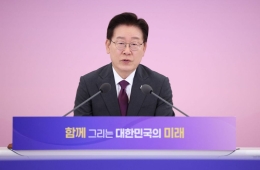
Different Focus in Military Pledges: Lee Jaemyung Emphasizes 'Military Reform', Kim Moonsu Stresses 'Deterrence Against North Korean Nukes'
Lee Junseok's Proposal to Select Officers and Non-Commissioned Officers from Active-Duty Conscripts Draws Attention
As the 21st presidential election, triggered by the 12·3 Martial Law Incident, enters full swing, each candidate's military-related pledges are drawing attention. Lee Jaemyung, the Democratic Party's presidential candidate, has put forward 'military reform' as a key theme, including the reform of military intelligence agencies. Kim Moonsu, the People Power Party's candidate, has highlighted strengthening deterrence against North Korea's nuclear threat as a major pledge. Lee Junseok, the Reform New Party's candidate, has promised to introduce a system for selecting officers and non-commissioned officers from among active-duty conscripts.

President Yoon Sukyeol declared martial law on the night of the 3rd, and in the early morning of the 4th, martial law troops are attempting to enter the main building of the National Assembly. Photo by Kim Hyunmin
View original imageAccording to the top 10 pledges submitted by each candidate to the National Election Commission on the 13th, Lee Jaemyung of the Democratic Party proposed the civilianization of national defense and the reform of military intelligence agencies through his pledge to 'overcome insurrection and restore the status of K-democracy.'
This is interpreted as a pledge that takes into account the need to reform the military’s structure, given its mobilization during the 12·3 Martial Law. Lee aims to strengthen democratic control over the military by appointing civilians as Minister of National Defense?a position monopolized by military personnel since the Third Republic. He also intends to adjust the roles of military intelligence agencies such as the Defense Security Command and the Intelligence Command, which led the 12·3 Martial Law.
In addition, Lee Jaemyung pledged to introduce a confirmation hearing system for the Chiefs of Staff of the Army, Navy, and Air Force. Currently, the Minister of National Defense recommends a general officer for each position, and the President appoints them after deliberation by the Cabinet. Lee's proposal appears aimed at further strengthening democratic oversight of these appointments.
The pledges also include measures to strengthen democratic control over the President’s authority to declare martial law. Lee proposes to reinforce institutional guarantees for the National Assembly’s power to lift martial law. Improvements are expected, such as requiring the President to obtain the National Assembly’s consent before declaring martial law, or allowing the Assembly to immediately lift martial law without Cabinet deliberation if it so decides.
Additionally, Lee Jaemyung pledged to secure comprehensive deterrence capabilities based on a strong South Korea-U.S. alliance. Specific measures include upgrading the performance of Korean ballistic missiles and advancing the Korean missile defense system. However, pledges such as the introduction of nuclear-powered submarines were not included among the top 10, possibly in consideration of U.S. concerns about sensitive country designation.
Kim Moonsu did not present a separate military reform pledge. Instead, he proposed strengthening deterrence against the growing North Korean nuclear threat. Kim pledged to amend the South Korea-U.S. nuclear agreement to allow South Korea to acquire uranium enrichment and plutonium reprocessing technology at a level comparable to Japan, thereby enhancing nuclear potential. He also declared that, through close U.S.-South Korea consultations, South Korea would accumulate nuclear weapon design technology if necessary.
In particular, Kim Moonsu pledged that if North Korea’s nuclear threat intensifies, he would consult with the U.S. on the 'redeployment of tactical nuclear weapons' and 'NATO-style nuclear sharing.' He also plans to pursue the development of nuclear-powered submarines.
Hot Picks Today
 At President Lee's Call to "Give Enough to Shock," Whistleblower Rewards Become a Real Lottery
- If They Fail Next Year, Bonus Drops to 97 Million Won... A Closer Look at Samsung Electronics DS Division’s 600M vs 460M vs 160M Performance Bonuses
- Lived as Family for Over 30 Years... Daughter-in-Law Cast Aside After Husband's Death
- "If Both Spouses Work There, How Much Would They Make?" "They Earn More Than Me, and I'm a Doctor"... Envy Erupts Over Samsung Electronics' Bonus
- "Who Is Visiting Japan These Days?" The Once-Crowded Tourist Spots Empty Out... What's Happening?
Lee Junseok drew attention by pledging to introduce a system for selecting officers and non-commissioned officers from among active-duty conscripts. He proposes conducting four weeks of integrated basic military training for all conscripts and selecting outstanding individuals as officers or non-commissioned officers. These individuals would receive incentives such as full tuition support for university or graduate school, proportional to the length of their service, if they fulfill their short-term service obligations faithfully.
© The Asia Business Daily(www.asiae.co.kr). All rights reserved.