Even the Military Command Faces Indictments... The Aftermath of the 'Incompetent' Public Corruption Investigation Unit
President Yoon Suk-yeol Ultimately Fails to Arrest
Inevitable Impact on Trial
Joint Task Force System Faces 'Shaking' Crisis
The High-ranking Officials' Crime Investigation Agency (HCIA) is facing severe backlash after failing to arrest President Yoon Seok-yeol, who has been identified as the ringleader of the insurrection. Although military commanders and others involved in the insurrection have been consecutively indicted, the investigation into the ringleader himself has not taken place, raising concerns about negative repercussions for future trials and investigations of other participants. The cooperation system between the HCIA and the police is also reportedly wavering, which could hinder the swift progress of the investigation.

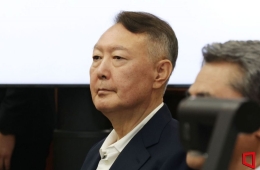
Odongwoon, Chief of the High-ranking Officials' Crime Investigation Department, is arriving at the Public Officials Crime Investigation Office within the Government Gwacheon Complex on the 6th. Photo by Jo Yongjun
View original imageEffectively Yoon’s Indictment... Inevitable Impact on Trial
According to the legal community on the 7th, the Special Investigation Headquarters of the prosecution, which is investigating the December 3 emergency martial law incident, indicted Moon Sang-ho, the commander of the Defense Intelligence Command, yesterday on charges including participation in a major insurrection. Since the 27th of last month, the prosecution has been consecutively indicting military commanders involved in the insurrection who conspired to deploy troops to the National Assembly and the Central Election Commission, including former Minister of National Defense Kim Yong-hyun, Counterintelligence Commander Yeo In-hyung, Capital Defense Command Commander Lee Jin-woo, Army Chief of Staff Park An-soo, and Special Warfare Command Commander Kwak Jong-geun.
The indictments of these individuals can be said to be effectively indictments of President Yoon himself. The word “President” appears 141 times in former Minister Kim’s indictment. The prosecution stated in the indictments that these individuals acted under President Yoon’s orders.

However, the HCIA, which received the case from the prosecution, failed to execute the arrest warrant for President Yoon before its expiration and chose to reapply to the court. During the upcoming trials of former Minister Kim and others, the evidence secured by the prosecution will be disclosed. This means the suspects will be able to anticipate and respond to the evidence held by the investigative agencies in advance. If the investigation into President Yoon is further delayed, it will inevitably affect not only the security of the case but also other investigations and trials.
HCIA’s Self-Admitted ‘Incompetence’
Despite strong opposition from President Yoon’s side claiming that the HCIA lacks jurisdiction over insurrection charges, the court issued an arrest warrant, thereby recognizing its legitimacy. After the warrant was issued, President Yoon’s side even resorted to a legally unsupported “objection” procedure, but the court rejected it again, confirming the legitimacy of the warrant issuance.
However, the HCIA sent an official letter to the police the day before the warrant expired, attempting to delegate the execution of the warrant to the police, only to withdraw it later, resulting in an embarrassing situation. During this process, the police pointed out that the official letter had legal defects, causing further humiliation. This amounted to an admission that the HCIA lacked both the capability to execute the warrant and the ability to properly review and apply legal principles.
Questions are also being raised about whether the HCIA is properly engaging in this investigation. Aside from the arrest warrant for President Yoon, the only other arrest warrant the HCIA has obtained is for Commander Moon. Even that case was transferred to the HCIA after the police made an emergency arrest, which the prosecution did not approve due to Moon being an active-duty military officer.

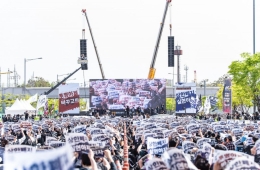
On the 6th, members of a civic group calling for the arrest of President Yoon are regrouping near the presidential residence in Yongsan-gu, Seoul. Photo by Kang Jin-hyung
View original imageShaken ‘Cooperative Investigation Headquarters’ System
Although the HCIA and the police claim that the Cooperative Investigation Headquarters (CIH) system remains intact, the reality is different. On the 3rd, during the execution of the arrest warrant, there was disagreement over the arrest of Park Jong-jun, the head of the Presidential Security Service. At that time, the police attempted to arrest Park, who had prevented the arrest of President Yoon, but the HCIA reportedly blocked the attempt.
Hot Picks Today
 "I Wish I Could Get Some Sleep" Frozen Meals an...
- The Quoted 800,000 Won, the Bill Was 5 Million... Bereaved Families of 'No-Funer...
- "You Can Only Have This in Korea": Which National Museum Cafe Menu Is Captivatin...
- Samsung Electronics Faces Production Disruption: Foundry Output Plunges 58% on D...
- "Never Hike Alone as a Woman" "Even Two Are at Risk"... Growing Fear of Crime on...
Regarding the HCIA’s unilateral delegation of warrant execution, police expressed dissatisfaction, saying, “There has never been a case where the police executed a warrant issued to the prosecution on their behalf,” and “It’s absurd to just be told to arrest someone without the case being transferred.”
© The Asia Business Daily(www.asiae.co.kr). All rights reserved.