Chairman Chey Tae-won Meets Leaders of Four Parties to Discuss Semiconductor Subsidies, Regulatory Relief, and Energy Shortage (Comprehensive)
Chairman Choi: "Direct Semiconductor Subsidies Will Be Helpful"
Also Points Out "Lack of National-Level AI Strategy"
Choi Tae-won, Chairman of the Korea Chamber of Commerce and Industry, met with the leaders of the People Power Party, the Democratic Party, the Joguk Innovation Party, and the Reform Innovation Party at the National Assembly on the 5th to request deregulation relief, energy issues, and direct subsidies for semiconductors. In response, the leaders of the four parties expressed their intention to pursue bipartisan cooperation and review the requests.

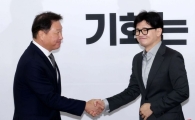
Handonghun, leader of the People Power Party, is greeting Chey Tae-won, chairman of the Korea Chamber of Commerce and Industry, who visited the National Assembly on the 5th. Photo by Hyunmin Kim kimhyun81@
View original imageOn that day, Chairman Choi first met with Han Dong-hoon, leader of the People Power Party. Kwak Gyu-taek, senior spokesperson for the People Power Party, explained, "Chairman Choi said that AI data centers and advanced industries require massive amounts of energy, and renewable energy alone might be insufficient," adding, "He did not specifically advocate for expanding nuclear power generation, but emphasized that since renewable energy alone is insufficient, sufficient attention should also be given to other energy sources such as nuclear power."
Senior spokesperson Kwak also conveyed, "Chairman Choi said that deregulating regional projects is necessary to resolve youth issues, educational disparities, and regional gaps," and "He also requested active consideration of ways to relieve regulations related to regional projects." In response, Leader Han said, "We will listen carefully to the regulatory reform issues and continue the dialogue together."
Chairman Choi is also reported to have pointed out a lack of a national-level strategy related to AI. Kim Sang-hoon, chairman of the People Power Party’s Policy Committee, responded that the AI Basic Act has been proposed and that they will sincerely consult with the opposition party. Furthermore, Chairman Choi expressed his intention to deliver regulatory-related opinions suggested by member companies of the Korea Chamber of Commerce and Industry to the National Assembly.

Chairman Chey Tae-won of the Korea Chamber of Commerce and Industry is shaking hands with Cho Kuk, leader of the Innovation Party, at the National Assembly on the 5th. Photo by Kim Hyun-min kimhyun81@
View original imageAfterwards, Chairman Choi met with Joguk Innovation Party leader Jo Guk and conveyed his hope for direct government subsidies in the semiconductor sector. Kim Bo-hyeop, senior spokesperson for the Joguk Innovation Party, told reporters after the meeting, "Chairman Choi said that most competing countries have direct subsidies, but South Korea is the only one without them," adding, "He requested the Joguk Innovation Party’s cooperation on this matter." When Leader Jo asked whether direct subsidies might violate World Trade Organization (WTO) agreements, Chairman Choi replied, "They have effectively become meaningless," and explained, "If direct subsidies exist, it would help not only Korean companies like Samsung and SK but also attract foreign companies. It would serve as an incentive for foreign companies to enter Korea." Meanwhile, although the ruling People Power Party is pushing for a Semiconductor Special Act as party policy, the government is hesitant to include provisions for direct semiconductor subsidy support in the special law.
Chairman Choi also held a meeting with Lee Jae-myung, leader of the Democratic Party. Leader Lee said, "A few days ago, I spoke with Leader Han about jointly researching and promoting support measures for core industries such as AI and semiconductors," adding, "We will try to open that path as quickly as possible." He continued, "We have supported and cooperated to help the Yongin semiconductor cluster settle quickly, but I heard they are struggling due to power issues, which is regrettable," and emphasized, "Going forward, since the AI industry consumes enormous amounts of power, transitioning to renewable energy and a carbon-zero society poses a major challenge for South Korea. I look forward to hearing about possible alternatives."

Lee Jae-myung, leader of the Democratic Party of Korea, met with Choi Tae-won, chairman of the Korea Chamber of Commerce and Industry, who visited the National Assembly on the 5th, exchanged greetings, and then moved to another location. Photo by Kim Hyun-min kimhyun81@
View original imageFollowing this, Leader Lee and Chairman Choi held a private meeting to discuss the power demand and supply measures necessary for the Yongin semiconductor cluster. Cho Seung-rae, senior spokesperson for the Democratic Party, explained, "99% of the private meeting focused on energy issues, including opinions on the flow of renewable energy and how to evaluate nuclear energy," adding, "The two did not reach any conclusions but shared and communicated about the current energy issues and exchanged updates."
Related Articles
 Handonghun "Both Parties Support Semiconductors"... Choi Taewon "Advanced Industries Can't Rely on Renewable Energy Alone"
Finally, Chairman Choi visited Heo Eun-ah, leader of the Reform Innovation Party. In her opening remarks, Leader Heo said, "The Reform Innovation Party fully sympathizes with Chairman Choi’s special interest in the Semiconductor Special Act and other matters," adding, "I hope there will be many opportunities to work together. I hope today will be a precious first step in building a communication platform with the business community to jointly design the future of reform." Chairman Choi said, "Now that the regular National Assembly session has begun, I hope there will be a strong wind blowing from Yeouido," and added, "I heard that reform is now more difficult than revolution. The business community will also show great courage for better reform."
© The Asia Business Daily(www.asiae.co.kr). All rights reserved.







