Kim Moon-soo: "Our ancestors during the occupation period were Japanese nationals... Was Son Ki-jeong wrong for the 'Rising Sun Flag'?"
"During Japanese Colonial Period, Ancestors' Nationality Was Japanese" Maintains Existing Position
"Was Forced Labor of Koreans at Sado Mine True?" Responds "Don't Know"
![Minister of Employment and Labor Kim Moon-soo maintained his previous stance that "ancestors' nationality during the Japanese colonial period was Japanese." The photo shows Minister Kim responding to questions at the National Assembly confirmation hearing on the 26th of last month. <br>[Photo by Yonhap News]](http://www.asiae.co.kr/news/img_view.htm?img=2024090313190716241_1725337147.jpg)
Minister of Employment and Labor Kim Moon-soo maintained his previous stance that "ancestors' nationality during the Japanese colonial period was Japanese." The photo shows Minister Kim responding to questions at the National Assembly confirmation hearing on the 26th of last month.
[Photo by Yonhap News]
Kim Moon-soo, Minister of Employment and Labor, maintained his previous stance that "the nationality of our ancestors during the Japanese colonial period was Japanese."
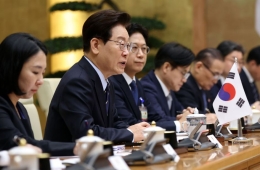
On the 2nd, during the comprehensive policy questioning at the National Assembly's Special Committee on Budget and Accounts, Democratic Party lawmaker Lee Jae-gang pointed out, "Minister Kim said that the nationality of our ancestors who lived under Japanese rule was Japanese." In response, Kim retorted, "If not Japanese nationality, then what nationality would it be?" He added, "It was the Provisional Government, not a state. Son Ki-jung was not a traitor but a patriot just because he competed in the Berlin Olympics under the Japanese flag."
When Lee criticized, "The behavior of Minister Kim and other New Right figures corresponds to the disruption of the national order as defined by our criminal law," Kim shot back, "Study more. Look at international law."
When Lee asked, "Were the Koreans who worked at Japan's Sado Mine and Hashima Island (Gunkanjima) voluntary laborers who went to earn money, or were they slaves forcibly taken?" Kim evaded the question, saying, "I don't know the exact details about the Sado Mine because I haven't studied it."
When Lee asked again, "Are you saying that the countless souls who were forcibly taken to Sado Mine and Hashima Island, worked without pay, and never returned to their homeland, are Japanese?" Kim responded, "We need to uncover whether such people exist."
Regarding the Supreme Court ruling that recognized Korean laborers at Sado Mine as victims of forced mobilization, Kim said, "It's not that I don't acknowledge the Supreme Court's ruling," but added, "The facts need to be confirmed, and I cannot know all the facts right now."
Hot Picks Today
!["What Should I Eat? Cooking at Home Is a Hassle... 10,000~20,000 Won 'Hotel-Level Catering' Spreads in Ultra-Luxury Apartments [Luxury World]"](https://cwcontent.asiae.co.kr/asiaresize/93/2026042610544940447_1777168490.png) "What Should I Eat? Cooking at Home Is a Hassle...
"What Should I Eat? Cooking at Home Is a Hassle...
- Revealing Real Estate and Account Balances for Marriage... Duo Faces Fallout Aft...
- US Millionaire Trampled to Death by Elephant While Hunting in Africa
- "Up to 600,000 Won Per Person, Finally Available"... Be Careful: Filling Up at Y...
- No Work, No Inheritance for the Eldest... 30 Billion KRW in Shares Gifted to Sec...
Earlier, at a confirmation hearing held at the National Assembly last month, when criticism arose over his past remarks such as "The Republic of Korea was founded in 1948" and "It is common sense that the nationality under Japanese rule was Japanese," Kim responded, "During the Japanese colonial era, there was no country, so everyone had Japanese nationality. Where else would it be? The Republic of Korea did not exist, so how could it be otherwise?" This response sparked controversy.
© The Asia Business Daily(www.asiae.co.kr). All rights reserved.