"Massive Supply of Newlywed Housing"... Oh Se-hoon Reveals Reason for 'Greenbelt Release' (Comprehensive)
"We intend to significantly increase the supply of housing for newlyweds."
On the 9th, Seoul Mayor Oh Se-hoon made this statement in relation to the government's announcement to lift the Greenbelt (GB, Development Restriction Zone) in Seoul to supply housing.

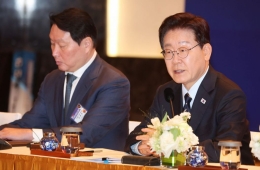
Seoul Mayor Oh Se-hoon announced the Seoul Metropolitan Government's plan to expand housing supply on the 9th at Seoul City Hall, in relation to the government's housing supply expansion measures announced on the 8th. The plan includes lifting some restrictions on greenbelt areas and supplying housing for future generations such as newlyweds. Photo by Heo Young-han younghan@
View original imageOn the same day, Mayor Oh held a press briefing at Seoul City Hall in the morning and explained, "Given the current era's circumstances, including population decline due to low birth rates and the urgent housing issues faced by the younger generation, partially lifting the Greenbelt is an unavoidable choice." The city had refrained from lifting the Greenbelt to preserve the natural environment, but as housing prices surged sharply and supply shortages intensified, the need for land development within Seoul grew, prompting a change in stance.
He said, "I understand there are many voices concerned about the destruction or shortage of green spaces," adding, "I myself hesitated a lot." He further stated, "We plan to proceed by utilizing areas that are unmanaged and damaged, with relatively low conservation value, addressing the concerns of citizens."
Mayor Oh explained the background of his participation, saying, "We judged that if the areas are limited to those already damaged and functionally lost, and used for housing supply for future generations, it could be acceptable. Even squeezing a dry towel, it is difficult to secure more than 4,000 households annually for newlyweds. We received a proposal from the government, and missing this decisive timing would render all efforts ineffective."
The city plans to supply most of the housing in the Greenbelt-lifted areas as long-term rental housingⅡ, such as ‘20-year Jeonse housing for newlywed household heads.’

This is the first time in about 12 years that the city has announced a Greenbelt lifting policy. The Lee Myung-bak administration lifted 34㎢ of Greenbelt from 2009 to 2012 in areas including Jagok-dong and Segok-dong in Gangnam-gu, Umyeon-dong and Naegok-dong in Seocho-gu, and Godeok-dong, Gangil-dong, and Sangil-dong in Gangdong-gu to supply housing.
The areas to be lifted this time will be disclosed in November. The city refrained from mentioning specific selection criteria and target sites. However, considering that most northern areas are mountainous and unsuitable for land development, it is expected that Greenbelt areas around Gangnam will be selected. Areas such as the Suseo vehicle depot in Gangnam-gu and the Gimpo Airport area in Gangseo-gu are being mentioned.
A Seoul city official explained about damaged areas, "Not all Greenbelt areas are covered with forests or woodlands. Areas with low slopes, farmland, or underutilized land with low environmental conservation value are called damaged areas." The official added that residential villages, which are in the form of housing, will be excluded as much as possible.
It is expected that apartments, which are easier to supply than detached houses, will be built in the lifted zones.
The city will also implement measures to prevent speculative demand following the Greenbelt lifting. On the 7th, Seoul held the 11th Urban Planning Committee meeting and temporarily designated the Seoul Greenbelt as a land transaction permission zone until the end of this year. Of the total 149.09㎢, 125.16㎢ are included, and when combined with the already designated areas in Gangnam and Seocho-gu and the Songpa-gu area designated by the Ministry of Land, Infrastructure and Transport, the entire Seoul Greenbelt is covered by the land transaction permission zone.
Hot Picks Today
 KOSPI Hits All-Time High, but "Why Is My Accoun...
- "If You Have This at Home, Remove It Immediately"... 'This Item' Is as Harmful a...
- President Lee and His Wife’s Favorite Item Was Also from Here... Sunjoo Lee’s ...
- "Violin Worth Billions" Spins Through the Air and Crashes to the Floor...Dramati...
- "I Spent Money in a Truly Meaningful Way"... How an SK hynix Employee Donated 10...
A Seoul city official said, "This is a preemptive response to prevent speculative demand focused on expecting development profits while the specific project scale and boundaries have not been finalized," adding, "Once the specific housing supply sites are confirmed, measures such as lifting restrictions will be implemented." The city also plans to conduct usage surveys of existing land transaction permission zones to monitor potential speculation.
© The Asia Business Daily(www.asiae.co.kr). All rights reserved.