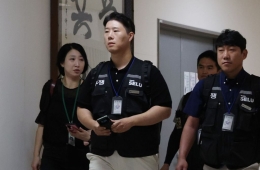
"Will blow up airport"... Police search after terror threat phone call
Threatening Call from Public Phone in Gimhae, Gyeongnam
Specific Airport for Terror Not Disclosed
A phone call warning of a terrorist attack at an airport was received by Korea Airports Corporation, prompting the police to launch a search.
On the 21st at around 1:40 PM, an unidentified person called the main number of Korea Airports Corporation and threatened to "blow up the airport," according to Yonhap News Agency. The caller did not specify which airport was targeted during the call.
The police are tracking the individual, believing the call was made from a public phone in Gimhae. Security personnel have been deployed to conduct searches not only at Gimhae International Airport but also at airports in other regions.

The photo is not related to the specific content of the article. A bird's-eye view of the expanded international terminal facilities at Gimhae Airport.
View original imageOn the 14th, a terror threat email claiming that explosives had been planted at airports and various unspecified institutions nationwide was also sent, and the police are investigating. The email, written in English, was sent to about 100 recipients, including public institutions nationwide, private companies, and religious organizations.
At around 9:06 AM that day, an employee at the Lost and Found Center of Incheon International Airport reported to 112 that they had received an email regarding the installation of explosives. The Incheon Airport Police Unit deployed a special task force and riot squad to the site to conduct a search, but no explosives were found.
In addition, extensive searches were conducted at major facilities nationwide, including Busan National University, Busan National University Hospital, Ulsan University Hospital, and the Gyeongnam Provincial Government Office, but no explosives or hazardous materials were discovered. Accordingly, the Cyber Investigation Unit of Incheon Police Agency suspects the threat is likely false and is tracking the email sender through internet protocol (IP) tracing and other methods.
Similar types of emails were reportedly sent in India in January and May. A police official stated, "Since the emails were sent via Google Gmail, we plan to request international cooperative investigations."
Meanwhile, a man in his 30s who posted bomb threat messages against five domestic airports in January received a heavier prison sentence in the appellate court than in the first trial. On January 30, the Jeju District Court Criminal Division 1 (Presiding Judge Oh Chang-hoon) overturned the original sentence of 1 year and 6 months imprisonment and sentenced the 30-year-old defendant A, who was indicted in custody on charges including obstruction of official duties by deception and violation of the Aviation Security Act, to 2 years and 6 months imprisonment.
A is accused of posting messages on a domestic online community bulletin board six times over about 3 hours and 35 minutes from 9:07 PM on August 6 last year until 12:42 AM the next day, threatening bomb attacks and murders at five airports: Jeju, Gimhae, Daegu, Incheon, and Gimpo International Airports. In his first post, he wrote, "Tomorrow at 2 o'clock, I will go to Jeju Airport to carry out a bomb attack. I have already planted a bomb at Jeju Airport and will stab people coming out of the airport with a weapon."
A, who majored in computer-related studies, is known to have used overseas IP addresses to bypass police tracking when posting the messages and reportedly reset his computer and mobile phone after the crime. Initially, he strongly denied the crime, but when the police presented objective evidence, he stated, "I wanted to test if the police could catch me. I wrote several threatening posts because I thought the police would start tracking me only if I received more attention."
Hot Picks Today
 "Samsung and Hynix Were Once for the Underachievers"... Hyundai Motor Employee's Lament
- "Was This Delicious Treat Enjoyed Only by Koreans?"... The K-Dessert Captivating Japan
- "Iran Considers Usage Fees From Surface to Seabed, Eyes $15 Billion Annual Revenue"
- Fair Trade Commission Fines "Big Five" Couriers Including Coupang and CJ 3 Billion Won for Shifting Safety Accident Liability to Agencies
- "That? It's Already Stashed" Nightlife Scene Crosses the Line [ChwiYak Nation] ③
Due to A's posts, massive public resources were wasted, including the deployment of armored vehicles for searches at the five airports. The court explained the sentencing by stating, "The defendant's crime is a serious offense that threatens public safety, and there must be awareness that such crimes warrant severe punishment," adding, "The original sentence was too light."
© The Asia Business Daily(www.asiae.co.kr). All rights reserved.