Goldman CEO Also Warns "Expecting 7 Rate Cuts Is Excessive" (Comprehensive)
"I think seven rate cuts this year are difficult. The market is moving too far ahead." Wall Street heavyweights and economic scholars gathered in Davos, Switzerland, are issuing daily warnings about the excessive expectations for rate cuts in the financial market.
![[Image source=Reuters Yonhap News]](http://www.asiae.co.kr/news/img_view.htm?img=2024011807140733524_1705529647.jpg)
David Solomon, CEO of Goldman Sachs, stated this during an interview with CNBC on the 17th (local time) in Davos, where the World Economic Forum (WEF, Davos Forum) annual meeting is being held. He said, "There is no doubt that we have made progress on inflation. The possibility of rate cuts is reasonable," but added, "Personally, I think the market's expectation of seven rate cuts this year is difficult."
This poured cold water on the market's expectations that the Fed would start lowering rates as early as March and implement 5 to 7 cuts by the end of the year. Solomon said, "Many things are happening around the world," and did not rule out the possibility that the recently heightened Middle East geopolitical risks could trigger a global inflation shock. In that case, the Fed would have no choice but to maintain high interest rates.
This aligns with the warning from Klaas Knot, President of the Dutch Central Bank, on the same day, who cautioned that the market's early rate cut expectations are excessive and could lead to 'self-destruction.' Earlier, economic scholar Kenneth Rogoff, a professor at Harvard University, also dismissed market expectations as a "pipe dream" in an interview with Bloomberg TV in Davos, saying, "The Fed will only pursue aggressive rate cuts (as the market expects) if the U.S. falls into a severe recession." According to Professor Rogoff, the probability of such a severe recession occurring is only 25%.
These warnings are particularly notable as they come amid U.S. December retail sales exceeding expectations. According to the U.S. Department of Commerce, retail sales in December last year increased by 0.6% compared to the previous month, surpassing Wall Street's forecast of 0.4%. Retail sales are considered a pillar accounting for two-thirds of the U.S. real economy and a comprehensive indicator for assessing economic health.
![[Image source=Reuters Yonhap News]](http://www.asiae.co.kr/news/img_view.htm?img=2024011706000931904_1705438809.jpg)
On Wall Street, there are also growing views that the pace of the Fed's first rate cut will fall short of market expectations. Sam Stovall, Chief Investment Strategist at CFRA Research, predicted that the Fed's rate cuts could be "later and fewer." Megan Horneman, Chief Investment Officer at Verdence Capital, dismissed expectations for a March cut, saying, "Given the current economic situation, there is no need to cut rates." She added, "If rates are cut while consumers are still spending, inflation could flare up again, which is likely the Fed's concern," and forecasted cuts in the second half of the year.
Chris Larkin, Managing Director at Morgan Stanley, also said, "The Fed has consistently emphasized that there is no need to rush rate cuts," and evaluated, "Since retail sales were stronger than expected, there is no need to change the policy stance of not rushing rate cuts." According to the Chicago Mercantile Exchange (CME) FedWatch, the interest rate futures market currently reflects about a 57% chance that the Fed will cut rates by at least 0.25 percentage points at the Federal Open Market Committee (FOMC) meeting in March after holding rates steady in January. This is significantly lower than the 70-80% range seen earlier this month.
However, the Beige Book released that afternoon contained information indicating signs of cooling in the overheated labor market, which has been fueling inflation. The Beige Book stated, "In almost all regions, there was at least one signal indicating labor market cooling, such as an increase in job seekers, a decrease in turnover rates, selective hiring by companies, and easing wage pressures." The overheated labor market is a key area the Fed has been monitoring closely, as it must cool down to achieve the 2% inflation target.
Hot Picks Today
 "Stocks Are Not Taxed, but Annual Crypto Gains Over 2.5 Million Won to Be Taxed Next Year... Investors Push Back"
- "Not Jealous of Winning the Lottery"... Entire Village Stunned as 200 Million Won Jackpot of Wild Ginseng Cluster Discovered at Jirisan
- "Jeong Yu-kyung Is a Neighbor"...Itaewon Standalone House with Record 23.2 Billion Won Appraisal Up for Auction [Real Estate AtoZ]
- "How Did an Employee Who Loved Samsung End Up Like This?"... Past Video of Samsung Electronics Union Chairman Resurfaces
- "Even With a 90 Million Won Salary and Bonuses, It Doesn’t Feel Like Much"... A Latecomer Rookie Who Beat 70 to 1 Odds [Scientists Are Disappearing] ③
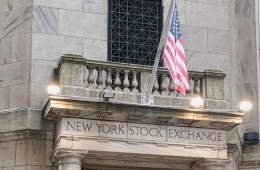
Meanwhile, the New York stock market closed lower across the board as expectations for early rate cuts retreated due to stronger-than-expected retail sales and rising Treasury yields.
© The Asia Business Daily(www.asiae.co.kr). All rights reserved.