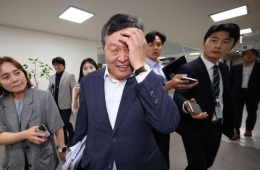
[2023 National Audit] Ruling Party: "Lee Jae-myung Perjury Coaching Trial Should Have Been Assigned to a Single Judge" (Comprehensive)
Kim Jeong-jung, Chief Judge of Seoul Central District Court, "Deemed a Case with Significant Social Impact"
Opposition: "Hundreds of Thousands of Evidence Records, Delays Due to Excessive Prosecution and Searches"
During the National Assembly Legislation and Judiciary Committee's audit on the 24th regarding the Seoul High Court and Central District Court, the ruling party criticized the assignment of the perjury coaching case involving Lee Jae-myung, leader of the Democratic Party of Korea, to a collegiate panel as a delay tactic, while the opposition party countered that the trial could be delayed due to the prosecution's excessive search and seizure and indictment.
![Kim Jeong-jung, Chief Judge of the Seoul Central District Court, is attending the National Assembly Legislation and Judiciary Committee's audit held at the Seoul High Court in Seocho-gu, Seoul, on the morning of the 24th, responding to questions from lawmakers. 2023.10.24 Photo by National Assembly Press Photographers Group [Image source=Yonhap News]](http://www.asiae.co.kr/news/img_view.htm?img=2023102419041227378_1698141852.jpg)
Kim Jeong-jung, Chief Judge of the Seoul Central District Court, is attending the National Assembly Legislation and Judiciary Committee's audit held at the Seoul High Court in Seocho-gu, Seoul, on the morning of the 24th, responding to questions from lawmakers. 2023.10.24 Photo by National Assembly Press Photographers Group [Image source=Yonhap News]
View original imageAt the audit, Jeon Ju-hye of the People Power Party stated, "The perjury coaching case against Lee was originally a case to be tried by a single criminal judge, but it is strange that it was assigned to a criminal collegiate panel through a reallocation agreement," adding, "This was a trick to extend Lee's political life. The court may face criticism for protecting Lee Jae-myung."
In response, Kim Jeong-jung, Chief Judge of the Seoul Central District Court, explained, "The perjury coaching case was initially received as a single judge case under the jurisdiction of a single judge, but the assignment authority, following regulations on the division of judges' duties and case allocation, judged that it was a case with significant social impact or that by its nature should be tried by a collegiate panel, and thus it was reassigned as a collegiate case."
The Seoul Central District Court assigned the perjury coaching case against Lee, indicted by the prosecution on the 16th, to the 33rd Criminal Division (Presiding Judge Kim Dong-hyun). This panel is also handling Lee's cases related to Daejang-dong, Wirye, Seongnam FC allegations, and the Baekhyeon-dong development preferential treatment allegations.
According to the regulations on judges' duty division and case allocation, the assignment authority (chief criminal presiding judge) may refer single cases with significant social impact to the reallocation decision committee to determine whether they should be tried by a collegiate panel.
Rep. Jeon questioned why the case was not assigned to the 34th division, which is not handling the multiple cases involving Lee, but to the 33rd division. Chief Judge Kim said, "Election law cases have separate provisions regarding loss of assembly membership and eligibility to run depending on sentencing, so they do not need to be sentenced together," and added, "I guess it was considered more appropriate to assign the case to the 33rd division handling other cases rather than the election law division (34th)."
In response, Kim Do-eup, chair of the Legislation and Judiciary Committee, said, "It is common for election law cases and general cases to be merged and heard together," and requested, "Please submit in writing this afternoon the reasons why the assignment authority made this decision."
Rep. Park Hyung-soo of the People Power Party also argued that the Daejang-dong, Baekhyeon-dong cases and the perjury coaching case have no commonalities and should not be merged. In fact, Lee's side has requested the court to merge the Baekhyeon-dong and perjury coaching cases with the Daejang-dong trial.
Rep. Park pointed out, "The Daejang-dong and Baekhyeon-dong cases have similar methods of crime and commonalities, but the perjury coaching case is completely different," adding, "If this case is merged as well, including Daejang-dong, Seongnam FC, Baekhyeon-dong, and perjury coaching, it will become a complex case, and it is uncertain when the trial will conclude."
On the other hand, Rep. Kim Seung-won of the Democratic Party countered, "Lee's defense counsel says the entire investigation record amounts to 400 volumes," and stated, "From the judge's perspective, reviewing hundreds of pages of indictments and hundreds of thousands of pages of evidence records naturally takes a long time."
Furthermore, the Democratic Party criticized the ruling party for pressuring the court by raising issues only about the perjury coaching trial, despite the prosecution having first requested the merger of the Daejang-dong and Baekhyeon-dong cases.
Hot Picks Today
!["Rather Than Endure a 1.5 Million KRW Stipend, I'd Rather Earn 500 Million in the U.S." Top Talent from SNU and KAIST Are Leaving [Scientists Are Disappearing] ①](https://cwcontent.asiae.co.kr/asiaresize/93/2026051914165468840_1779167814.png) "Rather Than Endure a 1.5 Million KRW Stipend, I'd Rather Earn 500 Million in the U.S." Top Talent from SNU and KAIST Are Leaving [Scientists Are Disappearing] ①
"Rather Than Endure a 1.5 Million KRW Stipend, I'd Rather Earn 500 Million in the U.S." Top Talent from SNU and KAIST Are Leaving [Scientists Are Disappearing] ①
- Given Grants, Then Says "No Launch" ... Innovative Korean Technology Ultimately Forced Overseas
- [Breaking] Chairman Park Sookeun: "Possibility of Agreement Instead of Samsung Electronics Labor-Management Mediation Proposal"
- "If That's the Case, Why Not Just Buy Stocks?" ETFs in Name Only, Now 'Semiconductor-Heavy' and a Playground for Short-Term Traders
- "No Cure Available, Spread Accelerates... Already 105 Dead, American Infected"
Rep. Kim Young-bae of the Democratic Party said, "The prosecution requested the merger of the Daejang-dong and Baekhyeon-dong cases, and Lee's side requested the merger of the perjury coaching case as well, but only the assignment of the perjury coaching case is being questioned," and claimed, "They are selectively pressuring the court by excluding parts favorable to themselves."
© The Asia Business Daily(www.asiae.co.kr). All rights reserved.
![Cheaper Than Candy, Yet Impossible to Find... Fears of a 'Pediatric Medical Crisis' as Pharmaceutical Companies Halt Production [Why&Next]](https://cwcontent.asiae.co.kr/asiaresize/307/2026051910065268365_1779152813.jpg)