[Why&Next] With Opinions on Interest Rate Cuts Emerging at the Monetary Policy Committee, Is a Power Struggle Beginning?
Delay in Inflation Target Convergence Due to Israel-Palestine Conflict
Growing Economic Uncertainty Fuels Future Monetary Policy Disagreements

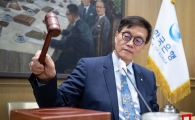
Lee Chang-yong, Governor of the Bank of Korea, is striking the gavel at the Monetary Policy Committee plenary meeting held at the Bank of Korea in Jung-gu, Seoul on the 19th. Photo by Joint Press Corps
View original image"Among the five Monetary Policy Committee (MPC) members, one emphasized the need for preemptive measures to prevent further deterioration of household debt, while another expressed that due to significant policy uncertainties, the base interest rate could either be raised or lowered over the next three months." (Lee Chang-yong, Governor of the Bank of Korea)
Governor Lee Chang-yong of the Bank of Korea (BOK) revealed at a press conference following the MPC's monetary policy meeting the previous day that although the decision to keep the base interest rate steady at 3.5% this month was unanimous, there were differing views regarding the interest rate outlook for the next three months. This has been interpreted as a reflection of the BOK’s dilemma. The war between Israel and the Palestinian militant group Hamas has pushed up international oil prices, increasing inflationary pressures, while the growing economic uncertainty in the fourth quarter has exposed the BOK’s struggle to balance inflation and growth.
One notable change in this MPC meeting was that one member kept both the possibility of raising and lowering the base interest rate open. This is the first time since the tightening began in August 2021 that the possibility of a rate cut has been officially mentioned within the MPC. Excluding the governor, the six MPC members had unanimously agreed on maintaining the base rate and the need for further hikes in the May, July, and August meetings, but this time, one member diverged and mentioned the possibility of a rate cut for the first time.
Governor Lee cautioned against overinterpretation by stating, "This is not an opinion to lower the interest rate," but the fact that a rate cut possibility was raised amid conflicting economic growth and inflation situations is seen as a significant turning point for future decision-making. Although uncertainty about U.S. monetary policy remains and the Israel-Palestine conflict adds variables, making it difficult to place much weight on the initial suggestion of a rate cut, it also indicates that a serious power struggle among MPC members could begin.
Governor Lee Cautions Against Overinterpretation... BOK’s Dilemma
Just before the MPC meeting the previous day, Governor Lee told reporters, "There is much to discuss," conveying a more urgent atmosphere than usual. This is interpreted as evidence that the governor was considering communication strategies in response to the emerging disagreements among MPC members. Given the ongoing need for tightening, there was concern that mentioning the possibility of a rate cut might be misinterpreted as a signal for monetary easing.
The market focused on the positions of the dissenting MPC members regarding future monetary policy decisions but generally emphasized that the timing of a rate cut might be delayed. Seok-gil Park, an economist at JP Morgan, revised his forecast for the timing of a rate cut from the second quarter of next year to the third quarter. Economist Park said, "The key point of this MPC meeting is that the timing for inflation to converge to the target has been delayed compared to initial expectations." He added, "The governor’s press conference was somewhat more hawkish than before because the BOK sees greater upside risks to the inflation stabilization path, suggesting that the current interest rate level may be maintained longer rather than additional hikes." Park anticipated one hawkish member, four neutral hawkish members, and one neutral dovish member, noting that this composition implies the BOK’s hawkish stance will persist if inflation and household leverage issues continue.
Regarding this, Jung-sik Kim, emeritus professor of economics at Yonsei University, said, "With market volatility increasing due to the sharp rise in U.S. Treasury yields and the won-dollar exchange rate, the conflict between inflation and growth has intensified, increasing the BOK’s dilemma." He added, "While the hawkish stance has been strengthened, the mention of a possible rate cut simultaneously shows the BOK’s predicament of being unable to either raise or lower rates."
Related Articles
 6 Consecutive Base Rate Holds... BOK at a Crossroads of Growth Rate and Inflation (Comprehensive Report 2)

Lee Chang-yong, Governor of the Bank of Korea, is presiding over the Monetary Policy Committee meeting held on the 19th at the Bank of Korea in Jung-gu, Seoul. Photo by Joint Press Corps
View original image© The Asia Business Daily(www.asiae.co.kr). All rights reserved.







