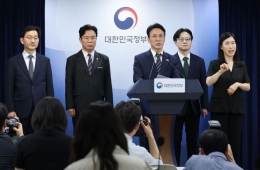
Human Rights Commission "Concerns Over Negative Impact of Public Opinion Survey Management Act on Freedom of Expression and Right to Know"
The National Human Rights Commission (NHRCK) expressed concerns that the Public Opinion Poll Management and Supervision Act, which strengthens the registration criteria for polling organizations and enhances the supervision of public opinion polls, could negatively impact freedom of expression and the right to know.

On the 18th, the NHRCK announced that on the 11th it had expressed an opinion to the Speaker of the National Assembly that the Public Opinion Poll Management and Supervision Act could significantly negatively affect the constitutionally guaranteed freedom of expression and the right to know. The reason for this opinion is that the scope of public opinion polls subject to the Act is excessively broad, the entities conducting the polls are considerably restricted, and the state is allowed to excessively intervene in the conduct, publication, and reporting of polls.
The Public Opinion Poll Management and Supervision Act, currently pending in the National Assembly, was proposed to manage and supervise public opinion polls conducted on political issues and other social matters, and consists of a total of 28 articles. To oversee matters related to the implementation, publication, and reporting of public opinion polls, the Act establishes the 'Public Opinion Poll Management and Supervision Committee' under the Prime Minister's Office and details prohibitions and obligations for polling organizations and publishers related to polls conducted for publication and reporting purposes. It is interpreted as expanding the regulatory methods applied to election polls under the Public Official Election Act to 'public opinion polls on social issues.'
The NHRCK stated, "Public opinion polls promote democratic decision-making, so they must be conducted scientifically and fairly, but at the same time, interpreting poll results and deriving implications can itself be seen as a social discussion process," adding, "Restricting the conduct, publication, and reporting of public opinion polls is closely related to freedom of expression and the right to know." Furthermore, it pointed out, "The state should be cautious in regulating the conduct and publication of public opinion polls," and "It is difficult to find cases in other advanced democracies where public opinion polls other than election polls are regulated."
Hot Picks Today
!["Not Everyone Can Afford This: Inside the World of the True Top 0.1% [Luxury World]"](https://cwcontent.asiae.co.kr/asiaresize/93/2026051507261063923_1778797570.png) "Not Everyone Can Afford This: Inside the World of the True Top 0.1% [Luxury World]"
"Not Everyone Can Afford This: Inside the World of the True Top 0.1% [Luxury World]"
- While All Eyes Were on Samsung and Hynix, This Company Surged 50% to New Highs in Four Days [Weekend Money]
- "Now Our Salaries Are 10 Million Won a Month" Record High... Semiconductor Boom Drives Performance Bonuses at Major Electronic Component Firms
- "Sold Out Everywhere" The Surprising Story of the 'Purple Gold' Philippine Yam That Has Captivated the World [Delicious Stories]
- Experts Already Watching Closely..."Target Price Set at 970,000 Won" Only Upward Momentum Remains [Weekend Money]
It continued, "The concerning parts are not just some provisions but the core contents of the bill, which are organically connected with other provisions such as the investigative and enforcement powers of the Public Opinion Poll Management and Supervision Committee and penalties, thereby exerting their effect," and stated, "It is judged that merely amending or deleting some provisions of this bill will not mitigate or resolve the negative impact on human rights, so careful consideration is needed regarding the enactment of this law itself."
© The Asia Business Daily(www.asiae.co.kr). All rights reserved.