Small and Medium Enterprises Meeting Lee Young Appeal for Extension of Exemption from Medium-Sized Company Act for Firms with Fewer Than 50 Employees
Meeting on SME Labor Issues Held on the Morning of the 26th
Discussion on Abolishing Foreign Workforce Quotas and Expanding Applicable Industries
The small and medium-sized enterprise (SME) sector requested Minister Lee Young of the Ministry of SMEs and Startups to extend the grace period for the Serious Accident Punishment Act for workplaces with fewer than 50 employees, abolish the foreign workforce quota and expand the industries where foreign workers can be utilized, and introduce more flexible working hours. In response, Minister Lee expressed empathy for the difficulties faced by SMEs and promised to raise their voices on behalf of the industry.

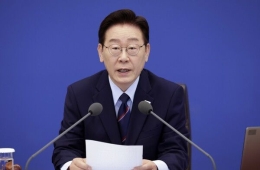
Lee Young, Minister of SMEs and Startups, is delivering opening remarks at the 'SME Labor Issues Meeting' held on the 26th at the Korea Federation of SMEs in Yeouido, Seoul. Photo by Kang Jin-hyung aymsdream@
View original imageOn the 26th, the Korea Federation of SMEs held a ‘Labor Issues Meeting with Minister Lee Young of the Ministry of SMEs and Startups’ at the Federation’s office in Yeongdeungpo, Seoul. The meeting was attended by Kim Ki-moon, chairman of the Federation, along with representatives from 10 organizations affiliated with the Council of SME Organizations.
Chairman Kim and the SME sector emphasized that extending the grace period for the Serious Accident Punishment Act, which will be enforced from January next year for workplaces with fewer than 50 employees, is the most urgent need. Chairman Kim stated, “There are 700,000 businesses with fewer than 50 employees, and 80% of them are unprepared. Since the regulations under the ‘Occupational Safety and Health-related Laws’ are broadly defined as ‘take necessary measures,’ it is difficult for SMEs to prepare, and finding specialized personnel is like finding a needle in a haystack. Although the government plans to support consulting for about 10,000 businesses this year, that is far from sufficient.”
Yoon Hak-soo, president of the Korea Specialty Contractors Association, said, “The Serious Accident Punishment Act does not consider the characteristics of companies by size, and its unclear obligations and excessive penalties mean that only large corporations or mid-sized companies with sufficient manpower and capital can respond technically and institutionally. Due to the worsening labor shortage caused by young people avoiding employment in the construction industry, it is very difficult to hire safety managers for accident prevention, so next year, companies are at a loss about what to do and how.”
Lee Jung-han, president of the Korea Women Entrepreneurs Association, also said, “With the enforcement of the Serious Accident Punishment Act in January next year, companies face a difficult environment, including the possibility of business closure due to the detention or punishment of company representatives. There are ongoing concerns that not only SME owners but also workers will suffer due to the creation of offenders and corporate bankruptcies.” She emphasized, “We ask the government to take the lead in creating safe workplaces by granting a grace period for the application of the law to workplaces with fewer than 50 employees, providing sufficient support, and presenting clear obligations.”
Minister Lee mentioned a positive review. He said, “If this ambiguous law proceeds without specific amendments, there will be significant preparation costs and confusion. I believe the Ministry of SMEs and Startups should raise a strong voice on behalf of the industry regarding this issue.” The ruling party has proposed a bill that includes a two-year grace period. Minister Lee added, “We will do our best, including consultations with related ministries and requests to the National Assembly, to ensure that the demands of the SME sector are reflected.”
In addition, voices were raised regarding the abolition of the foreign workforce quota, expansion of industries utilizing foreign workers, and flexible working hours. Jo In-ho, president of the Korea Mechanical Equipment Construction Association, said, “In plant construction sites such as power plants, steel mills, and petrochemical plants, foreign workers cannot be employed due to concerns about technology leakage and opposition from plant construction unions. However, most of the skilled workers deployed on-site perform tasks such as welding and piping, which are distinct from highly technical design work, so there is no risk of technology leakage. There is a shortage of about 10,000 skilled workers, and we propose allowing foreign workers to be employed at plant construction sites to ensure smooth manpower supply for specialty construction companies.”
Hot Picks Today
 "Stocks Are Not Taxed, but Annual Crypto Gains Over 2.5 Million Won to Be Taxed Next Year... Investors Push Back"
- "Don't Throw Away Coffee Grounds" Transformed into 'High-Grade Fuel' in Just 90 Seconds [Reading Science]
- Signed Without Viewing for 1.6 Billion Won... Jamsil and Seongbuk Jeonse Prices Jump 200 Million Won in a Month [Real Estate AtoZ]
- [Breaking] President Lee: "Sharing operating profit before taxes are deducted?... I don't understand"
- "Even With a 90 Million Won Salary and Bonuses, It Doesn’t Feel Like Much"... A Latecomer Rookie Who Beat 70 to 1 Odds [Scientists Are Disappearing] ③
Minister Lee explained, “Introducing foreign workers is no longer optional but becoming essential. We need to address practical issues such as problems with the immigration office and the broadening of visa allowances.”
© The Asia Business Daily(www.asiae.co.kr). All rights reserved.