South Korea and U.S. Conduct First Official Assessment of North Korea-Russia Space Cooperation
Defense Space Policy Working-Level Council Meeting Held in Seoul
South Korea and the United States recently shared an assessment of related trends concerning the emerging possibility of North Korea-Russia space cooperation. Although the shared trends and assessment details were not disclosed, it is noteworthy as the first official evaluation.

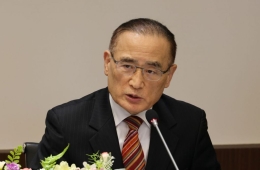
Choi Byung-ok, Director of Defense Policy at the Ministry of National Defense (right), and John Hill, U.S. Department of Defense Deputy Assistant Secretary for Space and Missile Defense, pose together for a commemorative photo (Photo by Ministry of National Defense).
View original imageAccording to the Ministry of National Defense on the 20th, from the 19th to the 20th, South Korea and the U.S. held the 2nd South Korea-U.S. Space Cooperation Tabletop Exercise (TTX) in Seoul and convened the 21st Defense Space Policy Working Group (SCWG) meeting. The event was co-chaired by Choi Byung-ok, Director of Defense Policy at the Ministry of National Defense, and John Hill, U.S. Deputy Assistant Secretary of Defense for Space and Missile Defense, with key officials from both countries in attendance.
During the TTX, the two countries focused on enhancing their shared understanding of responses and deterrence against potential threats in the space domain, and discussed mid- to long-term directions for bilateral space cooperation. The South Korean and U.S. defense ministries conducted exercises on how to respond to potential threats that may arise in the space domain. Notably, at the defense authorities’ level, they conducted the first official assessment and shared related information regarding North Korea-Russia space cooperation trends raised in light of North Korean Supreme Leader Kim Jong-un’s visit to Russia, drawing attention.
In this regard, the Ministry of National Defense stated, "The two countries paid attention to the recently identified possibility of North Korea-Russia space cooperation and shared assessments of related trends." However, the shared trends and assessment details of North Korea-Russia space cooperation were not disclosed.
Relatedly, on the 13th, North Korean Supreme Leader Kim Jong-un toured the latest rocket 'Angara' assembly and testing facility, the 'Soyuz 2' space rocket launch facility, and the currently under-construction Angara launch complex at the Vostochny Cosmodrome, guided by Russian President Vladimir Putin.
Some speculate that this visit may involve Russia transferring technology to assist North Korea’s reconnaissance satellite success, which has experienced repeated launch failures. It is analyzed that the South Korean and U.S. defense ministries conducted a detailed analysis of Kim Jong-un’s space base visit trends and evaluated expected cooperation areas during this TTX. This is the first time the defense authorities of both countries have officially analyzed and assessed North Korea-Russia space cooperation trends following Kim Jong-un’s visit to Russia through an official meeting. Additionally, the two defense ministries discussed space cooperation measures at the SCWG meeting.
The Ministry of National Defense explained, "In line with the goals set at the 54th Security Consultative Meeting (SCM) last November, various categories of space cooperation measures were discussed to further strengthen the alliance’s space cooperation."
Hot Picks Today
 "Now Our Salaries Are 10 Million Won a Month" Record High... Semiconductor Boom Drives Performance Bonuses at Major Electronic Component Firms
- Experts Already Watching Closely..."Target Price Set at 970,000 Won" Only Upward Momentum Remains [Weekend Money]
- Living the Homebody Dream? "I Was Shocked by My Spending" How to Cut Costs to 5,000 Won for Essentials [The Principles of Benefits]
- "Heading for 2 Million Won": The Company the Securities Industry Says Not to Doubt [Weekend Money]
- "Living in Another World"... The Real World of the Top 0.1%, Privileges Money Alone Can't Buy [Luxury World]
The Ministry of National Defense added that going forward, the two countries will faithfully implement the results discussed at the TTX and SCWG meetings.
© The Asia Business Daily(www.asiae.co.kr). All rights reserved.