China's Countermeasures Against Japan's Semiconductor Export Restrictions Gain Public Support: "Coming Soon"
As Japan announced measures to regulate the export of advanced semiconductor manufacturing equipment to China, a counter-response sentiment is rising within China. State-run media published experts' assessments emphasizing the need to protect China's interests through measures such as banning raw material exports. They predicted that, ultimately, Japanese companies would bear the brunt of these measures.
On the 23rd, China's state-run Global Times quoted local experts saying, "The government will take measures to protect our interests," and reported that "strategic raw material export bans and restrictions on foreign semiconductor manufacturers, as countermeasures against malicious regulations, could be 'coming soon.'"
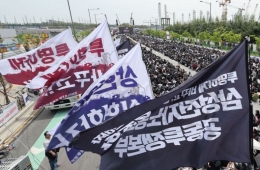
![[Image source=Reuters Yonhap News]](http://www.asiae.co.kr/news/img_view.htm?img=2023072409070416811_1690157224.jpg)
Earlier, Japan's Ministry of Economy, Trade and Industry announced that from this day forward, 23 items including lithography and cleaning equipment necessary for manufacturing advanced semiconductors would be added to the export control regulation list. The core of the policy is to apply comprehensive licensing to 42 friendly countries including the United States, South Korea, and Taiwan, while requiring separate permits for exporting related equipment to China and other countries or regions.
Da Zegang, director of the Northeast Asia Research Institute at the Heilongjiang Academy of Social Sciences, evaluated that Japan's measures could negatively impact the global semiconductor industry and that Japanese companies would also suffer damage. Director Da pointed out, "The export control measures adopted by the Japanese government will bring greater uncertainty and harm to the global semiconductor industry, which has already been hit by the United States," adding, "Japanese semiconductor manufacturers such as Nikon and Tokyo Electron may face significant difficulties, and their global competitiveness could weaken."
He further referred to the semiconductor war initiated by the United States in the 1980s, which led to the rapid decline of Japan's related industries and the downfall of giant companies like Toshiba, arguing, "If Japanese companies lose access to the Chinese market, they will face another Waterloo."
In fact, mainland China is the largest export market for Japanese semiconductor equipment manufacturers. Last year, the export volume reached 820 billion yen (approximately 7.0455 trillion KRW), accounting for about 30% of Japan's total semiconductor manufacturing equipment exports. According to the Semiconductor Industry Association (SIA) in the United States, China was the largest single semiconductor market last year, purchasing semiconductor sales worth $180.4 billion (approximately 232.3371 trillion KRW), which is one-third of global semiconductor sales.
Tu Xinquan, director of the WTO China Research Institute at Beijing Foreign Studies University of International Business and Economics, criticized, "China, as one of the major producers of information technology (IT) products and automobiles, must import a large number of chips to meet downstream production needs," adding, "This is a normal practice and part of global manufacturing and trade. There is no reason for Japan to invoke national security exceptions."
Hot Picks Today
 "Buy on Black Monday"... Japan's Nomura Forecasts 590,000 for Samsung, 4 Million for SK hynix
- "Plunged During the War, Now Surging Again"... The Real Reason Behind the 6% One-Day Silver Market Rally [Weekend Money]
- Even After the 'Tax,' High Profits Remain... Korea Emerges as a Premium Market [ChwiYakGukga]②
- "Samsung and Hynix Were Once for the Underachievers"... Hyundai Motor Employee's Lament
- "That? It's Already Stashed" Nightlife Scene Crosses the Line [ChwiYak Nation] ③
According to Chinese economic media Caixin, the local Ministry of Commerce recently held seminars with major semiconductor manufacturers to discuss the impact of regulations by the United States and its allies. Caixin reported that companies especially urged the Chinese government to take effective measures.
© The Asia Business Daily(www.asiae.co.kr). All rights reserved.