[1st Anniversary of Mayor Kang Gijeong of Gwangju in the 8th Civil Election]⑨ 'Citizen's Will' is the Top Priority
Leading Measures on Drought Countermeasures, Correcting the Name of the Joint Memorial Altar for Itaewon Disaster Victims
Nation's First Infant Heating Cost Support and Half-Price Breakfast for Workers Draw Attention with Small but Certain Happines
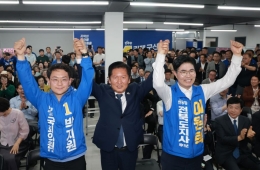
Gwangju Metropolitan City (Mayor Kang Gi-jung) is attracting attention with administration tailored to the citizens' perspective. The city is promoting citizen happiness administration through policies such as Gwangju’s nationally exemplary ‘Drought Countermeasures,’ the correction of the name of the joint memorial altar for the Itaewon tragedy victims according to citizens’ wishes, and the ‘Half-Price Breakfast for Workers,’ which was introduced for the first time nationwide?small but certain happiness, or ‘So-hwak-haeng’ policies.
![Replacement of the banner at the joint memorial altar for the Itaewon disaster. <br>[Photo by Gwangju Metropolitan City]](http://www.asiae.co.kr/news/img_view.htm?img=2023063017412282712_1688114481.jpg)
Replacement of the banner at the joint memorial altar for the Itaewon disaster.
[Photo by Gwangju Metropolitan City]
◆ ‘Drought Countermeasures’ Shining Through Citizen Water Conservation and Administrative Efforts
Having experienced the worst drought in 50 years, Gwangju overcame the crisis safely through ‘citizen conservation’ and ‘administrative efforts.’ Gwangju’s drought countermeasures became a national model and a representative case of turning adversity into opportunity.
The key factor in overcoming the drought crisis in Gwangju was the ‘citizen water conservation,’ with participation exceeding 10% water savings. Along with active citizen participation, administrative measures such as water bill reductions and water-saving education and publicity were implemented to strengthen citizen involvement.
After recently overcoming the drought crisis, Gwangju expressed gratitude to citizens by awarding plaques of appreciation to 12 outstanding citizen groups practicing water conservation and providing a special grant of 1.3 billion KRW to Seo-gu, the top-performing district in drought recovery evaluation.
In addition, drought recovery strategies such as securing emergency alternative water sources proved effective. Gwangju secured emergency alternative water sources at Yongyeon Water Purification Plant using the Yeongsan River system (Deokheungbo), which supplies 50,000 tons per day, developed groundwater (53 wells) in the upper Dongbok water source area, and prepared for rapid decreases in reservoir levels through emergency supply and alternative water resource development. They also devised water shortage solutions by adjusting the water supply system, including the use of water from Boseonggang Dam for power generation.
Furthermore, Gwangju plans to continue efforts to secure domestic water through water demand management by improving leakage rates via maintenance of water pipes over 20 years old, early establishment of a block system for water networks, and expanding water (rainwater) reuse.
Gwangju also plans to implement mid- to long-term measures to enhance urban resilience against the three major climate disasters?drought, flood, and heatwave?through systematic responses such as the ‘Add One More Dongbok Dam Project’ by connecting water channels (Water Grid).
◆ Administration Prioritizing Citizens’ Will
Gwangju’s communication administration, which prioritizes citizens’ will, also draws attention.
Through the online two-way communication platform ‘Citizen Plaza Gwangju ON,’ which newly added a survey function to the online citizen proposal platform ‘BaroSotong Gwangju,’ the city strives to capture diverse citizen voices. Additionally, the city listens to vivid voices from the field through ‘Monday Dialogue’ and ‘Policy Picnic,’ citizen dialogue channels hosted by the mayor, and reflects them in policies.
In November last year, Gwangju changed the name of the ‘Itaewon Accident Death Joint Memorial Altar’ to the ‘Itaewon Tragedy Victims Joint Memorial Altar.’ Considering the public’s rejection and ongoing social controversy over the term ‘accident death,’ Gwangju was the first in the nation to correct the name.
Not only was the name corrected, but the signboard reading ‘Itaewon Accident Death’ originally installed at the center of the altar was removed and replaced with portraits of the victims represented by white chrysanthemums on a black background. Subsequently, local governments in Gyeonggi, Jeonnam, Jeonbuk, Jeju, Seoul, and others followed suit in changing the name, earning much encouragement as an administration that soothes citizens’ hearts.
◆ Vibrant Gwangju Through ‘So-hwak-haeng’ Administration
Gwangju’s ‘So-hwak-haeng’ policies, which ensure small but certain happiness, are also bringing a breeze of small changes.
In March, Gwangju introduced the nation’s first ‘Half-Price Breakfast’ for workers to promote their health. This initiative was praised for securing the health rights and welfare of workers who cannot have breakfast and leave early for work, as well as reducing economic burdens amid economic crises such as high interest rates and inflation.
Gwangju also set an example by being the first nationwide to provide heating cost support to families with infants and toddlers. Moreover, the city’s advanced ‘Integrated Care Project for Severely Disabled Persons with Developmental Disorders’ was adopted as a national project, and ‘Gwangju-style Integrated Care’ has become a benchmark for local governments nationwide, highlighting Gwangju’s human rights sensitivity as a national concern.
Hot Picks Today
 "Now Our Salaries Are 10 Million Won a Month" Record High... Semiconductor Boom Drives Performance Bonuses at Major Electronic Component Firms
- Wallets Open Wide on Big News...300 Trillion Won Heads to the U.S., "Tax Breaks" Fail to Keep Funds at Home
- "Hope You Enjoy the 'Welfare' for Bereavement of Children"... Ridicule of Strike Non-Participants Intensifies Union Conflict at Samsung Electronics
- "Heading for 2 Million Won": The Company the Securities Industry Says Not to Doubt [Weekend Money]
- Experts Already Watching Closely..."Target Price Set at 970,000 Won" Only Upward Momentum Remains [Weekend Money]
In addition, Gwangju continues to promote work-family balance support policies such as the nation’s first 10 a.m. work start time during elementary school entrance periods, payment of work substitution allowances to workers covering for employees on parental leave, and employment retention support funds for pregnant working mothers, continuing efforts to realize ‘Gwangju, the City of Opportunities Where My Tomorrow Shines.’
© The Asia Business Daily(www.asiae.co.kr). All rights reserved.