[One Year of Yoon Administration]⑮ Busy Putting Out Interest Rate Hike Fires... Financial Innovation 'Missing'
Historic Interest Rate Hike at Inauguration
Base Rate Raised from 1.50% to 3.50% Before Term Ends
Bank Rate Adjustments, Support for Low-Income Finance
Relief for Self-Employed, Real Estate Stabilization
![[One Year of Yoon Administration]⑮ Busy Putting Out Interest Rate Hike Fires... Financial Innovation 'Missing'](http://www.asiae.co.kr/news/img_view.htm?img=2023050315060819850_1683093969.jpg)
The Yoon Suk-yeol administration faced an unprecedented period of rapid interest rate hikes immediately upon its launch. From May last year, when President Yoon took office, until January this year, the Bank of Korea raised its benchmark interest rate by 2 percentage points. The benchmark rate, which was 1.50% just before the start of the term, is now 3.50%. Although the Bank of Korea has entered a freeze stance, it is too early to be complacent. The repercussions of the rate hikes, such as the real estate market slump and rising delinquency rates, continue.
"Interest rates have never risen this fast. We had to put out the urgent fire first." This is the reflection of a policy finance institution president looking back on the financial policies of the past year. It is no exaggeration to say that adjusting bank interest rates, supporting low-income finance, rescuing self-employed individuals, and managing the real estate crisis have been all the financial policies of the Yoon Suk-yeol administration so far.

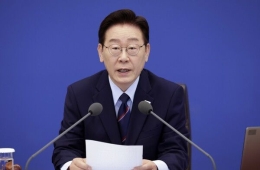
Financial Services Commission Chairman Kim Ju-hyun is speaking at the Financial Holding Companies Chairmen Meeting held at the Press Center in Jung-gu, Seoul, on the 31st. The meeting was attended by Financial Services Commission Chairman Kim Ju-hyun, Financial Supervisory Service Governor Lee Bok-hyun, Shinhan Financial Group Chairman Jin Ok-dong, Woori Financial Group Chairman Lim Jong-ryong, Hana Financial Group Chairman Ham Young-joo, NH Nonghyup Financial Group Chairman Lee Seok-jun, KB Financial Group Vice Chairman Yang Jong-hee, and Korea Federation of Banks Chairman Kim Kwang-soo. Photo by Yoon Dong-joo doso7@
View original imageInterest Rate Cuts and Low-Income Finance as Top Priorities
The first measure taken immediately after inauguration was the disclosure of the loan-deposit interest rate spread. It was originally a presidential pledge. The difference between the loan interest rate and the deposit interest rate, which is the bank's profit margin, was disclosed on the website of the Korea Federation of Banks so that the public could see it. The idea was to stigmatize banks with the highest loan-deposit spread and induce competition among banks on interest rates.
What had a much stronger effect were the verbal warnings from the heads of financial authorities. Financial Services Commission Chairman Kim Ju-hyun and Financial Supervisory Service Governor Lee Bok-hyun took the lead. They urged banks to raise deposit rates and lower loan rates. "Customers are struggling, but banks are making a lot of money. It’s questionable whether this is reasonable" (July last year, FSC Chairman), "Banks, as part of the national economy, must share the pain" (March this year, FSS Governor) ? they openly targeted banks. Although there was market criticism that financial authorities were undermining the Bank of Korea’s monetary policy, the effect of lowering loan interest rates was certain.
![[Image source=Yonhap News]](http://www.asiae.co.kr/news/img_view.htm?img=2023021912041828672_1676775858.jpg)
The tears of the 'Yeongkkeul-jo' (those who borrowed to the maximum) were wiped away by the Special Home Loan Program. As interest burdens rapidly increased for those who bought homes recklessly during the real estate price surge, this measure allowed them to refinance their loans at fixed rates of 3-4%. The refinancing demand from Yeongkkeul-jo, who were trapped by high interest rates, surged all at once. Initially, all personnel of the Korea Housing Finance Corporation were devoted to screening. Between February and March this year, 65% (25.6 trillion KRW) of the annual supply target was exhausted.
At the end of this month, a more definite method will be introduced. Led by the Financial Services Commission, a refinancing loan platform app will be launched that allows users to compare credit loan interest rates from first and second-tier financial institutions at a glance and switch immediately. Initially limited to credit loans, it will expand to mortgage loans and jeonse (key money deposit) loans within this year.
Low-income finance policies have been so radical as to raise concerns about moral hazard. The New Start Fund, which forgives debts of self-employed individuals, is a representative example. According to the Korea Asset Management Corporation (KAMCO), from October last year to March this year, the New Start Fund purchased non-performing loans and reduced principal by 39.5 billion KRW. It was implemented for a total of 603 people, with an average principal reduction rate of 74%.
The micro livelihood loan, which lends 1 million KRW to low-credit borrowers, continues to see bitter success that even surprised public officials. It marked one month since its launch at the end of last month, during which about 10 billion KRW was disbursed. The system is operated with funds donated by banks and KAMCO. The FSC expects the entire 100 billion KRW budget to be exhausted this year and has decided to receive an additional 64 billion KRW in donations from the financial sector.

On the 27th, citizens visiting the Jung-gu Central Microfinance Integrated Support Center in Seoul applied for loans from a small living expense loan product offering up to 1 million won with an annual interest rate of up to 15.9%. Photo by Kang Jin-hyung aymsdream@
View original imageThe Crisis Revealed as 'Water Drained from the Swimming Pool'
An unexpected crisis also emerged. The bond market instability triggered by the Legoland incident last October was such a case. As bond demand evaporated and funding dried up, liquidity was not supplied to low-credit financial institutions and construction companies. As Warren Buffett said, "When the water is drained from the swimming pool, you can see who was swimming naked," the issue of real estate project financing (PF) defaults surfaced. When the five major financial groups announced a liquidity support plan worth 95 trillion KRW to ease the funding market squeeze, the bond market quickly stabilized. However, PF defaults were an exception. The real estate market has not recovered from the slump, and the PF delinquency rate continues to rise over time.
The authorities’ determination is to "prevent a chain bankruptcy of PFs." This is also the background for the reappearance of the 'PF Lenders’ Agreement' last month for the first time in 15 years since the 2008 financial crisis. About 3,700 financial companies, including commercial banks, savings banks, insurance companies, and mutual finance institutions, agreed to extend maturities and restructure debts for PF operators who borrowed funds. Professor Sung Tae-yoon of Yonsei University’s Department of Economics said, "Because the financial market is still unstable, the authorities have no choice but to focus on management," adding, "Injecting liquidity and taking early action is the top priority."

Kim Kwang-soo, Chairman of the Korea Federation of Banks, is delivering a greeting at the PF Lenders Agreement Ceremony held on the 27th at the Korea Federation of Banks building in Myeongdong 1-ga, Jung-gu, Seoul.
Photo by Yoon Dong-joo doso7@
Meanwhile, banks that secured record-high profits after overcoming one crisis after another have become the target of strong public resentment. As public opinion surged criticizing banks for profiting from interest when others were struggling, even the president stepped forward to criticize the banks’ money feast. The worsening atmosphere cornered the banks. Following the president’s directive, financial authorities are working on plans to dismantle the banking oligopoly and reform the governance structure of financial groups.
Financial Innovation Far Down the Priority List
In fact, there was some expectation for financial innovation until Kim Ju-hyun took office as FSC Chairman. His inaugural statement was about 'relaxing the separation of banking and industry.' The core was to open the way for banks to enter other industrial sectors. In last year’s FSC demand survey, financial groups expressed their desire to enter real estate, automobile, and medical sectors. However, the clock on the separation of banking and industry stopped there.
An executive of a commercial bank said, "Banks have become public enemies; how can the authorities bring up deregulation issues now?" He added, "Under the previous Moon Jae-in administration, there were results such as fintech activation and the launch of internet banks, but under this government, financial innovation has fallen far down the priority list."
Related Articles
![[One Year of Yoon Administration]⑬Corporate Friendly, Economic Security Praised... Slow Execution Speed 'Problem'](https://cwcontent.asiae.co.kr/asiaresize/37/2023050309050919046_1683072309.jpg) [One Year of Yoon Administration]⑬Corporate Friendly, Economic Security Praised... Slow Execution Speed 'Problem'
[One Year of Yoon Administration]⑬Corporate Friendly, Economic Security Praised... Slow Execution Speed 'Problem'
- [One Year of the Yoon Administration] Investment Poured In as Regulations Were Lifted
- [1 Year of Yoon Administration]⑪Real Estate Expert: "Easing Comprehensive Real Estate Tax is Positive... DSR Regulations Should Be Further Relaxed"
- [One Year of the Yoon Administration]⑫ Avoided a Hard Landing Crisis... The Variable in the Second Half Is Economic Recession
"The concept of 'financial policy' is unique to our country. Abroad, 'financial policy' generally refers to corporate financial management. Our low-income finance is handled by the Ministry of Health and Welfare. The authorities only perform basic regulatory duties. There is no intervention in interest rates," a senior FSC official indirectly expressed that all efforts over the past year were focused on low-income finance and pressure on banks.
© The Asia Business Daily(www.asiae.co.kr). All rights reserved.